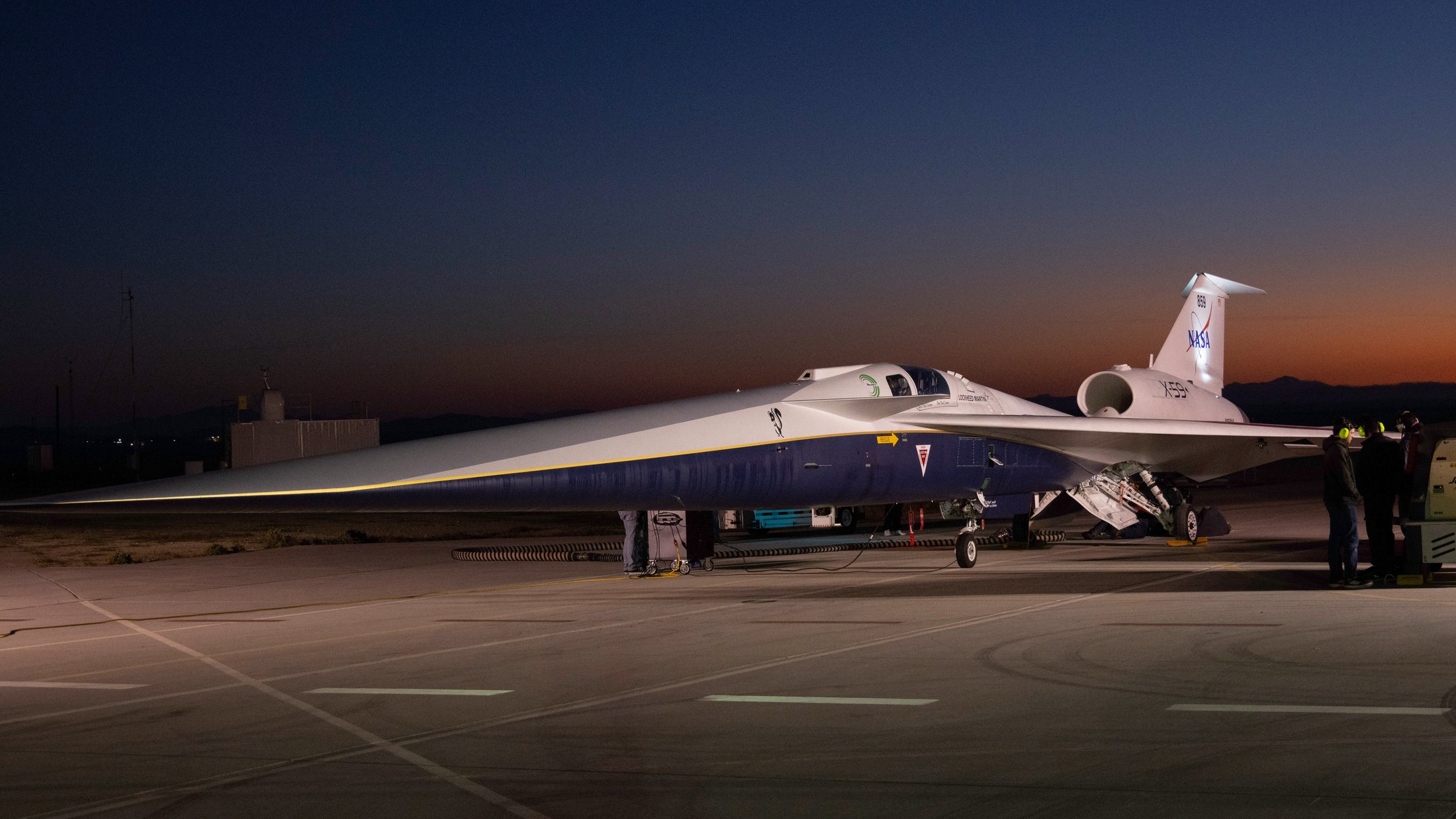
NASA's X-59 quiet supersonic research aircraft completed its flight from Birmingham, Alabama, to Daytona Beach, Florida, on November 5, the latest leg of the jet's first cross-country journey since its maiden flight one year ago. The aircraft is bound for Kennedy Space Center, where it will appear at the agency's MAX POWER aerospace expo and airshow on November 7–8.
The Lockheed Martin-built aircraft departed Edwards Air Force Base in California on October 28, exactly one year after its first flight. It made stops in El Paso and Fort Worth, Texas, before landing at Birmingham-Shuttlesworth International Airport on October 29. NASA says chase planes accompanied the aircraft throughout the route.
A Year of Envelope Expansion
In its first year of flight testing, the X-59 has completed more than 40 flights and reached speeds of Mach 1.53 and altitudes above 56,000 feet, according to NASA. The aircraft first exceeded the speed of sound on June 5, 2026, and subsequently demonstrated its intended operating conditions of Mach 1.4 at 55,000 feet. The first flight, by comparison, lasted 67 minutes and reached only 12,000 feet at 230 mph.
The jet is built to generate what NASA describes as a soft sonic "thump" of roughly 75 perceived loudness decibels, comparable to a car door closing nearby, rather than a traditional sonic boom. The effect comes from its distinctive 38-foot-long nose, which shapes the shockwaves produced at supersonic speeds to reduce their intensity on the ground.
That elongated nose creates a problem: there is no space for a forward windshield. Instead, the pilot navigates using what NASA calls the eXternal Vision System, a 4K monitor fed by cameras mounted on top of and below the fuselage. "It gives you a very good view," said Peter Coen, NASA's Mission Integration Manager for Quesst, in a recent interview with Aerospace America. NASA test pilot David Nils Larson noted the different camera positions take some adjustment. The aircraft does retain side windows and a canopy for peripheral visibility.
The Regulatory Stakes
NASA's next phase will measure actual ground noise levels and fly the X-59 over select communities to gauge public response. That data is intended to help regulators assess whether commercial supersonic flights over land could resume. Civil supersonic flight over the continental United States has been banned since April 27, 1973, when the FAA enacted regulations prohibiting aircraft from exceeding Mach 1 over U.S. territory.
The ban effectively killed American supersonic aviation for half a century. Only the Concorde, operated by Air France and British Airways, flew commercially at supersonic speeds, and only over water after 1973. The last Concorde retired in 2003.
The FAA proposed new regulations in June 2026 that would replace the speed-based ban with a noise-based standard, allowing aircraft to fly faster than Mach 1 over land if the resulting noise stays below a set level. The agency aims to finalize those rules by mid-2027.
MAX POWER
The MAX POWER expo is part of celebrations marking America's 250th anniversary. NASA Administrator Jared Isaacman announced the event in August at Kennedy Space Center's historic Shuttle Landing Facility. The Air Force Thunderbirds are scheduled to perform, and the X-59 will be on static display.
NASA's acoustic validation testing, the next phase of the Quesst mission, will begin after the aircraft returns from Florida. "Acoustic validation will put the tools and methods used to design the X-59 to the test," said Ed Cliatt, an acoustics engineer at NASA's Langley Research Center, in a September update. The flight campaigns over communities have not been scheduled.