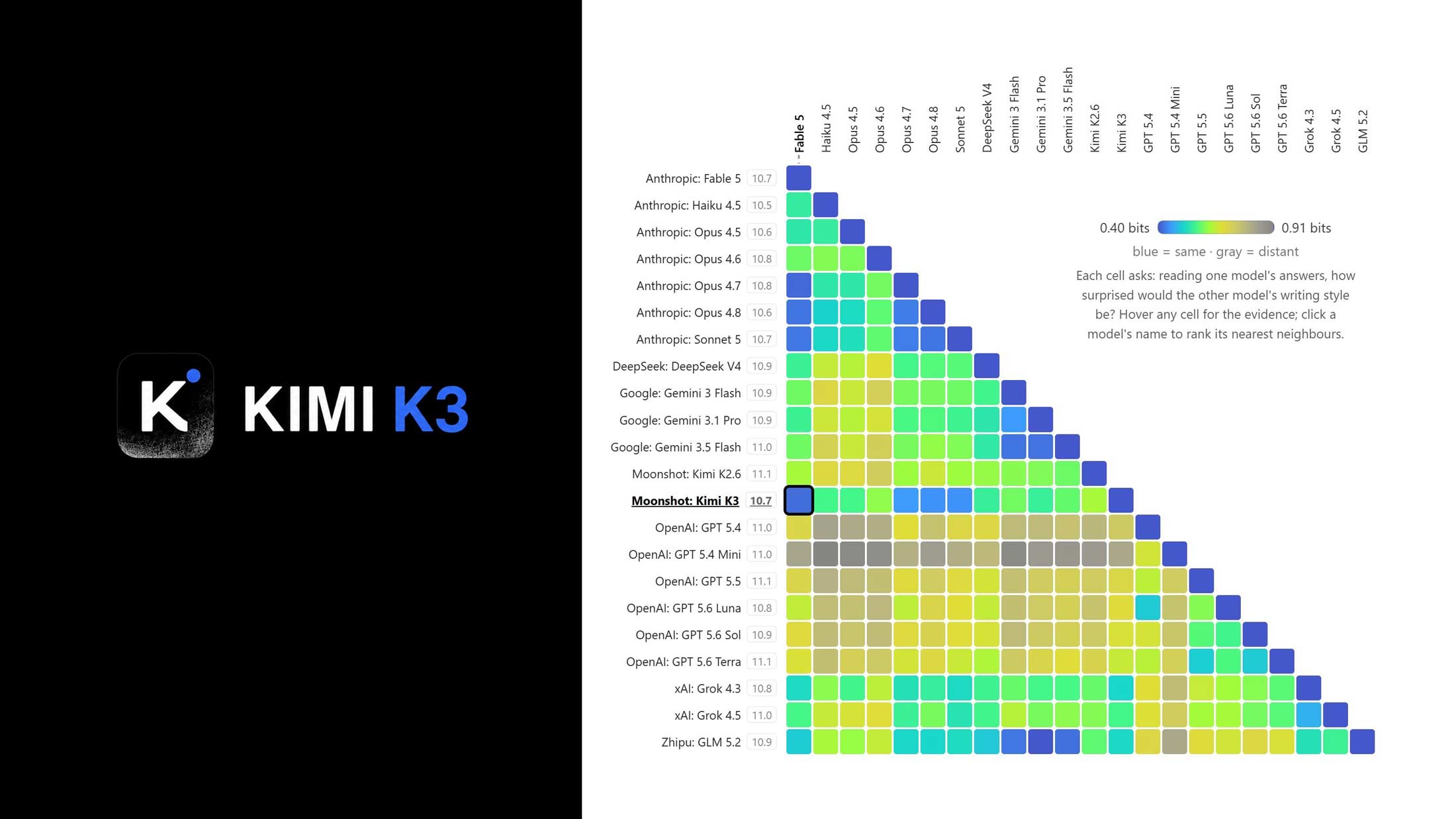
Ryan Greenblatt, Chief Scientist at Redwood Research, posted findings on X this week that appear to substantiate long-running allegations: Moonshot AI's Kimi K3 may have been distilled from Anthropic's Claude models.
In his post, Greenblatt wrote that he ran "a cross-entropy comparison of all raw text responses from numerous models using data I already had from a benchmark I run," with statistical analysis assisted by Fable itself. The results, published on Typebulb, show that K3 "claims to be Claude disproportionately often" when prompted about its identity. Greenblatt noted that K3 sometimes identifies as Claude 4.5, while actual Claude models do not exhibit this behavior.
The analysis did not find evidence of K3 claiming to be Mythos or Fable specifically, which Greenblatt said he was curious to investigate. But the pattern of Claude-identifying responses, occurring in a statistically significant distribution, is difficult to explain as random noise.
A Pattern Already Documented
The findings arrive amid a well-documented dispute. In February 2026, Anthropic publicly accused Moonshot AI, along with DeepSeek and MiniMax, of running what it called "industrial-scale distillation attacks" on Claude. According to the company, Moonshot alone generated more than 3.4 million exchanges through fraudulent accounts, targeting capabilities in agentic reasoning, coding, and computer-use agent development. The company said it traced some of the activity to senior Moonshot staff through API request metadata.
Moonshot has not publicly confirmed or denied that Kimi K3 incorporates training data from these campaigns. The company's official position focuses on its architectural innovations: Kimi Delta Attention, Attention Residuals, and a sparse mixture-of-experts framework that activates 16 of 896 total experts per token.
Greenblatt's findings do not prove distillation occurred. Model identity confusion can stem from training data contamination, system prompt leakage, or synthetic examples derived from public datasets. But the statistical regularity of the Claude self-identification pattern, combined with Anthropic's prior allegations, has shifted the conversation.
I ran a cross-entropy comparison of all raw text responses from numerous models using data I already had from a benchmark I run. I leaned on Fable for the stats-know-how; certainly seems very suspicious. The results/code are here for others to inspect:https://t.co/pSbxYS6bWb pic.twitter.com/zxiB617ovE
— typebulb (@typebulbit) July 19, 2026
Researchers Weigh In
Pedro Domingos, professor emeritus of computer science at the University of Washington and author of The Master Algorithm, responded to Greenblatt's post on X with a blunt assessment: "Surprise: Kimi was distilled from Fable." Domingos is a winner of the SIGKDD Innovation Award and the IJCAI John McCarthy Award, two of the highest honors in data science and AI.
Whether such reactions are warranted based on the evidence remains debatable. Greenblatt himself acknowledged the analysis uses a "calibrated ranking, not exact p-values," given that word occurrences are not fully independent across topics. The Typebulb page hosting the analysis invites others to inspect the code and results.
Policy Implications
The timing is significant. According to Axios, the Trump administration has been actively considering multiple mechanisms to restrict Chinese AI models from operating within the United States. The Commerce Department last year considered adding Chinese AI labs to its Entity List. The National Security Agency and White House Office of the National Cyber Director also considered issuing an advisory on Chinese AI threats.
Those earlier efforts stalled. Key voices such as former White House adviser Sriram Krishnan pushed back against restrictions that might stifle innovation. But personnel have shifted, and national security hawks have grown louder. Kimi K3's release, which placed it among the top-performing models in the world, reignited the policy conversation.
If Greenblatt's statistical findings are confirmed by independent researchers, they could provide the evidentiary support that regulators have lacked. Distillation from U.S. frontier models would be a concrete allegation rather than an abstract concern about competitive dynamics.
The administration's approach so far has emphasized "procurement rules, Entity List threats and public pressure campaigns aimed at U.S. companies using Chinese models," according to sources familiar with the discussions. An outright ban remains unlikely, but a pattern of credible distillation evidence could tip the balance.
The Structural Problem
Open-source AI models present a control problem that closed models do not. Once weights are published, as Kimi K3's will be by July 27, they can be downloaded and run locally. No export control, firewall, or API restriction can reach weights that are already distributed globally.
This is the fundamental tension underlying the entire debate. The U.S. has already imposed export controls on Anthropic's Fable 5 and Mythos 5, forcing the company to disable both models worldwide in June. The result was not American dominance but a surge of demand toward Chinese open-source alternatives.
Greenblatt's analysis does not resolve the policy question. But it does sharpen it. If Kimi K3 genuinely inherited behavioral patterns from Claude, as the statistical evidence now suggests, then the U.S. faces a choice between accepting that its frontier research will be extracted or attempting restrictions that may accelerate the very competition they aim to slow.
Moonshot has not responded to requests for comment on Greenblatt's findings. Anthropic, which has lobbied Congress for coordinated action against distillation, has likewise not commented on the new analysis. The Trump administration's AI policy apparatus remains in flux, with the Commerce Department and White House reportedly divided on how aggressively to act.