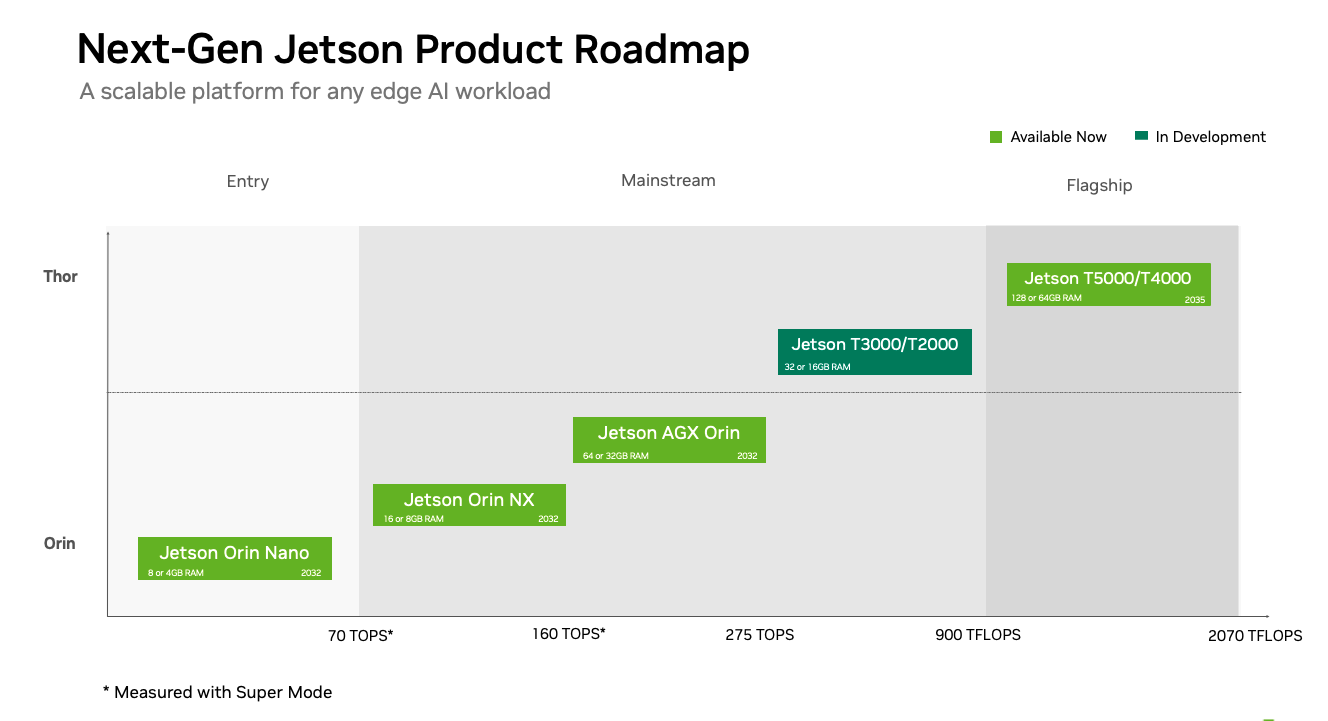
NVIDIA announced the Jetson T3000 and T2000 modules today, bringing Blackwell-class performance to a new tier of edge AI systems designed for mass-market robotics deployment. The timing is deliberate. Memory prices have surged by triple-digit percentages over the past year, and NVIDIA is betting that right-sizing hardware is now as important as raw performance.
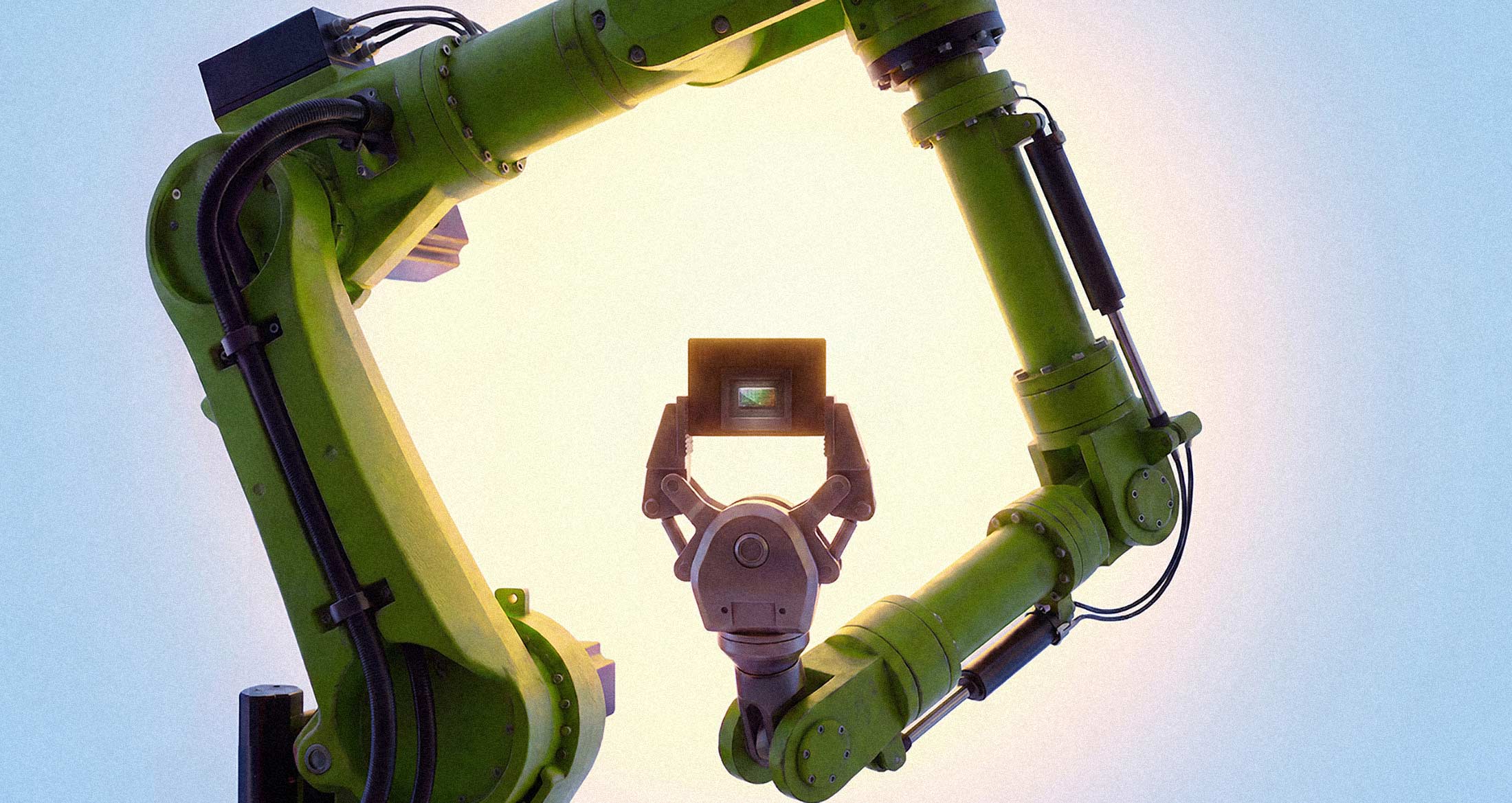
The T3000 packs an NVIDIA Blackwell GPU, an eight-core Arm Neoverse CPU, 32GB of LPDDR5X memory, and 273GB/s of memory bandwidth. It delivers 865 FP4 teraflops of AI compute in a form factor roughly half the size and power of the existing T5000 module. Despite the smaller footprint, NVIDIA claims the T3000 achieves similar inference performance to the T5000 for multimodal workloads, including large language models, vision language models, and world foundation models.
The Jetson T2000 sits below the T3000 with 400 FP4 teraflops of compute and 16GB of memory. NVIDIA is positioning it as an entry point for visual AI agents, autonomous mobile robots, and industrial manipulators that do not require full T3000 performance.
The Memory Problem
Connect Tech's analysis of the announcement put it plainly: "DRAM pricing rose 50 to 55 percent in a single quarter this year and supply growth for 2026 is projected at just 16 percent. Right-sizing your module is now a supply chain decision, not just a performance one." TrendForce data supports this, with contract prices for conventional DRAM rising by as much as 90-95% quarter-over-quarter in Q1 2026.
This is the context in which the T3000 makes sense. Migrating from a 64GB module to a 32GB module is not a downgrade if software optimization recovers the headroom you need. And that is exactly what NVIDIA's new Jetson agent skills are designed to deliver.
Agent Skills for Memory Optimization
The newly released Jetson agent skills automate development tasks that previously required deep domain expertise. Memory optimization skills help developers reclaim memory that would otherwise be reserved for hardware blocks, firmware, kernel behavior, display modes, unused camera subsystems, and other services the application does not actually use.
According to NVIDIA, companies have already achieved substantial memory savings through these tools. Humanoid robotics leaders UBTech and Agile Robots, along with industrial solutions provider Connect Tech, have reduced memory usage by up to 15GB, enabling them to move from the Jetson AGX Orin 64GB module to the 32GB variant. In smart retail, SandStar reduced memory usage by up to 4GB, enabling deployment on the Jetson Orin NX 8GB module instead of the 16GB configuration.
The pattern is consistent: software optimization is now a bill-of-materials decision, not just a performance exercise.
Cosmos 3 Edge Arrives
NVIDIA also announced Cosmos 3 Edge, a 4-billion parameter world model based on Nemotron that runs on edge GPUs and NVIDIA Jetson. The model enables on-device vision reasoning and robot policy generation, designed for real-time inference without round-tripping to the cloud.
Cosmos 3 Edge is the third tier of NVIDIA's Cosmos 3 family, joining the Super and Nano variants released in May. According to NVIDIA, the model can be adapted for robots, vehicles, and sensors in about a day. The choice of 4 billion parameters is deliberate: small enough to run on Jetson Thor hardware, large enough to serve as a customizable foundation for world-action models tailored to specific robot embodiments.
Industry Adoption
The list of companies building on the Jetson Thor platform reads like a who's-who of robotics: Boston Dynamics, Amazon Robotics, FANUC, Hitachi, Techman Robot, and humanoid robotics companies including 1X and Agile Robots. In Japan, NVIDIA announced that physical AI ecosystem leaders including FANUC, Fujitsu, Hitachi, Kawasaki Heavy Industries, Kubota, NEC, SoftBank, Sony, and Yaskawa Electric intend to join the Cosmos Coalition to help advance open frontier physical AI models.
Kawasaki Heavy Industries, for instance, plans to use NVIDIA Holoscan IGX, Isaac for Healthcare, Isaac GR00T, and Cosmos to develop surgical support functions, nursing assistant robots, and hospital transport robots. This is the kind of real-world deployment pipeline that justifies NVIDIA's bet on mainstream robotics hardware.
Availability
Developers can begin using T3000 emulation mode later this month with JetPack 7.2.1. Support for T2000 emulation mode is expected in a future release. The Jetson T3000 and T2000 modules are scheduled to become available in Q1 2027. Hardware partners including ADLINK, Advantech, AAEON, Connect Tech, and Seeed Studio will offer T3000 and T2000-based systems at launch.
NVIDIA now offers a scalable edge AI platform spanning performance from 70 TOPS to 2,000 teraflops. The question for robotics developers is no longer which module has the most memory, but which module has the right amount of memory once software optimization is factored in.