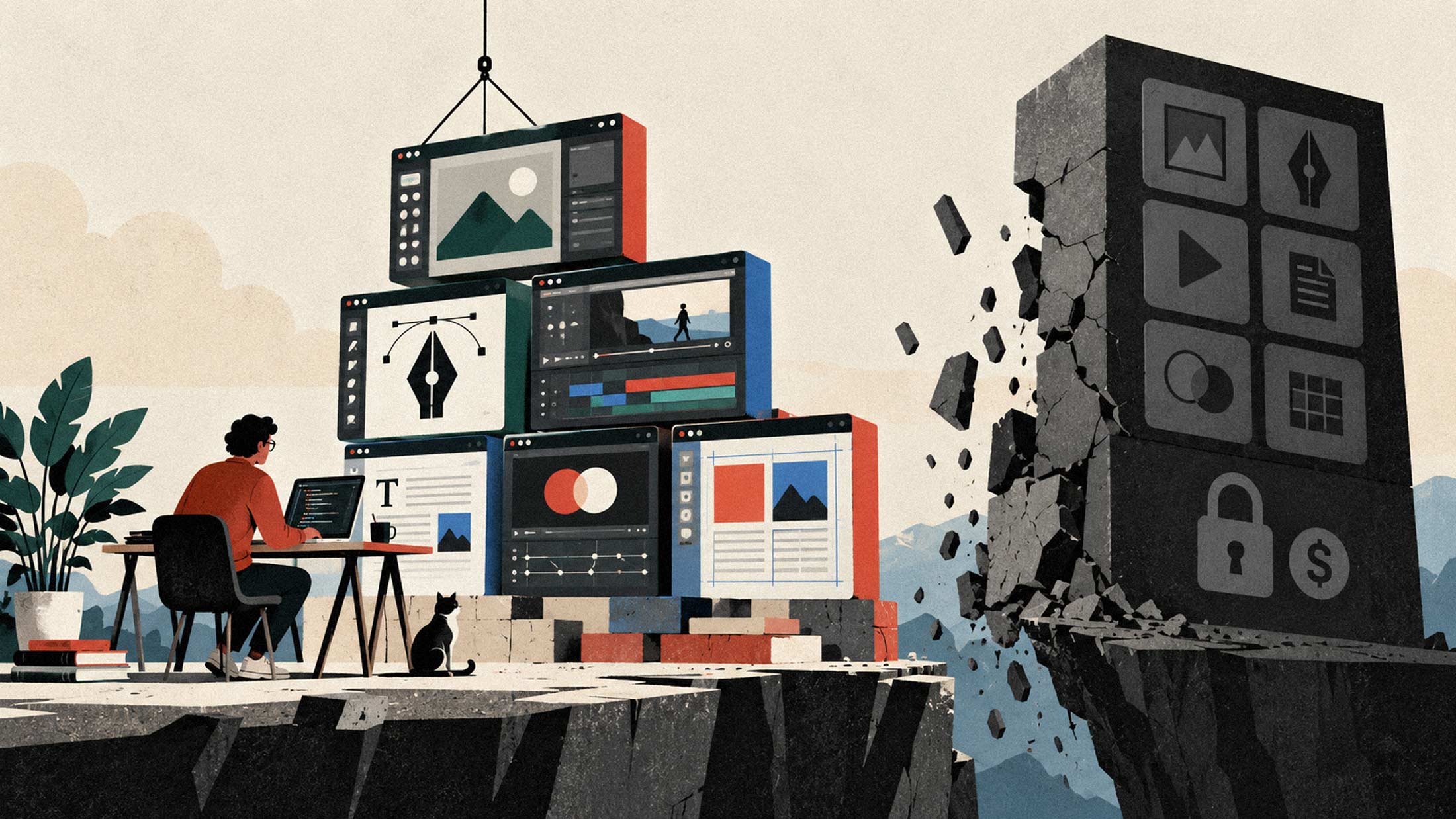
Brandon Thomas got fed up with Adobe's cancellation fees. So he built his own replacement.
The software engineer used Anthropic's Claude Opus 5.5 to create ArtCraft, an open-source suite that includes free alternatives to Photoshop, Illustrator, Premiere, Lightroom, Acrobat, After Effects, and InDesign. The apps are available for macOS, Windows, and Linux.
Thomas, who has about a decade of experience working on large-scale Rust projects, wrote on Hacker News that he was inspired after being "bit by the dark pattern 'cancellation fee' one too many times." He says he hopes to reach "100% feature parity" with Adobe's software within a month.
That timeline is ambitious, possibly delusional. Community feedback on platforms such as Hacker News has highlighted numerous current limitations, from missing features to performance gaps. But the point isn't whether ArtCraft ships a production-ready Photoshop killer next week. The point is that a single developer, armed with a frontier language model, could approximate a $300-billion company's core product line in a matter of months.
The Klarna Precedent
What Thomas did for creative software, Klarna is attempting across its entire operations. The Swedish fintech eliminated 1,200 SaaS tools, including Salesforce and Workday, consolidating operations into a unified AI-powered ecosystem. Off-the-shelf software has been replaced with in-house AI systems optimized for automation, data standardization, and efficiency.
The nuance matters. Klarna confirmed it stopped using Workday and Salesforce's CRM solutions, but the real story was that it consolidated 1,200 SaaS applications into a unified in-house knowledge stack built on Neo4j, a graph database, as the basis for a custom AI layer. It still uses some third-party tools. But the direction is unmistakable: the future of software isn't buying more tools, it's building exactly what you need, powered by AI.
The Self-Hosted Stack Is Maturing
Strong open-source alternatives now exist in six AI categories: LLM runtimes, agent frameworks, MCP servers, RAG stacks, automation, and Claude Code skills. Most match paid SaaS on capability while removing per-seat fees and vendor lock-in. The real cost shifts to self-hosting, maintenance, and security review.
A developer paying for Cursor, Perplexity Pro, and meeting note tools could be spending over $100 to $250 every month. In 2026, the same capabilities can run on a 100% private, self-hosted open-source AI stack for $0 per month. The trade-off is time and technical skill. But those barriers are eroding fast as tooling improves.
Accounting is following the same pattern. AI-native software automates up to 98% of transaction categorization versus QuickBooks' manual rules. For the first time since QuickBooks Online replaced desktop accounting in the early 2000s, the underlying assumptions about how accounting software should work are being fundamentally rethought. AI isn't being added to existing platforms as a feature. New platforms are being built from the ground up with AI at their core.
Hardware Is Next
The same forces reshaping software are coming for silicon. At the center of the open-source hardware movement sits RISC-V, an open instruction set architecture that provides a foundation for custom chip design without the licensing fees that have defined the semiconductor industry for decades. With AI reshaping computing demands and driving need for specialized processors optimized for machine learning workloads, RISC-V offers a path for companies and researchers to build AI-specific chips without starting from scratch or cutting royalty checks to incumbent architecture owners.
In January 2026, Chinese RISC-V chip company SpacemiT announced its K3 AI CPU. The company aims to combine the open RISC-V instruction set with general-purpose and AI computing capabilities, offering a more flexible, power-efficient and cost-effective platform for intelligent terminals and edge computing.
The pattern echoes software's trajectory: open standards lower barriers, AI accelerates development, and users gain ownership of their tools. Custom silicon at scale is behind a multi-million dollar, one-year-plus moat. If agent-driven design scales, custom MCUs tuned for specific sensor and peripheral combinations become feasible at volumes that never justified dedicated silicon before. RISC-V is positioned perfectly with its open-source, no-license-or-NDA-needed value proposition.
None of this means Adobe, Intuit, or Arm will vanish next year. Established platforms have deep integrations, regulatory compliance features, and support infrastructure that matter to enterprises. But the calculus is shifting. Software that can reshape itself around a company will always beat software that forces the company to reshape itself around the tool.
Thomas's ArtCraft suite remains buggy and incomplete. Klarna's internal systems still require significant engineering resources. SaaS isn't dead. But for users willing to invest the effort, the option to own rather than rent is becoming real. The OpenHW Foundation puts it plainly: the goal is for every organization to have complete control over their own tech stack. Whether that happens at Adobe's expense remains to be seen.