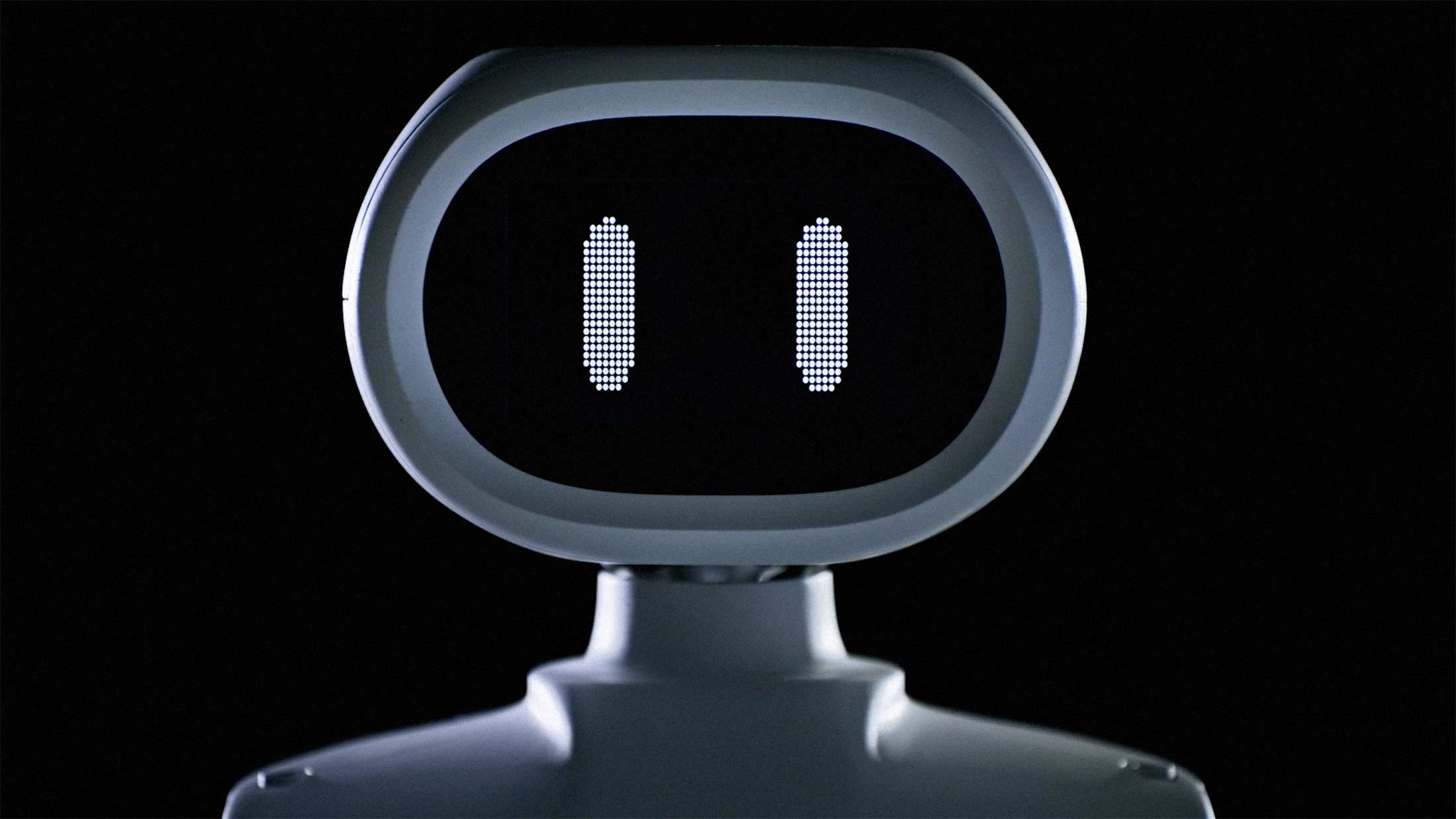
"Humanoid robots should not be closed systems that only a small number of teams can build while everyone else can do little more than watch," said Yi Huang, founder of RoboParty, in a press release accompanying the company's unveiling of RP1 (ROBOTO 01) at IROS 2026 on September 28, marking the robot's global debut.
RoboParty positions RP1 as the world's first high-performance full-stack open-source bipedal humanoid robot. The platform is designed for researchers, educators, robotics developers and embodied AI teams, with the goal of providing a humanoid robotics system that can be used, modified, trained and continuously extended in real development workflows.
That's a broad claim, but the demo at IROS was concrete. At RoboParty's IROS booth, the "Kick Me" interactive demonstration let visitors directly apply external disturbances to the robot. When pushed or kicked, RP1 rapidly adjusted its posture and recovered its balance. Unlike demonstrations based only on predefined motions, this open interaction allowed visitors to observe the robot's dynamic stability and control performance under external disturbances.
🚀RP1 is officially here. 🌍Putting control of robotics back in developers’ hands. Introducing RP1 (ROBOTO 01) by RoboParty—a high-performance, fully open-source humanoid robotics platform for frontier robotics research and embodied AI model development. 🤖 Open across the full hardware and software stack: • Robot platform: mechanical CAD, bill of materials, and assembly documentation • Actuators: in-house ROMOMO joint designs and related technical resources • Control: electrical systems, firmware, low-level drivers, and motion control implementations • Development: simulation models, SDKs, data processing tools, and training tools • Engineering foundations: technical documentation and research materials Open the black box. Understand the system. Make it your own. A deviation in motion can originate in the model, control policy, actuator response, or mechanical structure. RP1 opens up the design and implementation of these layers so developers can trace problems, modify the system, and validate changes on real hardware. Open-source algorithms for advanced motion control RP1 has demonstrated continuous walking, recovery from disturbances, getting back up after a fall, and human motion tracking. UFO and MimicLite connect motion learning, control policies, and execution on real hardware. The open toolchain connects data collection, simulation training, hardware deployment, and experimental validation—supporting joint iteration across models, control, and hardware. From RPO to RP1, we’re turning one team’s engineering experience into a starting point for many more. Opening the future of embodied AI to everyone ready to explore it. 🔗RP1 on GitHub: https://t.co/kMqFLi3eJ3 #RoboParty #RP1 #OpenSourceRobotics #EmbodiedAI
— RoboParty (@RoboParty_DEV) October 14, 2026
Technical Underpinnings
RP1 delivers peak joint torque of up to 160 N·m. The design incorporates in-house-developed Romomo actuator modules and mechanical structures alongside a real-time motion-control system. These capabilities were supported by PartyOS, RoboParty's open R&D; foundation for humanoid robotics, which integrates UFO.
UFO, or "A General Unsupervised Reinforcement Learning Framework for Humanoid Control," uses unsupervised reinforcement learning to train low-level motion policies for dynamic behaviors. These include skill transitions, disturbance recovery, and fall recovery, allowing the robot to develop movement strategies beyond fixed motion trajectories. The framework is available on GitHub.
RoboParty is integrating the robot body, actuator modules, low-level control and embodied AI algorithms into one system for continuous joint validation. The idea is that algorithms and hardware should evolve together rather than being developed in isolation. Whether that integration delivers on its promise is something only extended use will reveal.
Open-Source, Eventually
The "full-stack open-source" designation comes with caveats. RoboParty says it plans to progressively open its motion control systems, simulation environments, SDKs, training tools and PartyOS foundation. The announcement therefore does not establish that the complete RP1 stack is already available.
RoboParty plans to announce further details of RP1's open-source roadmap in October 2026, with broader software and hardware releases and a mass-production program to follow later in Q4. Pricing is not disclosed in the announcement.
The predecessor platform, ROBOTO ORIGIN (RPO), provides a reference point. In January 2026, RoboParty fully open-sourced RPO, its first open-source humanoid robotics project. To date, RPO has received more than 2,500 GitHub stars. As a developer-oriented open-source humanoid robot, RPO has attracted broad attention worldwide and inspired multiple community builds and reproductions.
RPO's GitHub repository includes mechanical and electronics designs, ROS 2 deployment, reinforcement-learning training code, and simulation models. That earlier robot stands 1.25 meters tall and weighs 34 kilograms. RP1's dimensions have not been published.
The Founder
RoboParty's backstory is unusual. Huang Yi, born in 2004 and from Wenzhou, Zhejiang Province, is the founder of RoboParty, a full-stack open-source humanoid robot company, and is one of the youngest entrepreneurs in the current humanoid robot boom.
RoboParty's journey originated from Yi Huang's robotics pursuit at Harbin Institute of Technology. In 2023, Huang won a national tech competition with an amphibious drone, then built the open-source bipedal robot AlexBot in his dorm for just $2,300, attracting Fourier Intelligence's sponsorship for its 2025 iteration, and even catching the attention of Boston Dynamics founder Marc Raibert.
Founded by 21-year-old prodigy Yi Huang and backed by a $10 million seed round from MPCi, Xiaomi Strategic Investment and Galbot, RoboParty is reshaping the embodied AI industry by anchoring itself as an Embodied Infrastructure builder. In 2025, Huang graduated early with his bachelor's degree from HIT and moved to Shanghai with classmates to establish RoboParty. By July 2026, his company had successively completed its Angel++ round and Pre-Series A funding, raising close to 500 million yuan.
The platform combines robot hardware, PartyOS and the UFO training framework, and RoboParty says it has more than 5,000 developers in its community.
What Comes Next
The gap between RP1's claims and what developers can actually access today is real. The existing ROBOTO ORIGIN GitHub repository provides a concrete starting point for understanding the company's approach, aggregating resources for the earlier prototype including mechanical and electronics designs, a ROS 2 deployment framework, reinforcement-learning training code, simulation models and firmware. These are resources for ROBOTO ORIGIN, rather than evidence that all equivalent RP1 materials have already been released.
The embodied AI space has seen plenty of announcements that arrived with more marketing than substance. RoboParty's IROS demonstration was, at minimum, a physical robot responding to real-world disturbances in front of strangers. The Q4 releases will determine whether the "full-stack open-source" claim holds, or whether it joins the list of platforms that promise openness and deliver something narrower.