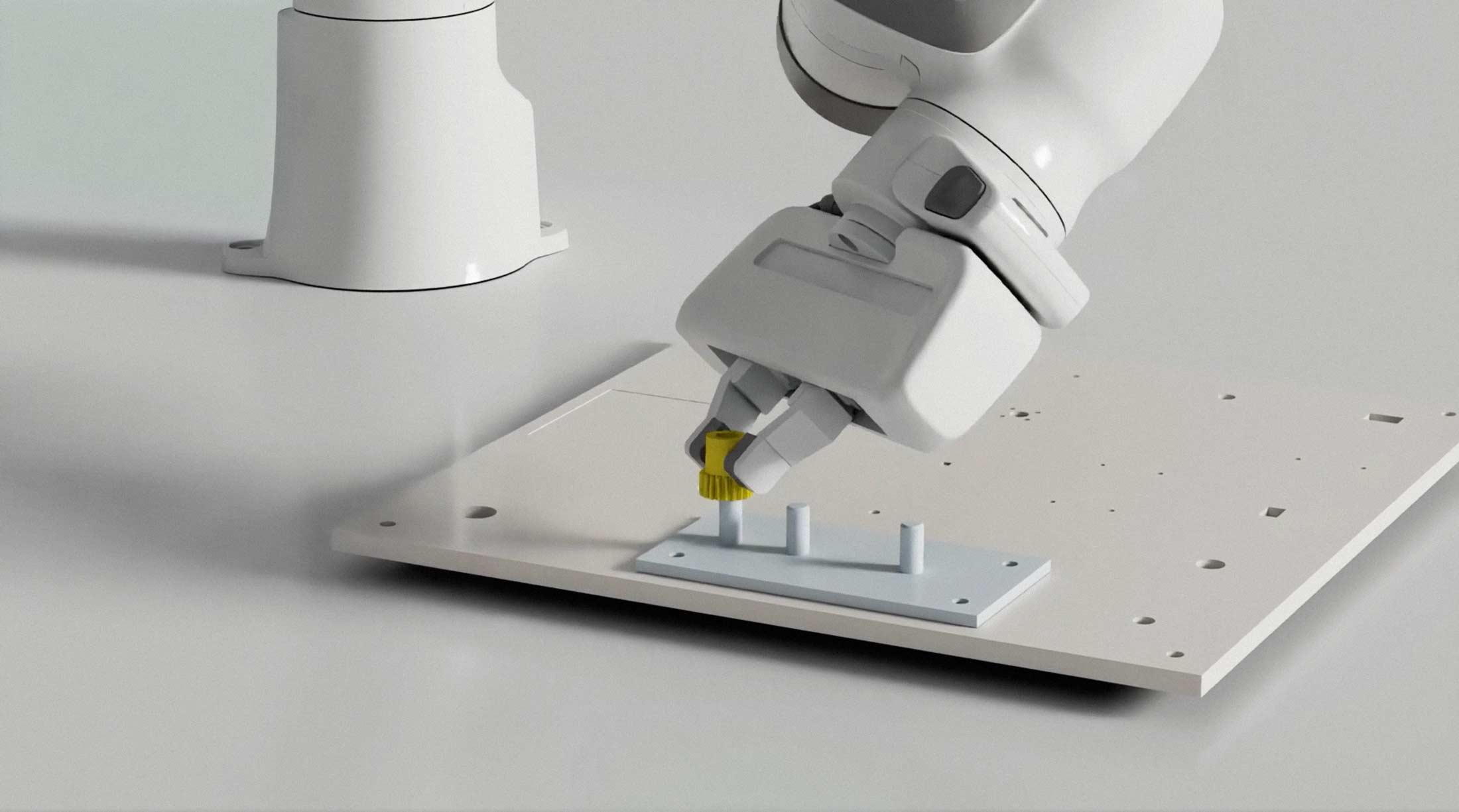
A simulated robot arm, given no instructions on how to assemble anything, figured out how to thread nuts, insert connectors, and mesh gears across 20 distinct manufacturing tasks. AlphaNIST, published last week by researchers at NVIDIA's Seattle Robotics Lab, trained a single neural network policy to complete every task on the NIST Assembly Task Board #1 with a 98.2% success rate in simulation.
The approach dispenses with the scaffolding most robotic manipulation research relies on: no human demonstrations, no progress-tracking rewards that nudge the robot along a predefined trajectory, no task decomposition, no scripted primitives, no per-task tuning. The policy receives a binary signal only when a part is fully assembled. That single bit of feedback, combined with a modest control cost to discourage thrashing, is all the learning system gets.
(1/6) From @GoogleDeepmind’s AlphaGo to AlphaZero, we saw machines find moves that reached beyond what we’d imagined for them. No one taught them those strategies. They emerged from reinforcement learning: playing, failing, and trying again under a single binary task reward for success or failure. Inspired by them, we couldn’t help but wonder: what might a robot discover if we gave it that same freedom to learn? That question led us to AlphaNIST. Starting tabula rasa, with that same binary reward plus only a simple control cost, a single policy solves all 20 @NIST assembly tasks at a 98.2% success rate in simulation. More surprising still, AlphaNIST can complete 10 different tasks in a row, receiving that reward only once, after all 10 are done. Just as AlphaGo’s strategies surprised its creators, AlphaNIST discovered dexterous strategies we couldn’t have come up with ourselves. Paper: https://t.co/HZBYgG7SWK Website: https://t.co/VyUKiYFI2y
— Octi Zhang (@octi_zhang) October 13, 2026
The benchmark
NIST Assembly Task Board #1 has served as a proving ground for robotic manipulation since it debuted in 2017. The board includes 20 assembly pairs relevant to actual factory work: peg insertions of various diameters, gear meshing, electrical connector insertion, and nut threading. Some parts are as small as 4 mm. Tolerances are tight enough that a tilted nut will jam or cross-thread.
"To the best of our knowledge, no learning-based approaches have solved all tasks on any of the boards," the paper states. Prior work on the NIST benchmark relied on demonstrations, dense reward shaping, or task-specific fine-tuning to make progress. AlphaNIST treats the entire board as one multi-task learning problem.
What emerged
The policy developed manipulation strategies the researchers did not anticipate. In one case, when grasping an 8 mm peg at its center, the robot sets the peg down, releases it, and re-grasps near one end to leave more of the peg exposed for insertion. In another, it uses contact with the board surface to reorient a waterproof connector before sliding it into its socket. For a D-sub connector, it sets the part down, repositions its grip, and aligns the connector with its mate. A medium gear, held from the side, pivots into a horizontal pose above its mounting post.
These are not programmed sequences. They are solutions that fell out of scale and sparsity.
The framework extends to multi-component assembly. A separately trained policy can complete 10 assembly pairs in a single episode, receiving its reward only when all 10 parts are finished. The robot chooses its own ordering, a planning-like behavior that emerges without an explicit planner.
The method
AlphaNIST runs inside NVIDIA's Isaac Lab simulation framework, scaling across up to 256,000 parallel environments with 4,000 environments per GPU. The robot is a 7-DoF Franka Emika Panda with a parallel-jaw gripper. At 25 Hz, the policy outputs a 7D relative joint position target and a 1D gripper command.
The researchers generated a cache of assembly-relevant starting states across all 20 tasks, then sampled from that cache using a success-guided distribution that prioritizes harder cases. A shared policy and reward function train across all tasks without task identifiers. The policy observes robot state plus point clouds of the movable part, mating geometry, and the robot itself.
The team found that adding dense rewards for reaching or alignment actually degraded performance. Sparse rewards forced the policy to discover complete solutions rather than optimizing intermediate proxies that might not lead anywhere.
Context and limitations
This is simulation-only work. Sim-to-real transfer remains a separate challenge, one the Seattle Robotics Lab has addressed in prior projects like IndustReal and AutoMate. Real-world tolerances on the NIST board are even tighter than simulation permits, with clearances as small as 0.029 mm on some tasks.
NVIDIA's broader robotics push at GTC 2026 included open-source Isaac simulation frameworks and GR00T foundation models for humanoid robots. The company's internal research has also focused on robotic assembly for its own GB300 tester trays, a target that demands factory-grade success rates above 99.5%.
AlphaNIST's contribution is narrower but pointed: a demonstration that a robot can discover assembly strategies rather than being taught them, if the reward is simple enough and the compute is large enough. The 15-author team includes Octi Zhang as lead author, with Yashraj Narang, Ankur Handa, and Iretiayo Akinola among the senior contributors. The paper is on arXiv; the project site at alpha-nist.github.io includes video demonstrations.
Whether the emergent behaviors transfer to physical hardware, or whether the success-guided caching scales beyond 20 tasks, remains open. The paper does not include ablations on task count or generalization to unseen geometries.