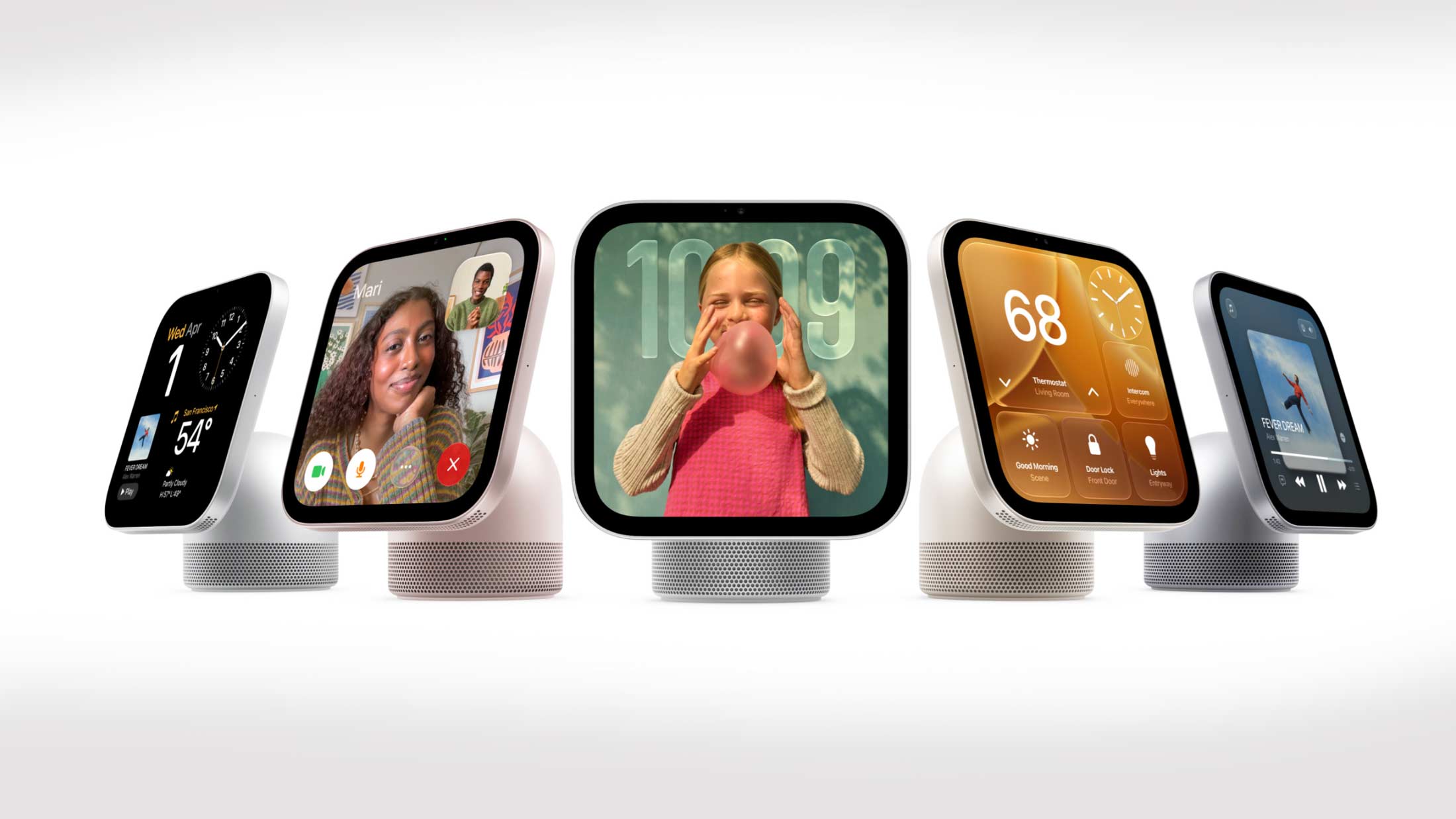
Apple announced HomeView on October 13, a $299 smart display built around Siri AI and face recognition that can identify up to six people in a household. Pre-orders opened the same day, with units shipping November 13 in the US, UK, Canada, Australia, New Zealand, India, Singapore, and South Africa.
The European Union is not on the list. Apple's press release includes one sentence explaining the exclusion: "Apple HomeView is not available for sale in the European Union, as Siri AI is currently unavailable in iOS in the EU."
What HomeView Does
HomeView runs on an A18 chip with a 7-inch Liquid Retina display at 1088-by-1088 resolution. The tabletop model connects the screen to a domed speaker base through a stainless steel hinge that tilts. A wall-mounted version exists in a thinner form factor, sold at the same price but requiring a separate Schneider Home mount starting at $59.95.
"Apple HomeView is designed to be shared by everyone in the home yet feel completely personal to each user," said Greg Joswiak, Apple's senior vice president of Worldwide Marketing. The device recognizes faces and switches between individual home screens depending on who approaches. Personal content like Messages, Calendar, and Reminders appears only when the enrolled user is recognized and their paired iPhone is on the same Wi-Fi network.
The speaker base houses a down-firing woofer and two force-canceling passive radiators, with two full-range drivers in the display for Spatial Audio. Apple describes the system as delivering "room-filling" sound, though the wall-mounted model lacks the woofer and relies on computational audio tuned for on-wall placement.
A Smart Home Hub With Partner Hardware
Alongside HomeView, Apple introduced the Apple Home Collection, a lineup of nine smart home accessories co-developed with LG Electronics and Schneider Electric. The accessories include cameras, a video doorbell, a smart lock, thermostats, and room sensors. Prices range from $39.95 for temperature sensors to $399.95 for the Floodlight Cam. All of them pair with a single tap on an iPhone and run entirely inside Apple's Home app.
"Working closely with industry leaders LG Electronics and Schneider Electric, we designed every accessory to work seamlessly with Apple Home, so managing your home is simple, reliable, and private," said Matthew Costello, Apple's vice president of Hardware Engineering. The Home Collection accessories go on sale in December, with some following in early 2027.
Physical Data as AI Fuel
The launch fits into a pattern that has defined Apple's AI moves over the past year. Siri AI, which began rolling out in June, draws on what Apple calls "personal context" to answer questions by searching messages, emails, photos, and calendar events. That context feeds into more complex workflows. A user could ask Siri about dinner plans mentioned by a family member, retrieve a related address from an email, and add it to Contacts without switching apps.
HomeView extends that logic into physical space. With a camera that tracks faces, sensors that detect presence, and integration with thermostats, cameras, and door locks, the device captures data about how people move through and interact with their homes. Apple insists this stays private. The company says personal data remains on the device or passes through Private Cloud Compute, where Apple claims even its own engineers cannot access it.
Whether regulators agree is another matter. The EU dispute centers on whether Apple must grant rival assistants the same deep access to user data that Siri enjoys. Apple has resisted, and European buyers cannot purchase HomeView at all as a result.
Jennifer Kent, principal analyst at Parks Associates, offered context for the timing. "Apple always waits for an ecosystem to develop first until they are positive they can provide a stellar user experience," she told CNBC.
What Gets Captured, What Gets Used
The strategic logic is straightforward. An AI assistant becomes more useful the more it knows about the person using it. Home devices with cameras, microphones, and environmental sensors generate exactly the kind of hyperlocal data that makes an assistant feel genuinely personal. Apple is betting that its privacy architecture gives it permission to collect that data where competitors might hesitate.
Google and Amazon have sold similar devices for years. Neither has built multi-user face recognition as a central feature. Apple has, and that distinction may matter more than the speaker quality or the display resolution.
HomeView comes in silver, starlight, rose pink, and space gray for the tabletop model. The wall-mounted version is limited to silver and space gray. The Home Collection accessories ship to the US, Canada, and the UK only. Apple has not provided a timeline for EU availability.