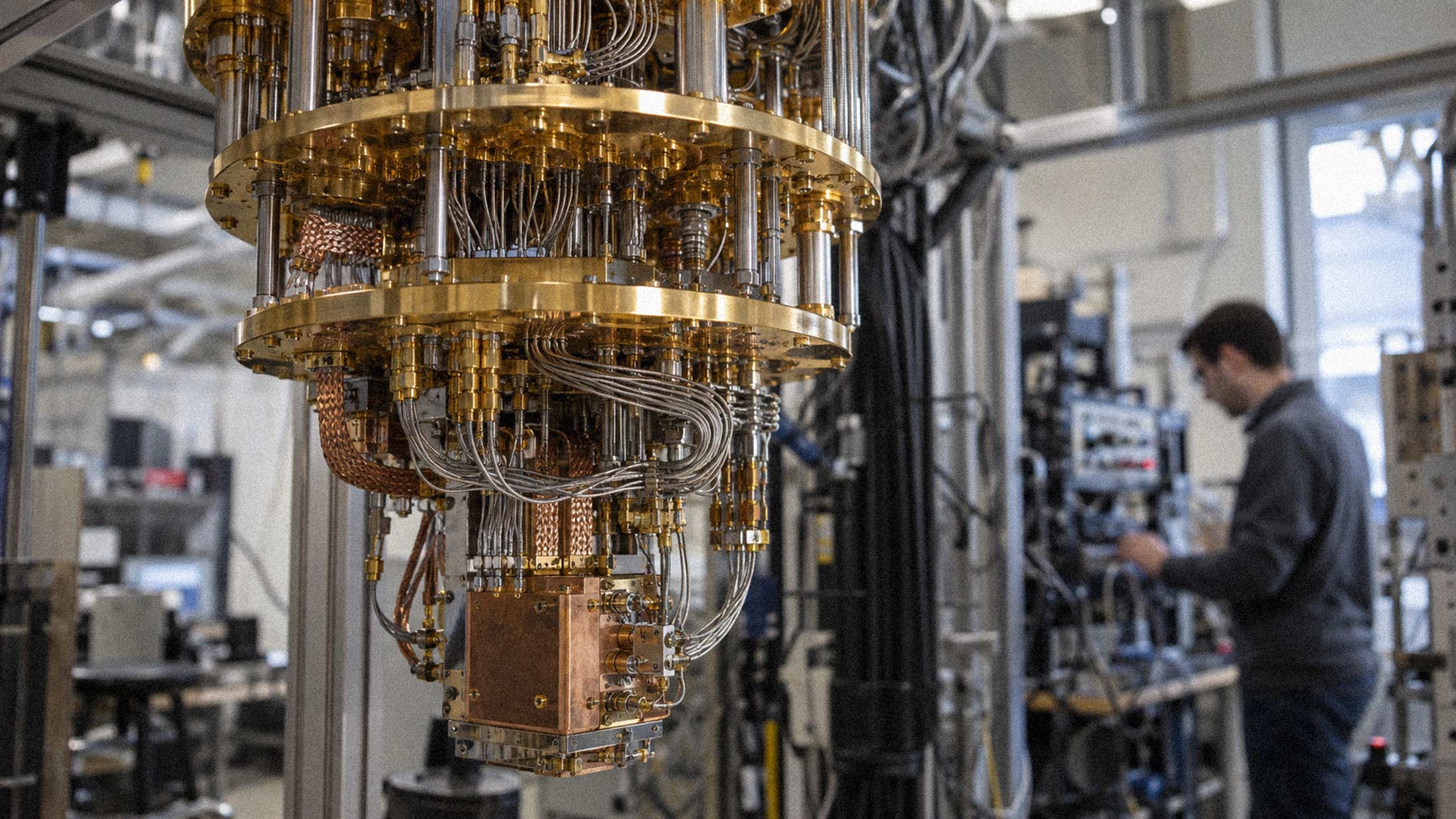
The U.S. Department of Energy today launched the Quantum Genesis Q Competition, a $215 million initiative challenging domestic companies to build the world's first fault-tolerant, scientifically relevant quantum computer. Applications are due October 19, 2026.
The competition targets machines capable of at least 100 logical qubits and hundreds of millions of fault-tolerant operations. This is a significant shift in emphasis: rather than chasing raw qubit counts, the DOE wants reliability. Quantum computers are famously error-prone, with physical qubits degrading rapidly from environmental noise. Logical qubits use error-correcting codes to protect information across multiple physical qubits, suppressing errors to levels that allow sustained computation.
"Through the Quantum Genesis Q Competition, we are building a new era of computational power for the nation through innovative public-private partnerships," Under Secretary for Science Darío Gil said in the announcement. Gil framed the moment as comparable to the construction of the first particle accelerators.
Why the DOE Wants This Machine
The Department of Energy runs 17 national laboratories and oversees some of the world's most demanding scientific computing workloads. Classical supercomputers excel at many tasks, but they hit a wall when simulating quantum systems. Modeling the behavior of atoms and molecules at the quantum mechanical level is computationally intractable beyond a handful of particles.
This matters for chemistry, materials science, plasma physics, and high-energy physics. A fault-tolerant quantum computer could simulate molecular interactions with enough precision to design better catalysts, discover new materials for batteries and superconductors, or model the extreme conditions inside fusion reactors. Current quantum hardware cannot do this reliably. The Quantum Genesis initiative aims to change that by 2028.
One frequently cited example: nitrogen fixation. The Haber-Bosch process that produces ammonia for fertilizer is energy-intensive and responsible for roughly 1-2% of global carbon emissions. Fault-tolerant quantum computers could simulate the complex enzyme reactions that nature uses to fix nitrogen at ambient temperatures. That insight could lead to more efficient industrial processes.
How the Competition Works
The competition is structured in two phases. Phase I provides fixed awards of up to $1.5 million per participant for meeting early milestones. Phase II is more aggressive: a $100 million incentive pool for teams that demonstrate 100 logical qubits, with additional $50 million bonus pools for reaching 150 and 200 logical qubits.
The DOE is also establishing a Quantum High-Performance Computing Validation and Verification Testbed through a separate lab call with $45 million in planned funding. This infrastructure will characterize and validate competing systems across the full computing stack.
The initiative follows President Trump's June executive order on quantum innovation and builds on the growing capabilities of commercial quantum hardware. Gil acknowledged the 2028 target is ambitious but said feedback from industry partners suggests a machine at this scale is within reach.
Private-sector companies are eligible to apply. The DOE will host a virtual webinar on September 25 for prospective applicants. The agency has made it clear that companies with longer development timelines will not be disqualified from future collaborations if they choose not to participate in this particular race.