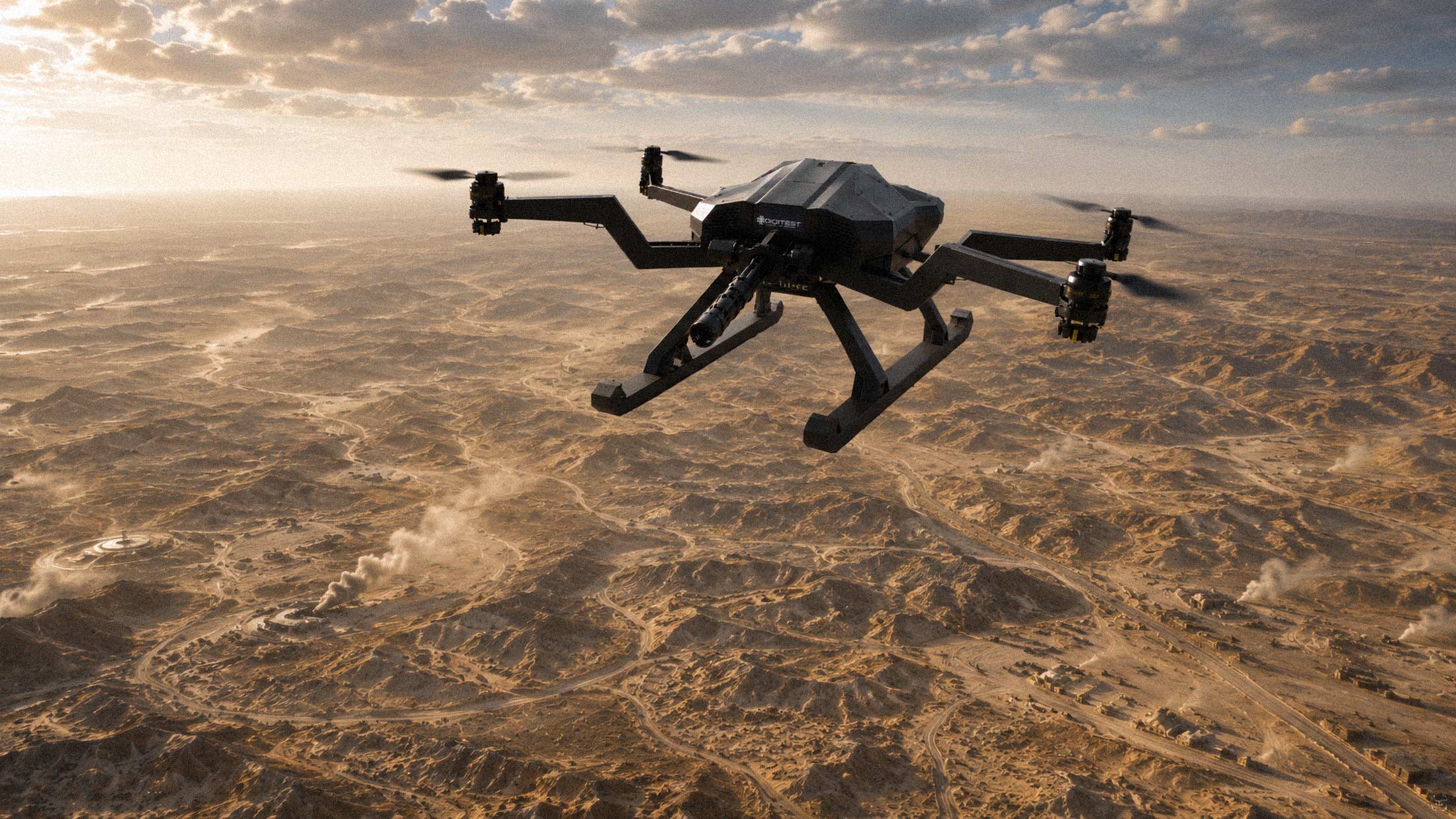
At SAHA 2026 in Istanbul this week, Turkish defense contractor Digitest is previewing the GATREX, a counter-drone system that takes an aggressive approach to aerial defense: mount a TUFAN 7.62 mm six-barrel rotary machine gun on a heavy-lift UAV capable of carrying up to 150 kg. Details remain sparse, as the system is still in early showcase stage, but the concept itself signals where drone warfare is heading.
📌Digitest is showcasing its GATREX counter-drone system for the first time at #SAHA2026.
— Defensehere (@defensehere_en) May 7, 2026
📌The system is equipped with TUFAN 7.62 mm six-barrel rotary machine gun, designed for high-volume firepower against aerial threats.
📌The drone can carry payloads of up to 150 kg. pic.twitter.com/IyxZHkly4c
The GATREX represents a specific answer to a problem that has consumed military planners since the conflict in Ukraine began in earnest: how do you stop cheap, expendable drones without spending a fortune? Traditional surface-to-air missiles cost hundreds of thousands of dollars per shot. Laser systems require massive power infrastructure. Electronic jamming works until drones start flying autonomously without GPS or radio links. High-volume kinetic defeat, the military euphemism for shooting things out of the sky with a lot of bullets very fast, has its own appeal.
The Kinetic Revival
Digitest, an Ankara-based firm with over two decades in defense systems, builds armored vehicle modernizations, unmanned ground vehicles, and anti-drone weapon systems. The company manufactures in compliance with AS9100-Rev.D standards and holds both NATO and national security clearances. All systems are designed, developed, and integrated in-house.
The GATREX is entering a crowded field at SAHA 2026. Across the exhibition floor, Turkish firms are showcasing a range of counter-drone solutions. ASELSAN presented its KORKUT and GÜRZ hybrid air defense platforms, combining cannons with HISAR missile launchers for layered engagement. SYS Group, another Turkish firm, announced it has begun exporting its CANiK M3 FALCON heavy machine gun system, designed specifically for the new battlefield where low-cost drones have become a major operational threat. The company claims the system is ready for use against Shahed-type UAVs.
Elsewhere, Rheinmetall debuted the RCWS320C-UAS at Enforce Tac 2026, a remote-controlled weapon system built specifically for vehicle and base protection against drone swarms. The U.S. Army awarded Smart Shooter a $13 million contract in May 2025 for Smash 2000L systems. The Pentagon has identified Raytheon's Coyote and Anduril's systems as key elements of its counter-drone strategy.
Why Put a Gun on a Drone?
The logic of mounting a six-barrel rotary gun on a 150 kg payload drone comes down to mobility and positioning. Ground-based counter-drone systems require fixed infrastructure or vehicle mounting. A flying platform can reposition rapidly, intercept threats at altitude, and potentially engage targets before they reach their destination. It trades the endurance advantage of ground systems for tactical flexibility.
The 7.62 mm caliber is notable. It is heavy enough to reliably destroy small to medium UAVs but light enough to allow for sustained automatic fire without catastrophic recoil effects on the airframe. The rotary design, commonly called a minigun configuration, delivers the high cyclic rate needed to saturate a target area and improve hit probability against fast-moving, small aircraft.
Heavy-lift drones capable of 100 kg or more are now commercially available for logistics, construction, and emergency response. Military adaptation of these platforms for weapons carriage was inevitable. The GATREX represents one of the first public acknowledgments that counter-drone drones, flying platforms designed to hunt and destroy other flying platforms, are entering production pipelines.
The Escalation Problem
Turkey is positioning itself as a leader in this space. At SAHA 2026, Haluk Bayraktar, CEO of Baykar and chairman of the SAHA board, announced plans to use exhibition revenues to establish drone production centers in all 81 Turkish provinces. The goal is to achieve production capacity of millions of drones nationwide at any given moment. As Bayraktar noted, experience from Ukraine has demonstrated the decisive role of combining advanced technologies with large-scale industrial production in modern warfare.
The drone-versus-drone arms race is accelerating. Ukraine produced 100,000 interceptor drones in 2025, with production capacity estimated to have grown eightfold since then. Russia continues mass deployment of relatively inexpensive UAVs to saturate defenses. The question facing every military now is not whether to invest in counter-drone capability, but how much and in what form.
GATREX offers one answer. Whether it proves effective, cost-efficient, or survivable in contested airspace remains to be seen. But the concept, a drone with a gun that hunts other drones, is now on the table.