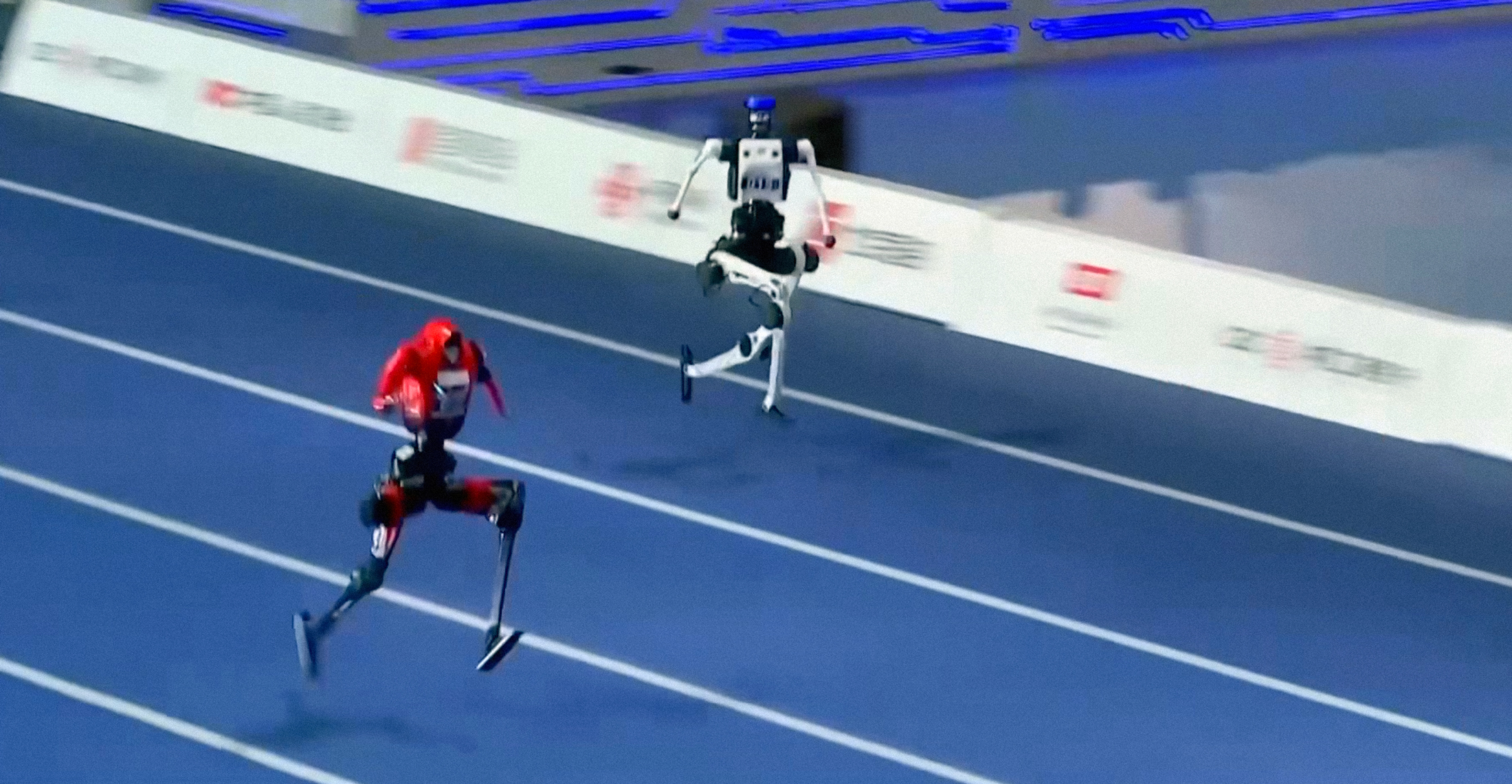
For almost two decades, Usain Bolt's 100-meter world record stood as the untouchable benchmark of human speed. No sprinter could get close. No training regimen, no technological shoe, no perfect conditions could break 9.58 seconds. Then, at a preparatory event for the World Humanoid Robot Games in Beijing on Saturday, a Chinese humanoid robot named Lightning ran the distance in 9.32 seconds.
That is a quarter-second faster than Bolt's mark from Berlin 2009. A quarter-second sounds marginal until you realize that Bolt's 9.58 was itself considered a once-in-a-generation leap, improving on his own prior record by 0.11 seconds. Lightning did not edge past history. It rewrote the physics of what a bipedal form can do.
9.3s…Humanoid robots have proven they can run faster than humans.
— CyberRobo (@CyberRobooo) August 22, 2026
The first to cross the finish line was X-humanoid's Tienkung. Honor's Lightning has a fast start, but lacks explosive power in the later stages. pic.twitter.com/bs7aGEYES9
A Record That Defined an Era
Bolt set his record on August 16, 2009, at the World Athletics Championships. By the time Lightning crossed the finish line in Beijing, that mark had stood for nearly 17 years. It was already the longest-standing men's 100-meter world record in history, surpassing the 14-year reign of American Jim Hines, who first broke the 10-second barrier in 1968.
The longevity of Bolt's record was not for lack of trying. The best human sprinters of the past decade have finished in the 9.7-second range. The gap between elite human capability and Bolt's singular performance seemed permanent. No active athlete was plausibly within striking distance.
The Machine That Did It
Lightning was developed by Honor, the Chinese smartphone maker that spun out of Huawei in 2020 and pivoted aggressively into robotics and AI under its Alpha Strategy, announced at MWC 2025. The robot reached a peak speed of 14.5 meters per second during its sprint, versus the approximately 12.3 m/s peak that Bolt achieved in his record run.
Honor's humanoid stands about 169 cm tall with legs engineered for stride efficiency. Researchers lengthened those legs by 10 cm ahead of this event, specifically to optimize the robot for short-distance explosive sprints. The chassis incorporates a proprietary liquid-cooling system and joint modules capable of producing up to 400 Nm of peak torque, roughly equivalent to the twisting force of a sports car engine.
Lightning had already proven its endurance capabilities in April, when it won the Beijing half marathon in 50 minutes and 26 seconds. That pace beat the human world record by nearly seven minutes.
The World Humanoid Robot Games
The second edition of the World Humanoid Robot Games opened in Beijing on Saturday, running through August 26 at the National Speed Skating Oval. A record 2,056 robots from 666 teams across 16 countries are competing in 51 events, ranging from track and field to firefighting simulations and retail assistance tasks. The games have quadrupled in robot participation from the 2025 inaugural event.
Most notable this year: the 100-meter race is now a fully autonomous event. No teleoperation. The robots make their own decisions in real time. That distinction matters. Lightning's performance was not a parlor trick. It was a demonstration of what embodied AI can do when optimized for a specific physical task.
What This Means Going Forward
This is not a replacement of human athletics. The record books will still distinguish between human and machine performance, just as chess ratings for humans remain separate from engine evaluations. Magnus Carlsen's victories still matter even though Stockfish would crush him.
But the implications cut deeper than athletics. Demonstrating AI superiority in any physical domain serves as proof of concept for investors and policymakers. It attracts capital. It accelerates development. It signals that humanoid robots are moving from trade-show curiosities to machines with real-world endurance and capability.
The optimistic case is straightforward. Robots that can sprint, run marathons, and navigate dynamic environments will eventually perform search-and-rescue operations, logistics, and hazardous work that puts human bodies at risk. The same motor control that clocked 9.32 seconds in Beijing could one day stabilize a robot pulling a survivor from rubble.
The more complicated question is what happens when these machines enter environments where humans and robots share space. Honor has already positioned Lightning as a potential urban running companion for night jogging. The boundary between tool and peer is getting thinner.
Human-robot athletic coexistence is no longer a thought experiment. The 2026 games in Beijing are now a testing ground for commercial products. The robots tumbling through soccer matches last year are the ancestors of machines that will work alongside humans in factories, hospitals, and city streets.
Bolt's record belonged to a world where humans were the only bipeds worth timing. That world ended Saturday in Beijing.