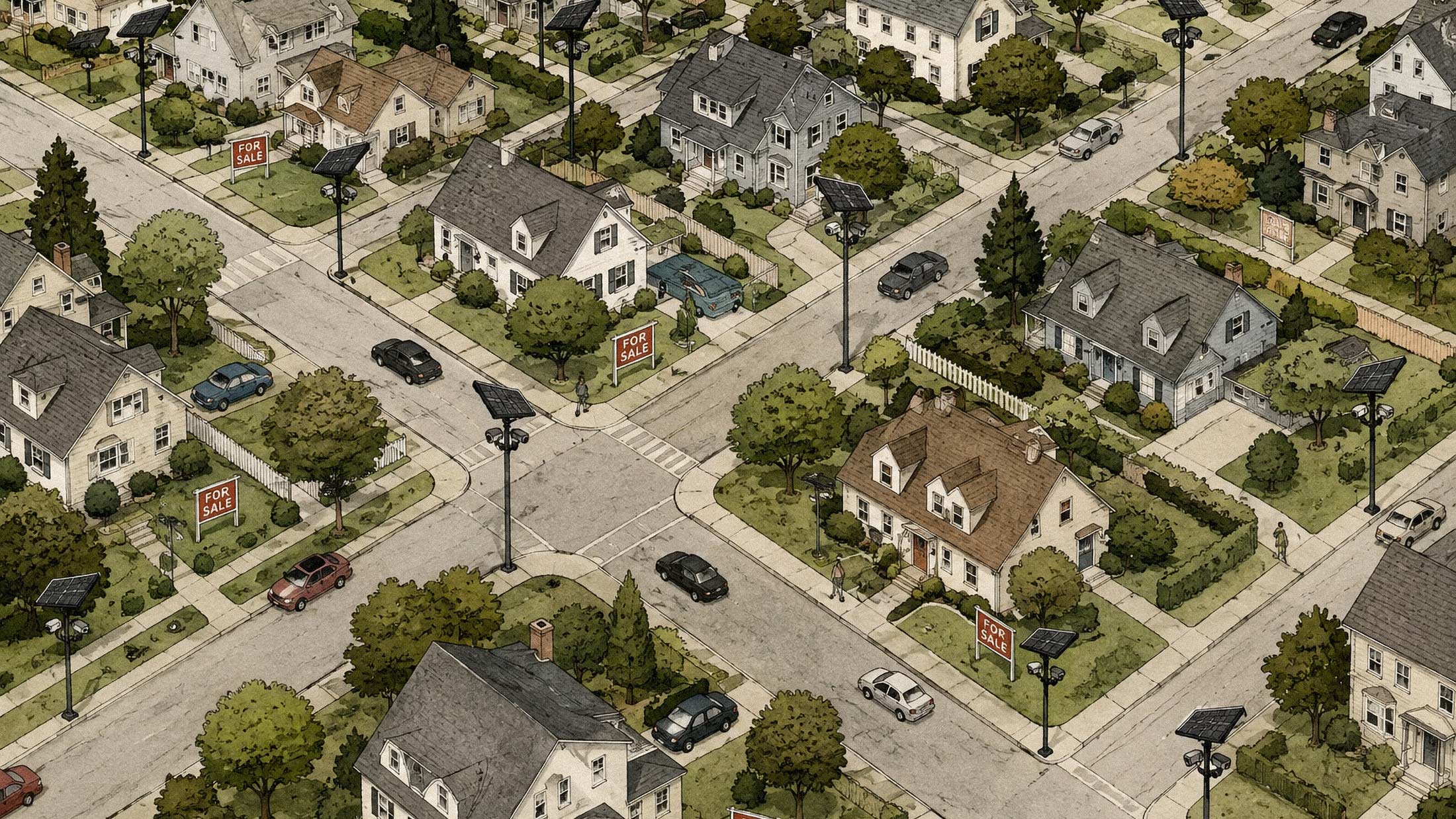
A prospective homebuyer canceled a scheduled showing in early August after reviewing DeFlock maps and discovering that the HOA-governed community had two Flock Safety cameras installed. One was positioned at the neighborhood entrance. The other was oriented toward the community pool.
Buyer cancels showing after Deflock shows two cameras utilized by the HOA pic.twitter.com/46a97HkxzN
— Lydia Kauppi (@lydiakauppi) August 17, 2026
The listing agent, who shared the incident on Reddit, confirmed the cameras are visible on the crowdsourced mapping tool at maps.deflock.org. The buyers expressed concern that the HOA could access the footage not for security purposes but for monitoring residents, issuing fines, or other forms of surveillance beyond the cameras' stated purpose. They did not reschedule.
The episode is a small data point, but it illustrates something larger: awareness of automated license plate reader placement is beginning to influence buyer decisions and, potentially, demand and values in HOA-governed communities.
The Surveillance Landscape
Flock Safety, the Atlanta-based company that manufactures the cameras in question, has built the largest ALPR network in the country. The company now operates more than 120,000 automatic license plate readers nationwide, collecting broad location data and sharing it across its network. Flock says it operates in over 5,000 communities across 49 states and performs over 20 billion scans of vehicles monthly.
Flock differs from competitors by marketing its services not just to law enforcement but also to homeowner associations and similar community organizations as tools for crime prevention. Flock markets directly to HOAs, and more than 200 have signed up. The pitch is "neighborhood security," but what actually happens is that a private board installs a police-grade plate reader on the street, funded by residents' dues.
When HOAs Go Further
The buyers who canceled their showing were worried about fines. That concern is not hypothetical.
In Florida, the Laurel Oak Estates and Country Club homeowners' association has begun issuing speeding fines using automated license-plate readers and speed-capturing cameras, penalizing not only residents but anyone who drives through the neighborhood. According to advocacy group DeFlockILM, some Florida HOAs now use the cameras to mail residents their own speeding fines.
As long as the roads are private rather than public, committees can impose rules for parking and, in some cases, for speed, according to a Manatee County Sheriff's Office spokesperson. The legal question of whether an HOA can issue automated fines based on camera data varies by jurisdiction, but the capability exists and some associations are already using it.
The concern extends beyond fines. An HOA can choose to integrate its Flock system with law enforcement, and once it does, the neighborhood's cameras feed the same nationwide, searchable Flock network the police use. That means the private street's reader stops being "just for the HOA" and becomes a node any participating agency can query.
The Mapping Tools
DeFlock, an independent open-source project opposed to widespread ALPR surveillance, maintains a searchable nationwide map of these devices. As of August 13, the map displayed nearly 129,500 reported cameras across the country.
DeFlock was founded in October 2024 by software engineer and privacy advocate Will Freeman. He was on a road trip from Washington state to Alabama when he noticed hundreds of newly installed cameras mounted on black poles with solar panels in towns along his route. After learning they were Flock cameras, Freeman created the platform to map them.
The community-driven project uses OpenStreetMap data and user contributions to document license plate readers and other surveillance devices. Users can search by address, city, or ZIP code, explore cameras in a neighborhood, or use a route-planning feature to check known cameras along a journey. The map is crowdsourced and may not be complete, but it has become one of the primary tools for buyers, renters, and residents seeking to understand what surveillance infrastructure exists in a given area.
A Growing Backlash
The canceled showing comes amid broader pushback against Flock. The Institute for Justice has cataloged more than 140 examples of ALPR abuse, including stalking romantic interests, wrongful stops and detentions, and non-law enforcement uses.
A string of recent police officer resignations or arrests for alleged abuses of Flock's system, including using it to stalk exes or romantic interests, have added to nationwide concerns among privacy advocates and community members. More than 50 cities have canceled their Flock contracts following concerns over unauthorized data sharing with federal agencies.
"It's mass surveillance, and I think we need guardrails around that," said Brentwood City Councilmember Jovita Mendoza. The Brentwood City Council plans to hold a future discussion on potential rules governing privately owned Flock cameras.
"Landlords and HOAs can't arbitrarily install cameras wherever they want, collect data about your comings and goings, and do whatever they want with it," says Jamie E. Wright, a trial attorney and founder of The Wright Law Firm.
Real Estate Implications
Whether this one canceled showing represents a trend is impossible to know. Anecdotes are not data. But the infrastructure for surveillance awareness is now in place: crowdsourced maps, advocacy toolkits from the ACLU, and a steady stream of news coverage about camera misuse.
The listing agent who shared this incident noted that buyers asked specifically about the HOA's data retention policies before canceling. They wanted to know who had access to footage, how long it was stored, and whether the HOA had integrated its system with law enforcement. The HOA's responses were evidently not satisfying.
Homeowners and renters have more leverage than most people realize, according to Wright, but only if they exercise it before signing anything rather than after. Before speaking with an HOA, property manager, or landlord about surveillance on private property, residents should know their rights.
For prospective buyers, the calculus is shifting. The presence of cameras is no longer just a privacy question but a financial one. If surveillance infrastructure can be used to issue automated fines, track residents' comings and goings, or share data with third parties, that represents a form of ongoing risk that did not exist a decade ago.
Real estate agents and HOA boards may soon need to address these concerns proactively. Disclosure of camera placement, data-sharing policies, and fine enforcement capabilities could become standard due diligence in communities where Flock or similar systems are installed. For some buyers, the presence of surveillance infrastructure will be a feature. For others, it will be a dealbreaker.