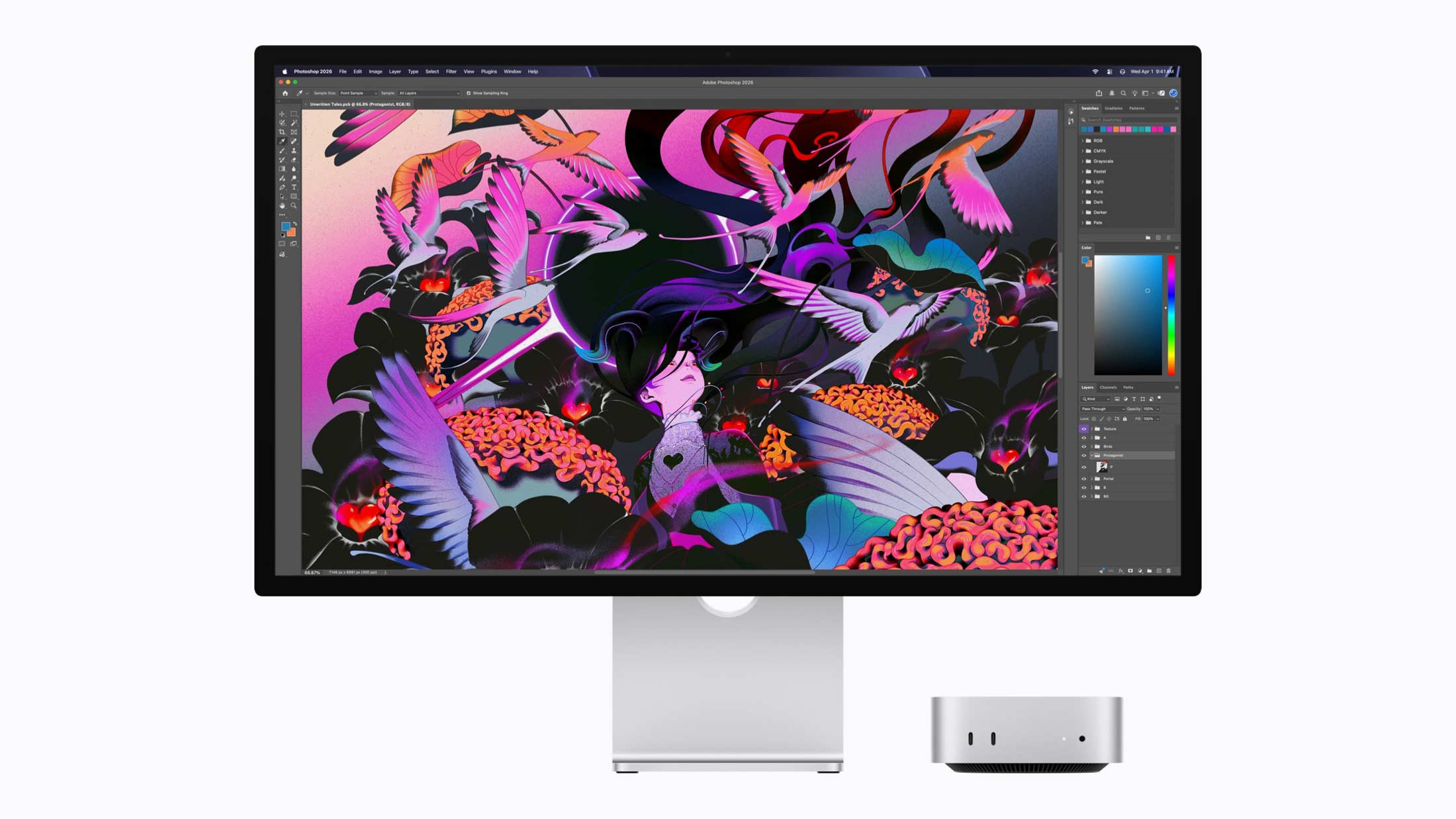
Apple announced a new Mac mini today, featuring the M6 chip in the base model and M5 Pro in the higher-end configuration. Pre-orders begin immediately, with shipments starting September 22. The entry price is $899.
That number deserves attention. When the M4 Mac mini launched in October 2024, Apple positioned it as the company's most affordable Mac at $599. The new M6 model costs $300 more than that original price point, a 50% increase. Even accounting for the fact that Apple pulled the $599 configuration in May 2026, citing supply constraints, the jump is substantial. The $899 starting price is the highest in Mac mini history.
What the M6 Actually Delivers
The M6 is Apple's first chip built on TSMC's 2-nanometer process, packing greater transistor density into a smaller die. The CPU has 12 cores, two more than the M5, with a new architecture: two super cores for single-threaded work, four performance cores for multi-threaded tasks, and six efficiency cores for background operations. Apple claims it delivers the fastest single-threaded performance in the industry.
The GPU also gets 12 cores, each with a Neural Accelerator built in. But the real story is the dual 16-core Neural Engine, a first for Apple silicon. With 32 Neural Engine cores total, the M6 delivers what Apple claims is up to 4x faster AI performance compared to the M4. Memory bandwidth rises to 170GB/s, up from 120GB/s on the M4, and the base configuration includes 16GB of unified memory configurable to 32GB.
Apple is clearly positioning the Mac mini as a machine for local AI work. The company's marketing describes it as the "leading desktop computer for always-on, deskside agentic computing." Whether running local LLMs through tools like LM Studio or processing on-device AI tasks, the M6 mini is built to handle agent workflows without cloud dependencies.
The M5 Pro Option
For users who need more headroom, the M5 Pro configuration starts at $1,699. This model features up to an 18-core CPU and a 20-core GPU with third-generation ray tracing. Memory scales to 64GB with 307GB/s bandwidth. Apple says this configuration delivers up to 8.5x faster LLM prompt processing in LM Studio compared to the M2 Pro, and up to 4x faster than the M4 Pro.
Connectivity differs between the two models. The M6 Mac mini gets three Thunderbolt 4 ports on the back, while the M5 Pro model includes three Thunderbolt 5 ports. Both configurations support Wi-Fi 7 and Bluetooth 6 via Apple's N1 chip, and both include 2.5Gb Ethernet as standard with 10Gb available as an upgrade. Apple also added genlock support through USB-C for video production workflows.
The Price Calculation
Apple's explanation for the higher price is implicit in the spec sheet: you're getting a 2nm chip with a dual Neural Engine, an architecture that didn't exist at any price point two years ago. But the context matters. The Mac mini has historically been Apple's value proposition, the machine that got people into the ecosystem without requiring a four-figure commitment.
The original Mac mini launched at $499 in 2005 under Steve Jobs. Two decades later, that same product category starts at $899. Inflation doesn't account for all of that, but neither does the raw silicon improvement. What's changed is positioning. Apple isn't trying to sell the cheapest computer anymore. It's selling the most capable on-device AI platform at the smallest physical footprint.
Education customers get a $100 discount, bringing the M6 model to $799. That's still higher than what the general public paid for the M4 mini at launch, but it keeps the machine within reach for students and schools building out their first AI development environments.
The design remains unchanged from the 2024 model: five inches by five inches, same thermal architecture, same aesthetic. Nearly everything inside is different. Whether that justifies a $300 price increase depends on what you plan to do with it. For local model inference and agent automation, the M6's dual Neural Engine represents a generational leap. For basic productivity, you're now paying closer to a grand for what used to be Apple's budget desktop.