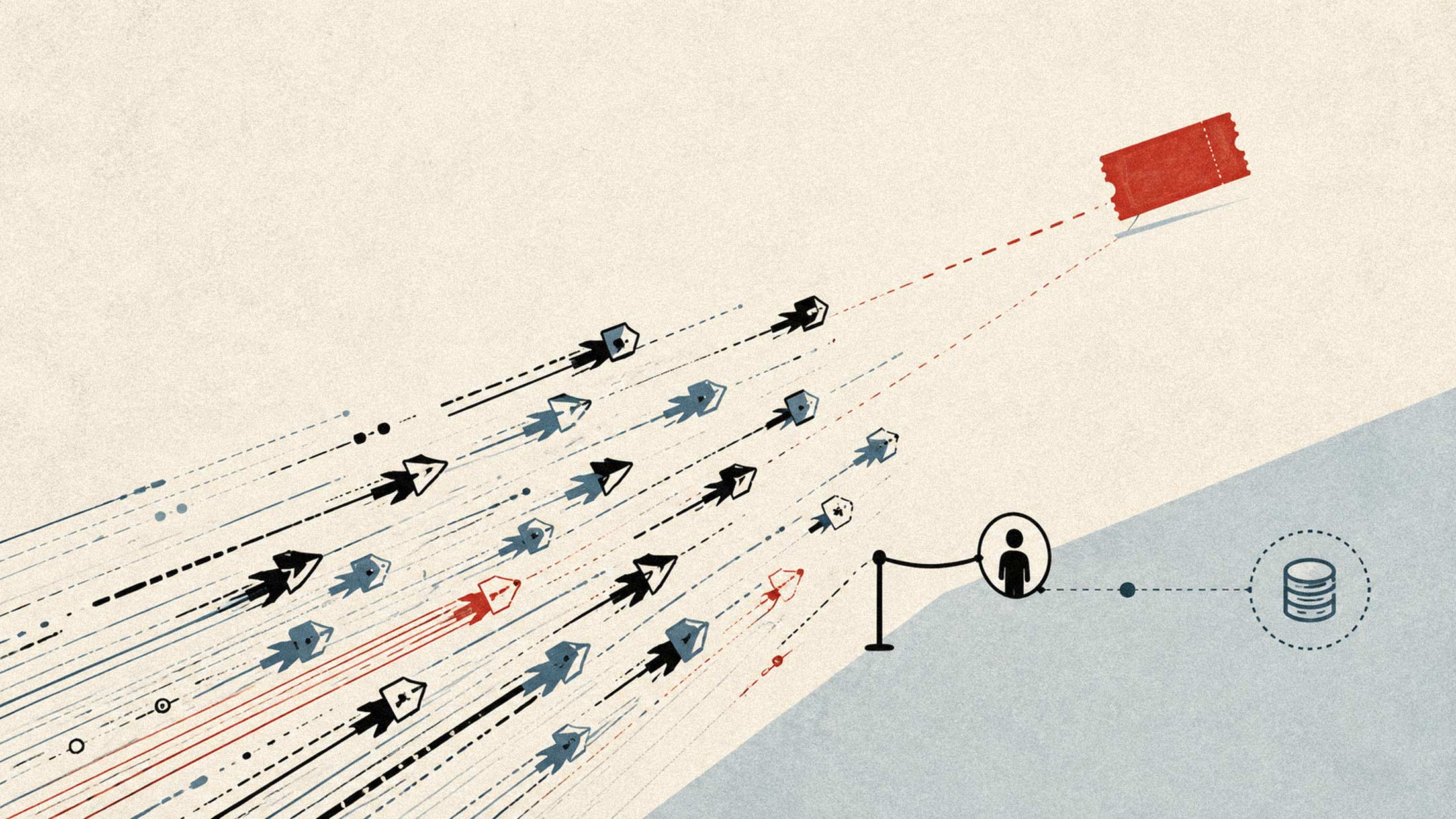
The arithmetic is simple. Cloudflare data from June 2026 shows that automated traffic now accounts for 57.5% of all web requests. Humans produce the other 42.5%. The crossover arrived 18 months ahead of schedule. Cloudflare CEO Matthew Prince had predicted bot-majority traffic by late 2027. Instead, agentic AI traffic grew 7,851% year over year, according to HUMAN Security's 2026 benchmark report.
This is not old-school crawlers indexing the web. These are AI agents browsing, comparing, filling forms, and completing transactions on behalf of actual people. They visit roughly 1,000 times more pages per task than a human would. And now they are all converging on the same scarce inventory: the canceled restaurant reservation, the last-minute concert ticket, the flight that just dropped $400.
The Scalping Problem, Industrialized
Ticket scalping has always been a bot problem. Automated software has been scooping up concert tickets for over a decade. But the scalpers had an advantage: most buyers were still human. That gap is closing. When a meaningful share of consumers deploys personal AI agents to hunt for Taylor Swift tickets or Resy cancellations, the playing field inverts. The scalpers are now competing with a billion individual bots, each programmed with different budgets, preferences, and tolerance for risk.
South Korea expanded its anti-scalping laws in January to target automated ticket-grabbing. China has summoned platforms including Ctrip, Fliggy, and Meituan over train ticket purchases that regulators called "strongly criticized." Tools for Humanity, Sam Altman's identity verification company, launched Concert Kit in April, letting artists set aside seats accessible only to buyers who have passed a proof-of-human check. The problem is obvious enough that even Altman, whose company builds the agents driving this traffic, is now building infrastructure to limit their reach.
The HFT Parallel
Anyone who watched high-frequency trading evolve over the past two decades can see where this leads. When multiple algorithms compete for the same asset at speed, milliseconds determine winners. Firms moved servers closer to exchange matching engines. They carved microseconds out of fiber routes. They built direct-market-access pipelines and paid for colocation.
Consumer agents competing for reservations or tickets face the same physics. Edge data centers positioned within 50 to 100 miles of users can reduce latency to 1 to 2 milliseconds versus 20 to 50 milliseconds for distant cloud regions. That gap matters when your agent is racing thousands of other agents to confirm a booking the instant it opens.
The logical endpoint is consumer-side colocation: premium agent tiers that run closer to the inventory servers. We are not there yet. But the infrastructure exists, the economics are plausible, and the landlords of the AI age are already building it.
Stablecoins as the Settlement Layer
Traditional payment rails were designed for human-initiated transactions with predictable patterns. Credit cards impose a minimum fee floor around $0.30 per transaction. That makes sense when a human buys one item. It breaks down when an agent executes a thousand sub-cent micropayments in a minute.
Stablecoin protocols are filling the gap. Coinbase x402, Stripe x402 on Base, Circle Wallets, and Visa's nine-chain stablecoin settlement program are all live. An agent can authorize micropayments on Solana at volumes that would crash traditional card processors. The stablecoin collective market cap now exceeds $300 billion, and machine-to-machine payment protocols like Google's AP2 and HTTP 402 are explicitly designed for autonomous agent transactions.
This is what micro-bidding looks like. Your agent does not simply request a reservation. It bids for priority in a queue, settles instantly on-chain, and moves to the next task. The restaurant or ticketing platform does not see a human. It sees a cryptographic credential tied to a budget and a set of constraints.
When Everyone Has the Advantage
Experts project that agentic commerce could orchestrate $3 trillion to $5 trillion in global transaction volume by 2030. J.P. Morgan estimates AI agents could account for up to 25% of U.S. online sales by then. That means agentic commerce is quickly becoming the default mode of commerce.
The question is what happens when universal agent access cancels out the speed advantage. If every consumer has an agent and every agent runs comparable infrastructure, the competitive edge shifts somewhere else: to the quality of the agent's reasoning, to the richness of user-preference data, to willingness to bid higher. Or it shifts to proof-of-humanity mechanisms that gate certain inventory entirely, creating a two-tier market where verified humans get access to pools that agents cannot touch.
The infrastructure providers win either way. Cloudflare is already building traffic management for agent-dense environments. DataDome is selling intent-aware virtual waiting rooms that filter malicious agents from legitimate ones. Okta is reportedly building Human Principal, a product that lets API builders verify whether a human stands behind an agent and enforce policies accordingly.
The consumer, meanwhile, inherits a new kind of anxiety: not whether they can afford the ticket, but whether their agent is fast enough, clever enough, or well-positioned enough to secure it before someone else's agent does. The surveillance anxieties of the physical world have a digital twin now, and it runs at machine speed.