For more than three decades, the little red pointing stick nestled between the G, H, and B keys on ThinkPad keyboards represented one of personal computing's most stubborn examples of form following function. The TrackPoint, invented by Ted Selker while at Xerox PARC in 1984 and refined at IBM before its 1992 debut on the ThinkPad 700 series, allowed touch typists to manipulate their cursors without ever lifting their fingers from the home row. Studies showed it saved roughly 0.75 seconds per switch from keyboard to mouse. For power users, that adds up.
Then, at CES 2025, Lenovo signaled a departure. The company announced the ThinkPad X9 Aura Edition, the first mainstream ThinkPad without the nub. Lenovo positioned the X9 as a competitor to the MacBook Air and Dell XPS, targeting what it calls "prosumers" who might view the TrackPoint as legacy design. The X9, available in 14- and 15-inch configurations starting at $1,399 and $1,549 respectively, prioritizes slim aluminum aesthetics over the ThinkPad's traditional rugged utilitarianism. The trackpad is larger. The red dot is gone.
Not Dead, but Displaced
Lenovo insists the TrackPoint lives on in other product lines. The X1 Carbon, T Series, P Series workstations, and even the experimental Z Series (which added double-tap shortcut functionality to the nub) retain it. But the X9 announcement crystallized something many ThinkPad loyalists already felt: the pointing stick's relevance is narrowing, not expanding.
Enter Ploopy, a Canadian company that has quietly built a reputation for open-source computer peripherals. They make trackballs, touchpads, a USB knob, even 3D-printed headphones. Their entire philosophy centers on releasing hardware with complete design files, QMK firmware support, and detailed documentation for modification and repair. Now they are bringing the pointing stick experience to any setup with the Bean.
The Bean: Specifications and Philosophy
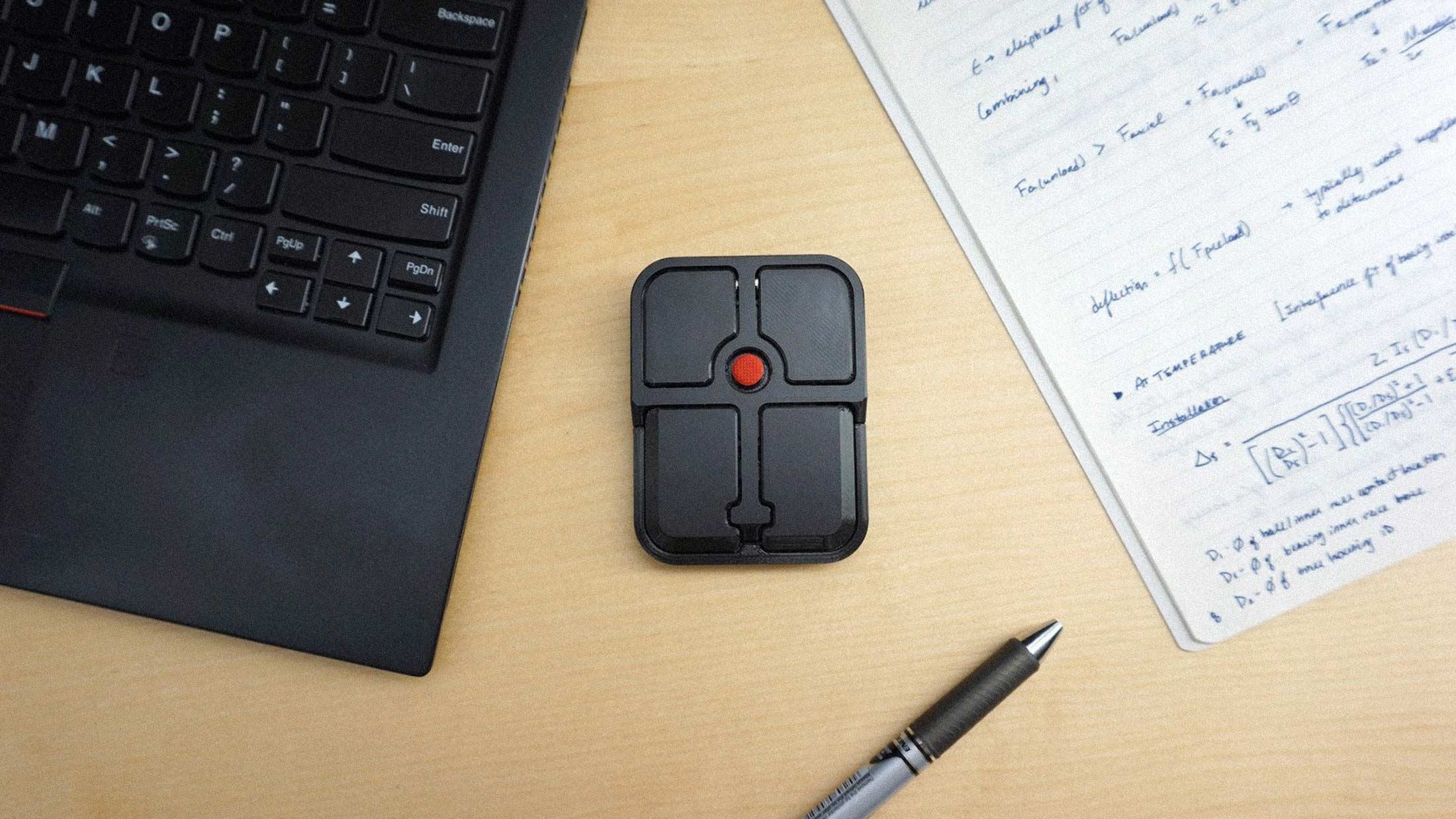
The Ploopy Bean is a compact pointing stick mouse measuring 84 x 64 x 16mm (roughly 3.3 x 2.5 x 0.6 inches). It connects via USB-C, features four Omron D2LS-21 switches configured for left click, right click, middle click, and click-to-drag/scroll by default, and uses a Texas Instruments TMAG5273 high-precision hall effect sensor that samples 20,000 times per second. Ploopy claims it can detect movements as small as 3 microns.
Where the Bean diverges from laptop-integrated pointing sticks is in its movement range: 11mm of travel in each axis, compared to the minimal deflection of a traditional TrackPoint. The idea is that the additional movement will reduce the finger fatigue sometimes associated with pushing against a mostly-fixed nub for extended periods. The silicone cap, like IBM's original, is red.
The device ships fully assembled with QMK firmware preloaded. Users can reconfigure button mappings through VIA, a web-based configuration tool, and since all design files live on GitHub, dedicated users can modify the 3D-printed enclosure, swap out parts, or build their own from scratch. The Bean polls at 1,000Hz.
Preorders are open at $69.99 CAD (approximately $51 USD). Ploopy has stated that orders will ship based on availability, a model the company has used successfully for previous product launches.
Who Is This For?
The obvious audience is ThinkPad devotees who have migrated to other hardware but miss the pointing stick. Split keyboard users, who often pair their setups with trackballs or small pointing devices, represent another potential market. The Bean is also wired and stationary, which means it works in tight spaces where a traditional mouse would be impractical.
Critics, including PCWorld's hands-off skepticism, note that the Bean fundamentally contradicts the TrackPoint's original purpose. Selker's design was meant to eliminate the hand movement between keyboard and mouse entirely. An external device reintroduces that friction. The argument holds if you already use a laptop with an integrated TrackPoint. It holds less if you use a desktop, a non-ThinkPad laptop, or a split mechanical keyboard.
There is also the question of whether the market for pointing sticks, however passionate, is large enough to sustain a $70 product. Ploopy's entire business model depends on serving dedicated niches with premium, repairable, open-source hardware. The edge computing world is full of specialized tools that survive on small, loyal user bases. The Bean is betting that pointing stick enthusiasts are no different.
Open Source as Insurance
For users worried about long-term support, Ploopy's open-source model functions as a kind of insurance policy. If the company disappears, the hardware designs, firmware, and documentation remain available. Users can print replacement shells, source their own switches, and modify the firmware to suit new use cases. This stands in sharp contrast to most consumer peripherals, where a discontinued product line means eventual obsolescence.
The Bean is a response to a specific moment: Lenovo is moving the TrackPoint toward the periphery of its product line, and there is no sign that other major laptop manufacturers plan to adopt it. If you want the red nub experience in 2026, you either buy from a shrinking pool of compatible laptops, or you bring your own. The boutique hardware market is full of products like this, devices that exist because enthusiasts insisted they should.
Ploopy is shipping preorders based on production availability. A one-year warranty covers the device, though the warranty is voided if you modify the hardware or firmware.