Drug discovery has always been a slow, expensive grind. The traditional peptide pipeline can stretch for years, burning through resources while researchers chase promising candidates that often fail in late-stage validation. Now, a new wave of autonomous systems is compressing that timeline into weeks.
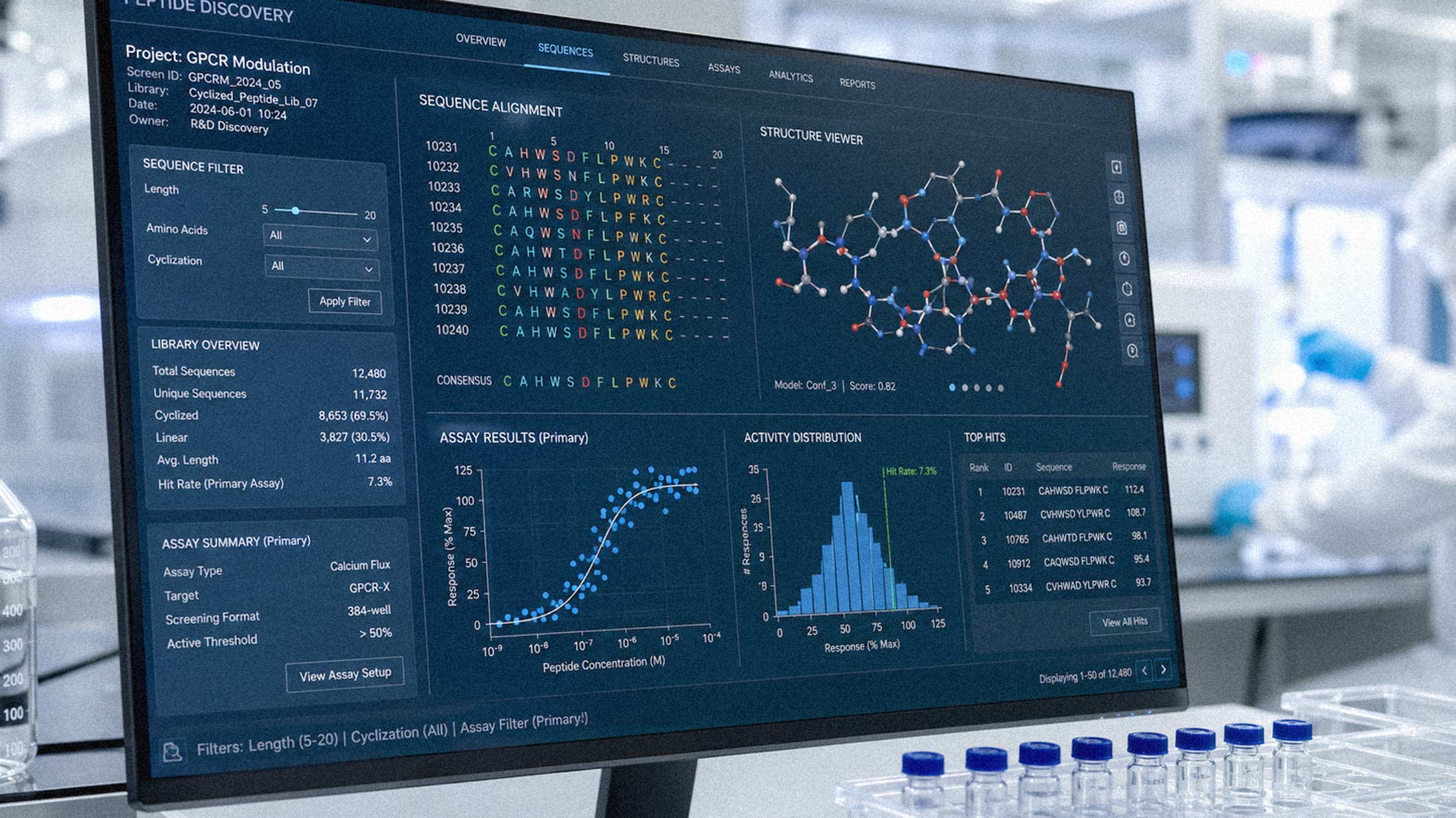
PeptAI is among the companies staking territory in this space. Its platform runs autonomous peptide discovery with live pipeline visibility, letting researchers track candidates through generation-by-generation screening. The system flags weak candidates before lab handoff, currently targeting the KISS1R receptor for fertility applications with 10 candidates in the pipeline. Every evaluation, every backtrack, every decision is visible by receptor target.
What Autonomous Discovery Changes
The core problem with traditional peptide drug development is its trial-and-error nature. Researchers historically relied on empirical approaches that are time-consuming, resource-intensive, and yield limited success rates. AI-driven platforms flip this equation by processing vast biological datasets to predict structures, optimize pharmacokinetic properties, and prioritize high-potential candidates across disease indications.
According to recent research in Chemical Communications, these computational approaches combined with autonomous peptide synthesis and high-throughput screening have reduced discovery timelines from years to months. One notable example: an AI-driven system called AMP Designer produced 18 de novo antimicrobial peptides in just 48 days, with 17 proving active. The two top candidates were effective in mouse infection models. That kind of hit rate was unthinkable a few years ago.
The market is responding accordingly. The AI-assisted peptide drug discovery platform sector is projected to grow at a 14.3% CAGR through 2035, as pharmaceutical companies seek faster timelines and higher success rates. Major players like AstraZeneca are already using AI-guided design to test thousands of peptide variations within days rather than months.
The DIY DNA Movement
While startups automate drug discovery in professional settings, a parallel phenomenon is unfolding in garages and kitchens. A loose network of hobbyists and privacy-focused technologists now calls itself Vibe Genomics, proving that with consumer-grade hardware, open-source AI models, and about $1,500 in equipment, anyone can sequence and analyze their own DNA without sending samples to corporate biotech labs.
The hardware making this possible is Oxford Nanopore's MinION, a pocket-sized sequencer that one biohacker recently paired with an M3 Ultra Mac Studio and Claude to sequence their own genome at home. The project was driven by a family history of autoimmune disease. Total cost per sequencing run: roughly $1,100.
What was once the province of multi-billion-dollar international projects is now achievable for the price of a mid-range laptop and some consumables. The first Human Genome Project took 13 years and cost approximately $2.7 billion. Today, complete home setups run between $1,400 and $2,500.
Personalized Medicine Gets Personal
These two trends converge in the emerging field of N-of-1 therapies. The FDA's February 2026 regulatory announcement created a "plausible mechanism" framework for custom CRISPR and RNA-based therapies targeting ultra-rare diseases. The pathway enables approval based on data from as few as five patients, provided a biologically plausible mechanism can be demonstrated.
The Philadelphia infant case directly informed this thinking. Baby KJ Muldoon, born with a rare metabolic disorder that left his body unable to remove toxic ammonia, became the first person to receive a bespoke gene-editing treatment using base editing. The researchers at the University of Pennsylvania developed a tailored therapy that, according to follow-up reports, has so far helped stabilize his condition.
Meanwhile, an Australian man used ChatGPT and university genomics facilities to design a cancer vaccine for his dog. By January 2026, the primary tumor had shrunk by nearly 50%. The technology to sequence, model, and create a personalized cure now exists in the hands of talented individuals. The regulatory systems, built for mass-produced blockbusters, are still catching up.
What Consumers Should Expect
For patients, faster peptide discovery means treatments for diseases like diabetes, cancer, and metabolic disorders could reach clinics sooner. The global peptide therapeutics market is projected to grow from $49.7 billion in 2025 to $100 billion by 2034. Over 100 peptide drugs are already approved globally, with GLP-1 analogs like semaglutide and tirzepatide demonstrating strong clinical outcomes.
The DIY movement offers a different value proposition: data sovereignty. People who don't want their genetic information sitting in corporate databases can now sequence at home, keep the data locally, and run additional analyses indefinitely. Clinical-grade sequencing still requires industrial equipment and validated protocols. If you need medically actionable information, a home setup won't replace a proper lab. But for understanding ancestry, exploring traits, or satisfying curiosity, the tools now exist.
The convergence of AI and biological sensing has lowered barriers across the board. What comes next depends on how quickly regulation adapts to a world where both professional labs and kitchen tables can generate viable therapeutic candidates.