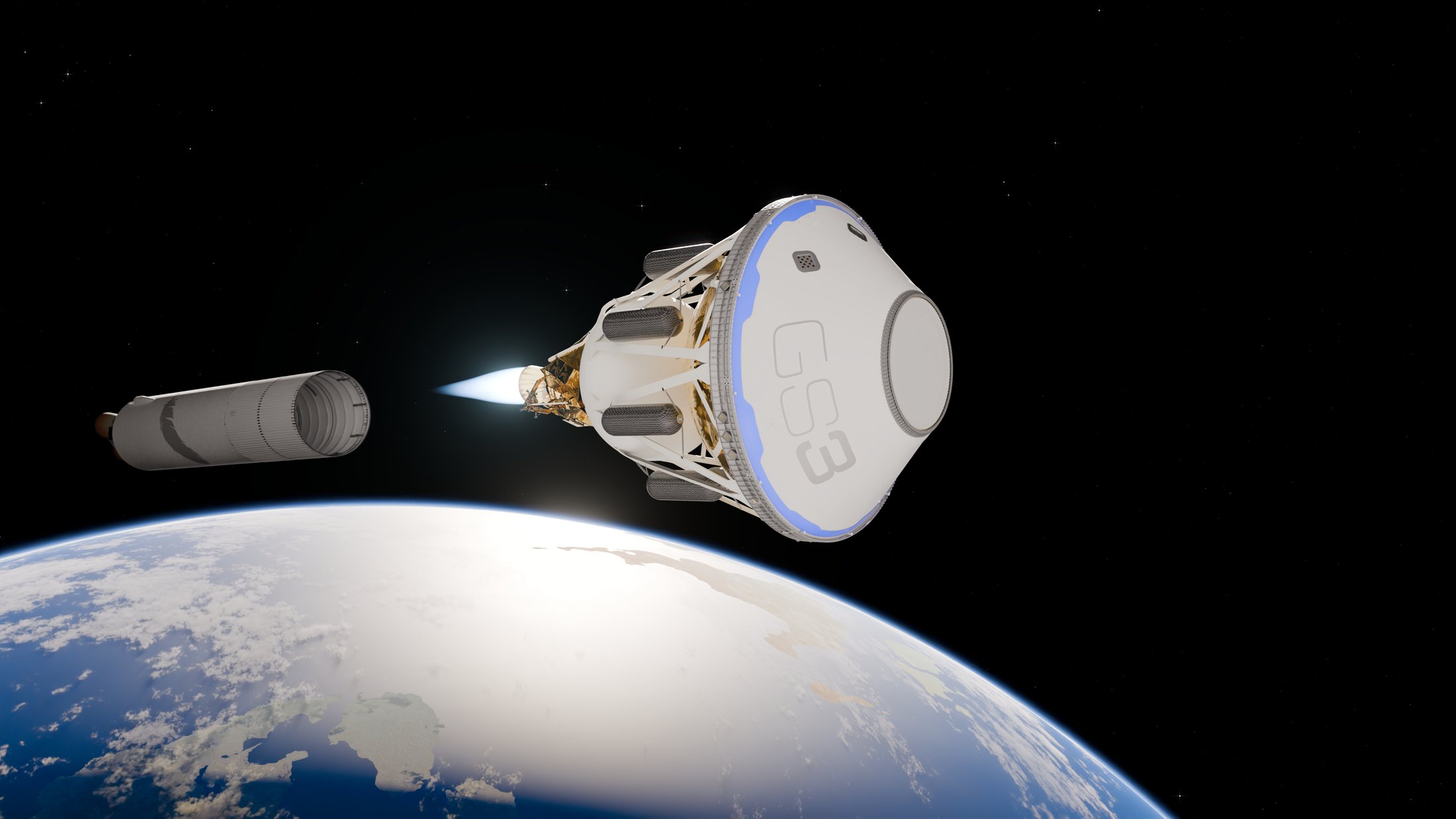
Blue Origin is expanding the New Glenn rocket family with two major hardware additions: a third stage called GS3 and a new first-stage engine named Northstar. CEO Dave Limp announced both at the UP.Summit conference at Kennedy Space Center on Thursday. The same day, the company pushed New Glenn's return to flight from late 2026 to January 2027.
The third stage is meant to handle missions the current two-stage stack cannot reach efficiently: direct injection to geostationary orbit and trajectories that leave Earth's gravity well. It does not change the customer interface. The stage fits inside an interstage, preserving the full fairing volume for payloads.
GS3 runs on a single BE-7 engine, the liquid hydrogen and oxygen powerplant Blue Origin developed for its Blue Moon lunar landers. The company quotes a vacuum specific impulse above 460 seconds. On a New Glenn 7×2, GS3 can haul 8 metric tons to geostationary orbit and 10 metric tons to translunar injection. On the larger 9×4 variant, those numbers rise to 14 and 20 metric tons, according to Blue Origin.
A government customer has already signed for a cislunar mission using the three-stage configuration. Launch is targeted for 2028.
The Composite Tank That Almost Didn't Work
The harder engineering problem was the tank. Liquid hydrogen is notoriously difficult to contain in composite structures: thermal cycling and mechanical loads open microcracks, and the tiny molecules slip through. Limp admitted the company was not sure a 5.5-meter composite hydrogen tank was even feasible.
At Launch Site One in Texas, teams recently completed a tanking test using flight fluid systems. The tank held 100 percent of its maximum expected operating pressure for 2.5 hours and 150 percent for 10 minutes. Blue Origin says the stage will carry the first composite liquid-hydrogen tank ever flown in space.
Northstar: A Cheaper, Simpler Booster Engine
The second announcement concerns the rocket's first stage. Northstar is a methalox engine, like the BE-4 it is meant to replace, but with half the parts and 30 percent less mass. Thrust rises from 640,000 to 715,000 pounds-force. Limp described that number as a "starting" figure.
More than 65 percent of the engine is additively manufactured using Blue Origin's in-house 3D-printing capability. The company says each engine can be assembled in under a day. It took 11 months from program approval to the start of developmental testing.
On cost, Limp put a number on it: Blue Origin believes it can manufacture Northstar for about 25 percent of what a BE-4 costs. The company did not disclose absolute dollar figures.
United Launch Alliance, which uses two BE-4 engines per Vulcan first stage, will continue receiving them. Blue Origin will keep producing the older engine for the partnership. No date was given for the first Northstar-powered New Glenn flight.
The Longer Shadow: New Glenn's Grounding
Limp's product announcements came alongside a less welcome update. In a memo to staff on Wednesday, viewed by CNBC, he wrote that New Glenn's return to flight is moving to January 2027. The company had previously targeted December.
The slip is about 10 days past the earlier internal target, but it breaks a pledge to fly before year's end. The delay stems from the May explosion that destroyed New Glenn's third first-stage booster during a ground test at Cape Canaveral. Industry observers called it one of the largest launch-vehicle explosions since the Soviet N1 rocket blew up in 1969.
Bad summer weather slowed the rebuild of Launch Complex 36. "Rebuilding at this pace hasn't been easy," Limp wrote. He added that a hot-fire test of the next upper stage should occur in one to two weeks at NASA's Stennis Space Center.
The New Glenn backlog now includes Amazon Leo constellation satellites, NASA lunar lander missions, and national-security payloads. Blue Origin says it has announced a $330 million expansion of its Florida facilities, with capacity to build up to 150 upper stages a year by summer 2027.
"There has never been higher demand for launch, ever," Limp told the UP.Summit audience. "I think if we had 50 rockets to fly in the next six months, we'd probably fill them all." Blue Origin currently has three New Glenn flights to its name.