For more than a century, the hydraulic brake has been one of the most durable designs in automotive engineering. Press the pedal, push fluid through lines, squeeze the calipers. The fundamentals stayed put while everything else changed. That era just ended.
Brembo announced this month that its Sensify intelligent braking platform has entered large-scale production for an unnamed "leading global vehicle manufacturer." The system is fitted as standard on every vehicle in the initial program, and Brembo says it has signed additional contracts that will put Sensify on hundreds of thousands of cars per year.
The identity of the first customer remains confidential. Speculation has centered on Tesla's Cybercab robotaxi, which would make sense given the vehicle's fully autonomous, pedal-free design. But Brembo isn't talking.
How Sensify Works
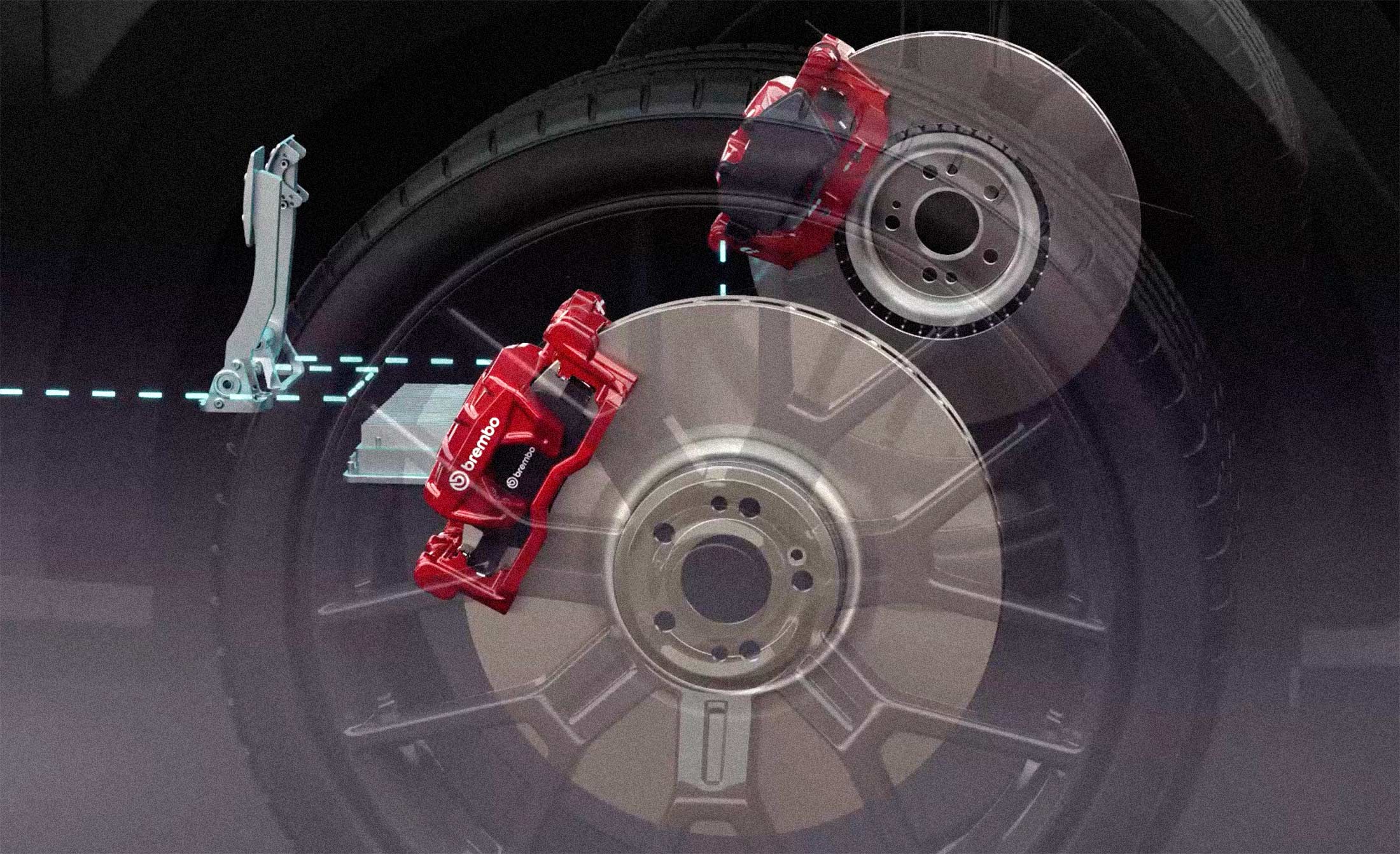
Unlike conventional brake systems that rely on a master cylinder pumping fluid through metal lines to each wheel, Sensify eliminates the hydraulic circuit entirely. Instead, sensors at the brake pedal read the driver's input and send electronic signals to actuators mounted at each caliper. Each wheel receives its own dose of braking force, modulated independently in real time.
This is what Brembo calls "distributing intelligence at wheel level." The control unit processes data from wheel speed sensors, steering angle, yaw rate, and road conditions to determine precisely how much force each corner needs at any moment. On surfaces with uneven grip, such as wet pavement or a snow-covered shoulder, the system can instantly adjust the balance across all four wheels to keep the car stable.
Anyone who has felt the stutter of ABS activation under hard braking will notice the difference. Traditional anti-lock systems use solenoid valves to pulse hydraulic pressure, which creates pedal kickback and sometimes inconsistent feel. Sensify uses continuous motor-driven torque control, maintaining grip at the limit without the mechanical judder.
Architectural Implications
The real significance here is not refinement. It is the removal of hardware that has constrained vehicle design for decades.
Hydraulic brake systems are not simple. They require a master cylinder under the hood, a brake fluid reservoir, steel and rubber lines routed from the engine bay to each wheel, and the periodic maintenance of bleeding air from those lines and replacing contaminated fluid. All of this occupies space, adds weight, and demands protective routing that complicates chassis packaging.
Strip the hydraulics out and you free up the front of the vehicle. Weight shifts away from the nose. The parking brake integrates directly into the electric motor system, eliminating cables and mechanical levers. The system becomes lighter, simpler to manufacture, and easier to service. No fluid leaks. No line corrosion.
There is also an efficiency benefit. Conventional hydraulic calipers maintain slight pad contact with the rotor even when not braking, due to the elasticity of piston seals. This creates drag. Sensify's actuators can physically retract the pads completely, reducing rolling resistance and extending range on electric vehicles.
Software-Defined Stopping
This is also, critically, a software play. Brembo has designed Sensify to integrate directly into vehicle digital architectures, supporting advanced driver assistance systems and autonomous applications. Braking behavior can be updated over the air. The pedal feel can be tuned by software. In vehicles with no human driver at all, the entire concept of a brake pedal becomes optional.
"Sensify translates our vision of an intelligent, integrated braking platform into industrial reality," Brembo CEO Daniele Schillaci said in the company's announcement. The framing reflects where the industry is heading: brakes are no longer just hardware. They are part of the software-defined vehicle stack.
Competition From China
Brembo is not alone in this race. Chinese suppliers have been developing electromechanical braking systems at speed. Beijing West Industries has announced EMB production for Kaiyi Auto and U Power in 2026. Chery's Exeed EX7, scheduled to launch this month, uses what the company calls "aviation-grade" electromechanical braking sourced from domestic suppliers. Li Auto's L9 Livis reportedly combines steer-by-wire with a fully dry EMB system.
China's regulatory framework has also moved faster. The mandatory GB21670-2025 standard for electrical transmission braking systems took effect on January 1, 2026, clearing the path for mass production. Chinese firms including Orient-Motion Technology, Jiongyi Electronic Technology, and Beijing West Industries are already building EMB assembly lines.
Brembo's early move to production with a major global OEM may be as much about establishing credibility against this Chinese surge as it is about advancing the technology itself. The company needs the automotive world to know that a Tier 1 Italian supplier can compete on timeline.
What This Means for Car Buyers
For most drivers, the transition will be invisible. The brake pedal still does what a brake pedal does. The change is underneath: electric vehicles that already rely heavily on regenerative braking will gain a friction system perfectly calibrated to work alongside it. Autonomous vehicles gain faster, more precise control. Over time, lower maintenance costs and improved efficiency will filter through to ownership economics.
Whether this technology reaches affordable vehicles depends on cost curves that remain unclear. Brembo has positioned Sensify as a plug-and-play platform adaptable across architectures, but production volumes will determine whether fluid-free brakes stay premium or go mainstream.
The first Sensify-equipped vehicles will reach consumers later this year. When they do, automotive teardown specialists will publish what Brembo would not say. Until then, the brake-by-wire era has quietly begun.