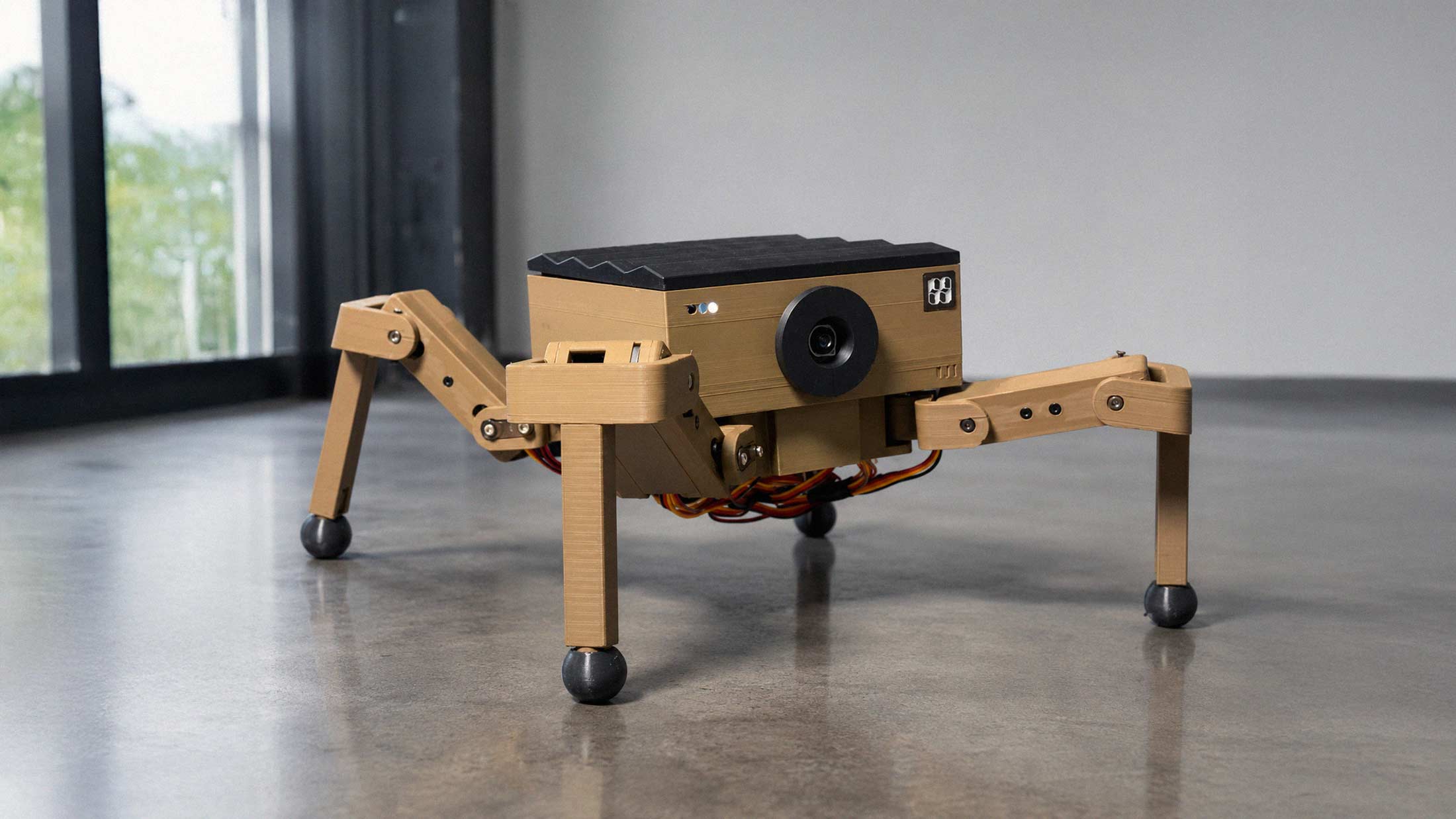
The robotics field has reached an inflection point. Commercial quadrupeds like Boston Dynamics' Spot still cost upward of $74,000, keeping serious legged robotics out of reach for most makers, researchers, and students. But a growing ecosystem of open-source projects and documentation platforms is changing the calculus. One example is CubeBot, an open-source robotics project by Vladimir Glukhov hosted on Tnkr, the platform that has positioned itself as a GitHub for physical intelligence.
Glukhov, a software developer with experience in frontend engineering and robotics, has been active in the open-source robotics community. His LinkedIn activity shows involvement with Hugging Face's LeRobot project, which aims to provide models, datasets, and tools for real-world robotics in PyTorch. The broader context matters: edge AI and physical intelligence are finally becoming viable outside corporate R&D; labs, and projects like CubeBot represent the kind of grassroots experimentation that accelerates the whole field.
A fully documented quadruped robot you can build yourself.
— tnkr (@tnkrdotai) July 20, 2026
CubeBot by Vladimir Glukhov, now on Tnkr.
Print files, BOM, wiring, assembly, and software. pic.twitter.com/A8PWDTA3Sh
Why Tnkr Changes the Equation
The platform hosting CubeBot is itself a significant development. Tnkr launched in 2025 with a specific mission: solving what it calls the hardware reproducibility crisis. According to Hackster.io, building an open-source quadruped or humanoid robot found online has historically been a nightmare, requiring makers to hunt through scattered PDFs, outdated forum posts, and broken GitHub links just to understand assembly.
Tnkr addresses this by unifying hardware, software, data, and AI models into a single workspace. The platform integrates with Onshape and SolidWorks for CAD files, connects to GitHub for code, and provides interactive 3D visualizations that let builders explore and rotate models to understand part placement. Its AI assistant, Leonardo, analyzes first-person build videos and automatically generates step-by-step assembly instructions.
This infrastructure matters for projects like CubeBot because documentation has always been the bottleneck for open-source hardware. Writing clear assembly guides is tedious, and most hobbyist creators skip it. Tnkr's automation changes the incentive structure: creators can now share complete, reproducible projects without dedicating weeks to manual documentation.
The Broader DIY Robotics Movement
CubeBot sits within a growing ecosystem of accessible robotics platforms. OpenCat, developed by Petoi founder Dr. Rongzhong Li, provides a framework for building quadruped robots on Arduino and ESP32 boards for under $300. Stanford Doggo offers an open-source jumping and trotting robot with 3D-printable parts. The Open Duck Mini brings Disney BDX-style bipedal walking to a $400 build using a Raspberry Pi Zero 2W and reinforcement learning trained entirely in simulation.
What these projects share is a modular architecture that lets beginners start simple and scale up. OpenCat's base layer handles servo control and inverse kinematics on microcontrollers, while an optional Raspberry Pi layer enables advanced capabilities like computer vision, SLAM, and reinforcement learning. This tiered approach means the same hardware can serve K-12 education and graduate research.
Edge AI Makes DIY Robotics Actually Useful
The timing matters. Until recently, DIY robots were impressive demonstrations but limited in practical capability. Now edge AI has matured enough that small, affordable compute can run real perception and decision-making onboard. Hugging Face's LeRobot provides imitation learning and reinforcement learning approaches that transfer to real-world hardware. NVIDIA's Jetson modules pack serious inference capability into embedded form factors. Vision-Language-Action models are getting small enough to fine-tune and deploy on modest GPUs.
Projects like CubeBot give builders hands-on experience with the full stack: mechanical design, embedded systems, sensor integration, and machine learning deployment. This matters because the gap between research prototypes and production robots is narrowing fast. The open-source AI gap has collapsed in language models, and physical intelligence appears to be following the same trajectory.
Data Contribution Loops
Tnkr has built in something that could prove significant: data contribution workflows. Builders can collect operational datasets from their deployed robots and feed them back into training pipelines. If enough people build CubeBot variants and share telemetry, that data corpus becomes a resource for training better policies. The same community dynamics that made open-source software powerful could apply to open-source robotics data.
This is why encouraging individual builders matters beyond the immediate projects they create. Every hobbyist running reinforcement learning on a quadruped is generating training data that, aggregated, could help the entire field. Platforms like Tnkr and frameworks like LeRobot provide the infrastructure to capture that value. The builders who start with projects like CubeBot today are positioning themselves for a robotics landscape that will look very different in five years.
The relevant question is no longer whether physical AI will become mainstream, but who will be ready when it does. Commercial home robots are shipping this fall. The pipeline between maker projects and production hardware is shortening. Open-source robotics has always been about democratization, but for the first time, the tools exist to make that promise real.