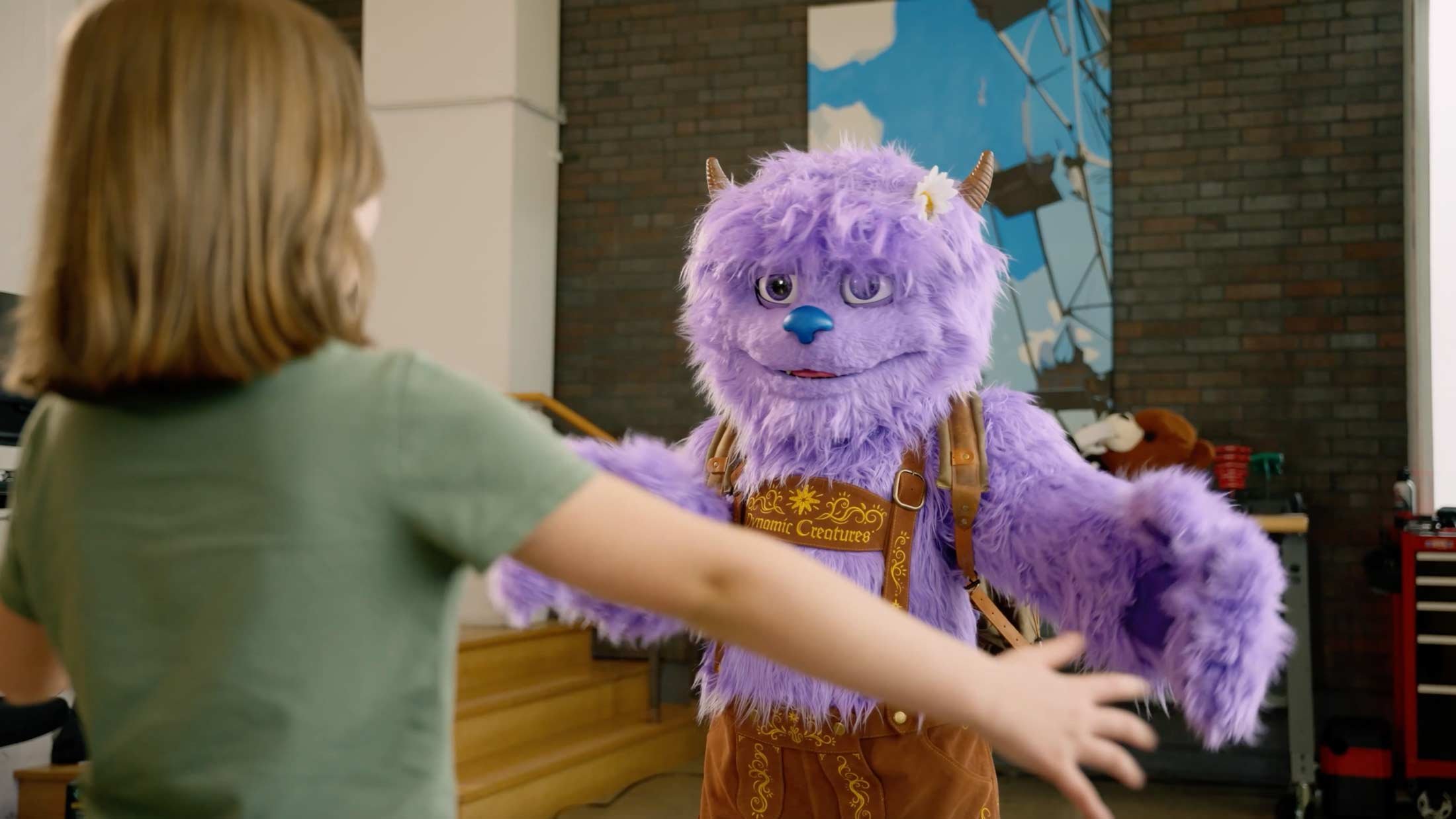
On October 13, Dynamic Creatures released a video of Hugo, a purple creature with small horns, embroidered shorts, and big eyes, walking through its Cambridge headquarters, high-fiving engineers and hugging children. Three days later, CEO Marc Theermann posted a thread on X claiming Hugo runs on what the company calls a Vision-Language-Expression model, which connects what the robot sees and hears to movement, gesture, and expression.
"Our ultimate goal is to revolutionize how humans and robots interact," Theermann told the Boston Globe.
There is a caveat. The Hugo in the video is being teleoperated under remote human control. The company says it is developing the software that will enable Hugo to respond to people autonomously, but that system cannot yet be trusted for unsupervised physical interactions. The prototype is a demonstration of hardware and character design; the AI that makes it feel alive is still in progress.
Introducing Hugo: the first human companion robot. At Boston Dynamics, I was Chief Strategy Officer, bringing robots into the real world. My co-founder, Farbod Farshidian, led research at the RAI Institute. Together, 15+ years teaching robots to run, jump, and work. So we asked: what if robots could connect with people? Hugo runs on the first Vision-Language-Expression (VLE) model. He links what he sees and hears to movement, expression, and gesture. He notices you, reads the room, and reacts in real time. And he's only the first. Dynamic Creatures is @BostonDynamics' official entertainment and hospitality partner. We're building a cast of characters with film studios, resorts, and theme parks. https://t.co/z6iUo6btek
— theermann (@theermann) October 16, 2026
The Hardware
Hugo pairs 43 actuators with animatronic character design and what the company calls its SnowJay platform, an integrated system that coordinates perception, learned control, programmed behavior, and costuming. One analysis noted a developer screenshot suggesting a possible modified Unitree G1 beneath the costume, though the company has not confirmed the underlying hardware.
Dynamic Creatures positions itself between fixed animatronics and task-oriented service robots. Traditional animatronics perform scripted sequences for crowds. Service robots guide, inform, or transport. Hugo, according to the company, is designed for face-to-face encounters where it can sense the context of each interaction and respond to the individual in front of it.
The Founders
Theermann spent nearly six years at Boston Dynamics as chief strategy officer, overseeing commercialization and go-to-market functions for Spot, Atlas, and Stretch. Before that, he led strategy at Google.
CTO Farbod Farshidian comes from the Robotics and AI Institute, where he led the HALO team developing learning-based control for humanoid and legged robots. His published work includes ZEST, a framework that teaches Boston Dynamics' Atlas dynamic skills like breakdancing and army crawls from motion capture, then transfers them to physical hardware. He holds a PhD from ETH Zurich and has more than 70 research publications with over 5,900 citations. "Robust and fluid movement, perception and behavior have to work as one system for a character to engage naturally in the physical world," Farshidian said in the company's launch announcement.
Dynamic Creatures is backed by Eniac Ventures, Kindred Ventures, Heliad, Sunshine Lake, and BlueGrass Ventures. Angel investors include Marc Raibert, who founded Boston Dynamics in 1992, and Lukas Ziegler. The company declined to disclose its funding amount.
The Partnership
Dynamic Creatures is Boston Dynamics' official entertainment and hospitality partner, a designation announced when the company emerged from stealth on September 8. Boston Dynamics holds no reported equity stake. Amanda McMaster, Boston Dynamics' interim CEO, said the spinoff is "combining proven robotic platforms with character design, adaptive behavior and real-time interaction to create experiences the market has not had access to before."
Hugo is not the company's only prototype. An earlier character, Danielle, is a lavender poodle-like creature built around a Spot-style quadruped platform. Theermann told Fortune the company would likely never build a photorealistic robot.
The Market
Disney has deployed its BDX droids at Galaxy's Edge parks worldwide, knee-high bipedal robots that use reinforcement learning to roam, emote, and engage guests. Those droids went from concept to themed park deployment in under a year, built by a team of eight. They are also appearing in the upcoming Mandalorian and Grogu film.
Dynamic Creatures is pursuing a different segment: larger, character-forward robots designed for extended face-to-face interaction. The company says it is already working with an unnamed major theme park and a large retailer. It plans managed pilot deployments in early 2027, with a leasing model intended to let venues deploy characters without large upfront capital investment.
Technical specifications, autonomy rates, operating duration, safety certification, and pricing remain undisclosed.