We may earn a commission if you buy through links on this page. It never affects our coverage. Prices are as reported at publication and may have changed. As an Amazon Associate we earn from qualifying purchases.
Framework has spent six years arguing that a laptop should belong to you in every sense that matters. The Framework Laptop 13 Pro, announced yesterday at the company's Next Gen event, is the clearest articulation of that philosophy yet: a ground-up redesign that finally matches the build quality and battery life of a MacBook Pro while remaining fully repairable, upgradeable, and open.
The Specs That Matter
The 13 Pro runs Intel's Core Ultra Series 3 (Panther Lake) silicon paired with LPCAMM2 memory. That RAM standard matters here. Framework is one of the first to pair it with Panther Lake, enabling LPDDR5X running at 7,467 MT/s in a modular form factor. Translation: the memory still comes out. It can be swapped. Nothing is soldered down.
Battery capacity jumps 22 percent to 74Wh, and the efficiency gains from Intel's new architecture more than double runtime. Framework claims over 20 hours streaming Netflix at 4K, which would edge out the 14-inch MacBook Pro M5. A new 100W GaN charger replaces the older 60W brick to handle faster refills on the larger cell. The company also says users can expect 80 percent capacity after 1,000 cycles.
The display is Framework's first fully custom panel. It's a 13.5-inch, 3:2 touchscreen running at 2880 x 1920 with a variable refresh rate between 30 and 120Hz and a peak brightness of 700 nits. Touch support was a longstanding request. Framework initially resisted, but after building the Laptop 12, the team changed its mind. A haptic touchpad sourced from LiteOn rounds out the input updates.
Modularity Holds
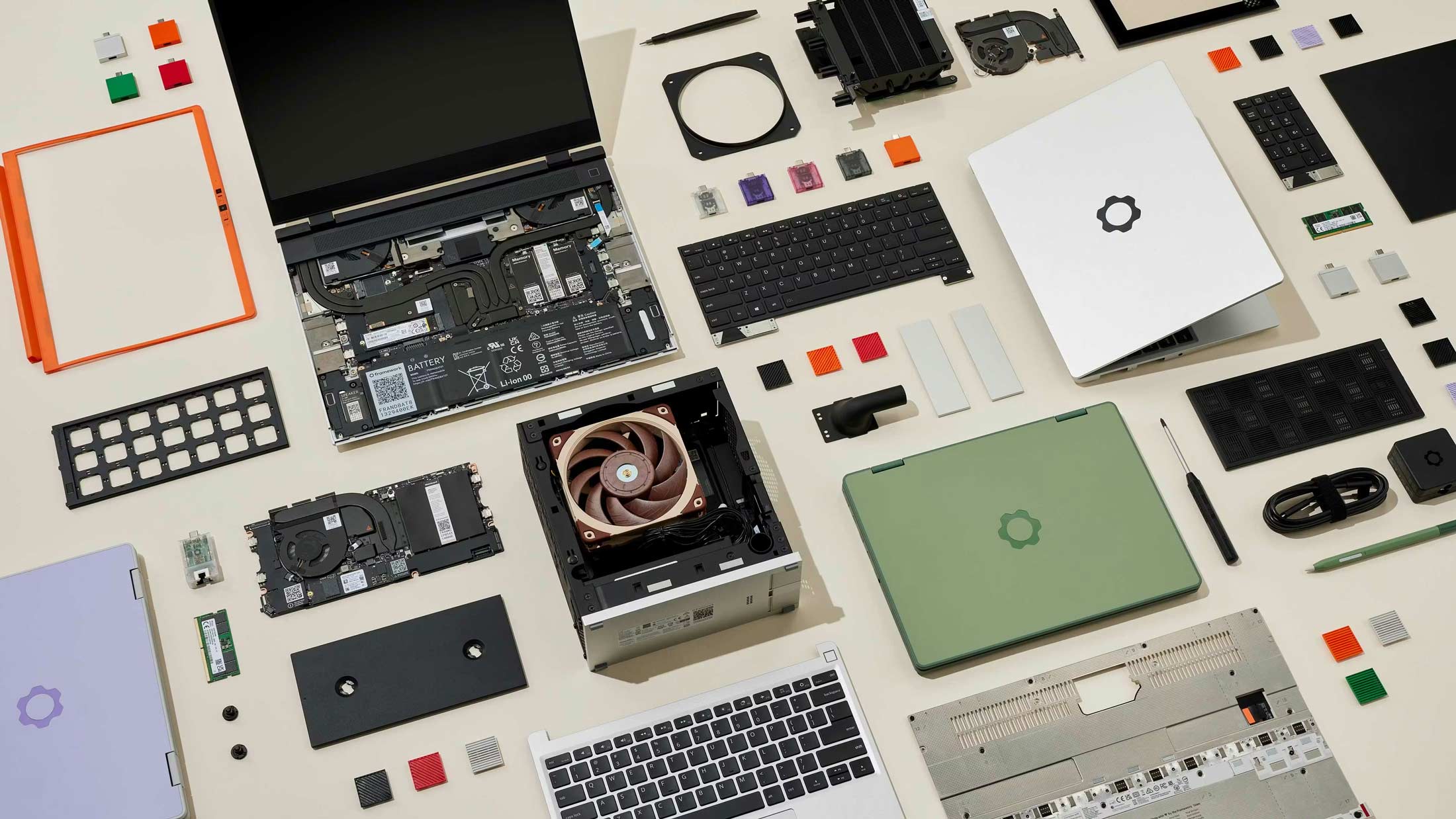
Here's where the pitch coheres. The new mainboard plugs directly into Framework Laptop 13 enclosures going back to the original 2021 model. Older boards also work in the new chassis after a BIOS update. The Expansion Card system remains intact, and Framework announced a 10-gigabit Ethernet module alongside the 13 Pro. A growing ecosystem of networking and storage modules ensures the laptop can evolve with your needs.
Framework has also published open-source CAD files, partial schematics, and embedded controller firmware on GitHub. The company's documentation includes pinouts for the battery, display, webcam, fingerprint reader, and touchpad connectors. Privacy hardware switches cut power to the webcam and microphones at the circuit level.
Linux First
For the first time, Framework is shipping pre-built machines with Ubuntu certified and installed. No Windows license tax if you don't want it. The company also seeded development hardware to Fedora, NixOS, CachyOS, Bazzite, and others. This Linux-forward stance isn't cosmetic. Framework CEO Nirav Patel described the internal design brief as building a "MacBook Pro for Linux users."
Pricing starts at $1,199 for the DIY Edition, which requires you to bring your own memory, storage, and OS. Pre-built configurations with Ubuntu or Windows begin at $1,499. First shipments are expected in June.
The broader right-to-repair movement has won legislative battles and pushed giants like Apple toward incremental concessions. Framework's approach is more direct: publish the files, ship the parts, and let owners decide what happens next. Whether that model scales remains an open question. For now, the 13 Pro is the strongest evidence that it can.