Google today announced Gemini Intelligence, a suite of AI features arriving on Android devices this summer. The rollout will begin on Samsung Galaxy and Google Pixel phones, with broader availability across watches, cars, and laptops later this year.
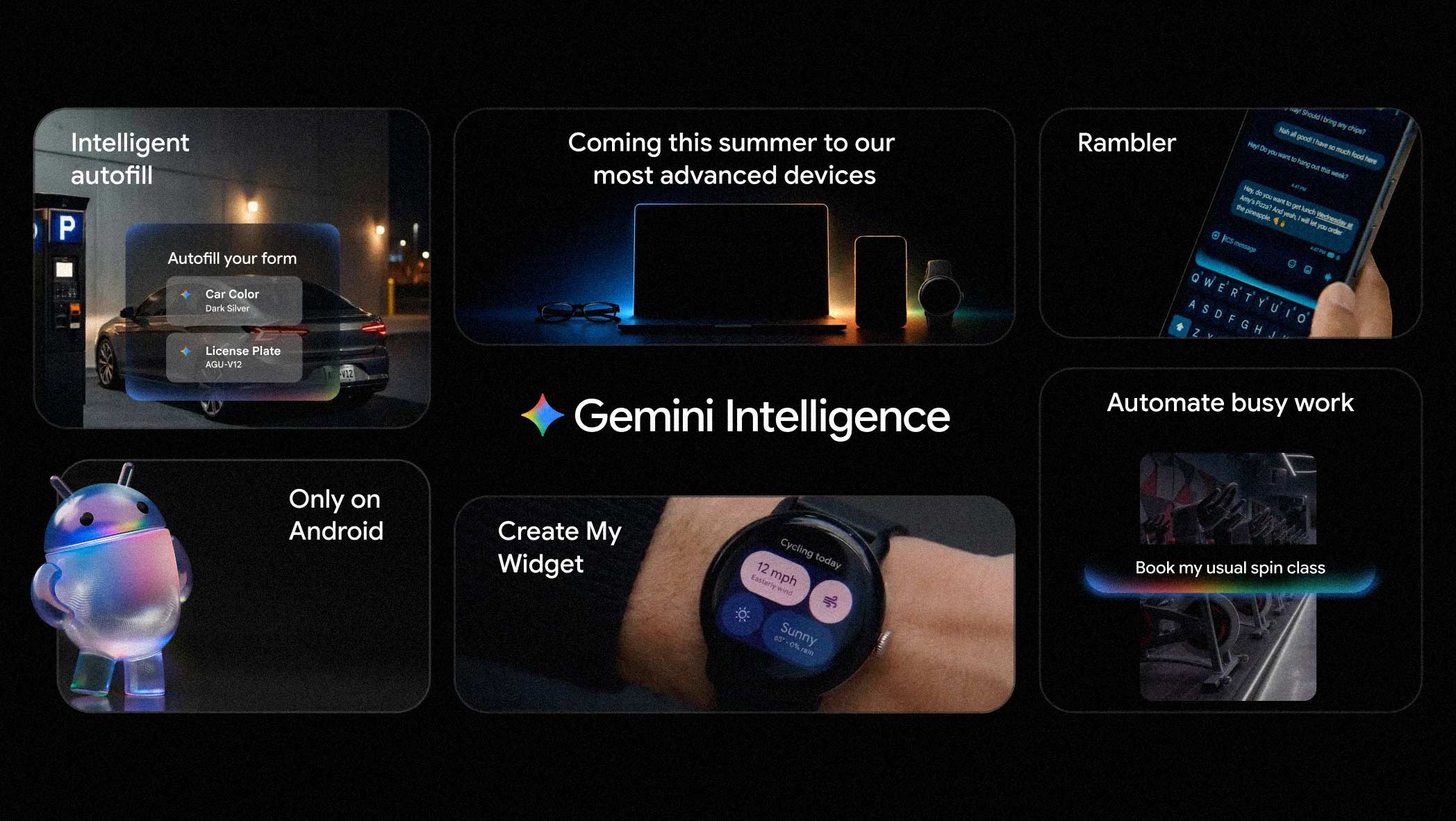
The pitch is straightforward: let Gemini handle the low-grade tasks that consume time without adding value. Google positions this as bringing "the best of Gemini to our most advanced devices," integrating hardware and software to work proactively throughout a user's day.
Autofill Gets Personal Intelligence
Autofill with Google is evolving beyond basic address and credit card fields. With Gemini's Personal Intelligence integration, Android devices will fill out complex forms across apps, including Chrome. Google describes it as tackling "a universal hassle: filling out complex forms on a mobile screen."
The feature pulls relevant information from connected apps to complete forms automatically. Think airline booking forms, DMV applications, or insurance paperwork. The connection is strictly opt-in, meaning users choose when to enable Gemini's access and can disable it in settings at any time.
Rambler: Voice Input That Understands How People Actually Speak
Gboard already converts speech to text, but Rambler addresses a different problem. As Google puts it, "the way we talk isn't always the way we want to write. We self correct, repeating ourselves or fill the gaps with 'ums,' 'ahs' and 'likes.'"
Rambler uses Gemini models to understand the core of what users want to communicate and filters out filler words, pauses, repetition, and self-corrections. The result is a concise message derived from natural speech. According to 9to5Google's coverage, Rambler also handles accents with improved accuracy, making voice dictation more reliable for users who previously struggled with transcription errors.
Google emphasizes that no audio data is stored. The feature processes speech locally and produces polished text without retaining the raw recording.
Generative UI: Create My Widget
Perhaps the most conceptually interesting addition is Create My Widget, which Google describes as "the first step in generative UI." Users describe what they want in natural language, and Gemini builds a custom widget.
The examples Google provides are practical: a meal prepper could request "Suggest three high-protein meal prep recipes every week," and the system generates a dashboard widget. A cyclist might create a weather widget showing only wind speed and precipitation. These widgets work across devices, appearing on phones and Wear OS watches.
This moves beyond the static app-provided widgets Android has offered for years. The widgets are described as "functional, intelligent tools backed by Gemini" that adapt to user needs rather than forcing users to adapt to developer templates.
Task Automation Expands
Gemini Intelligence also includes broader task automation capabilities. The system can navigate multi-step tasks across apps, handling logistics like reserving a gym class, building shopping carts from photos of grocery lists, or finding travel options from a brochure image.
Users track progress through notifications as Gemini works in the background. This follows the agentic AI trend that has dominated AI product development over the past year, shifting from chatbots that respond to prompts toward systems that execute tasks autonomously.
Availability
Gemini Intelligence features will roll out in waves starting this summer on the latest Samsung Galaxy and Google Pixel phones. Google says the features will expand to Android devices including watches, cars, glasses, and laptops later in 2026. The autofill and Rambler features are rolling out in Q2 2026, with generative widgets expected later in the year.
Whether these features deliver on Google's promises remains to be seen once they reach actual users. The company's track record with AI-powered productivity tools is mixed. But the direction is clear: Google wants Gemini embedded in every interaction layer of the Android experience.