Picture a whale on a beach. Massive, immense, breathing in the dry air that will kill it. The ocean is right there, close enough to see, but the animal cannot move itself back into the water. It will die unless something changes. Something external.
That whale is us. Humanity, stuck on a single fragile planet, burning through resources, arguing over borders while asteroids drift through the dark. The universe does not care. It has no obligation to let us continue. Entropy is the default. Extinction is the baseline.
What gets us unstuck? Technology. The tools we build. The machines that multiply our strength a thousandfold. The rockets that can, finally, push us off this beach and back into the cosmic ocean where we belong.
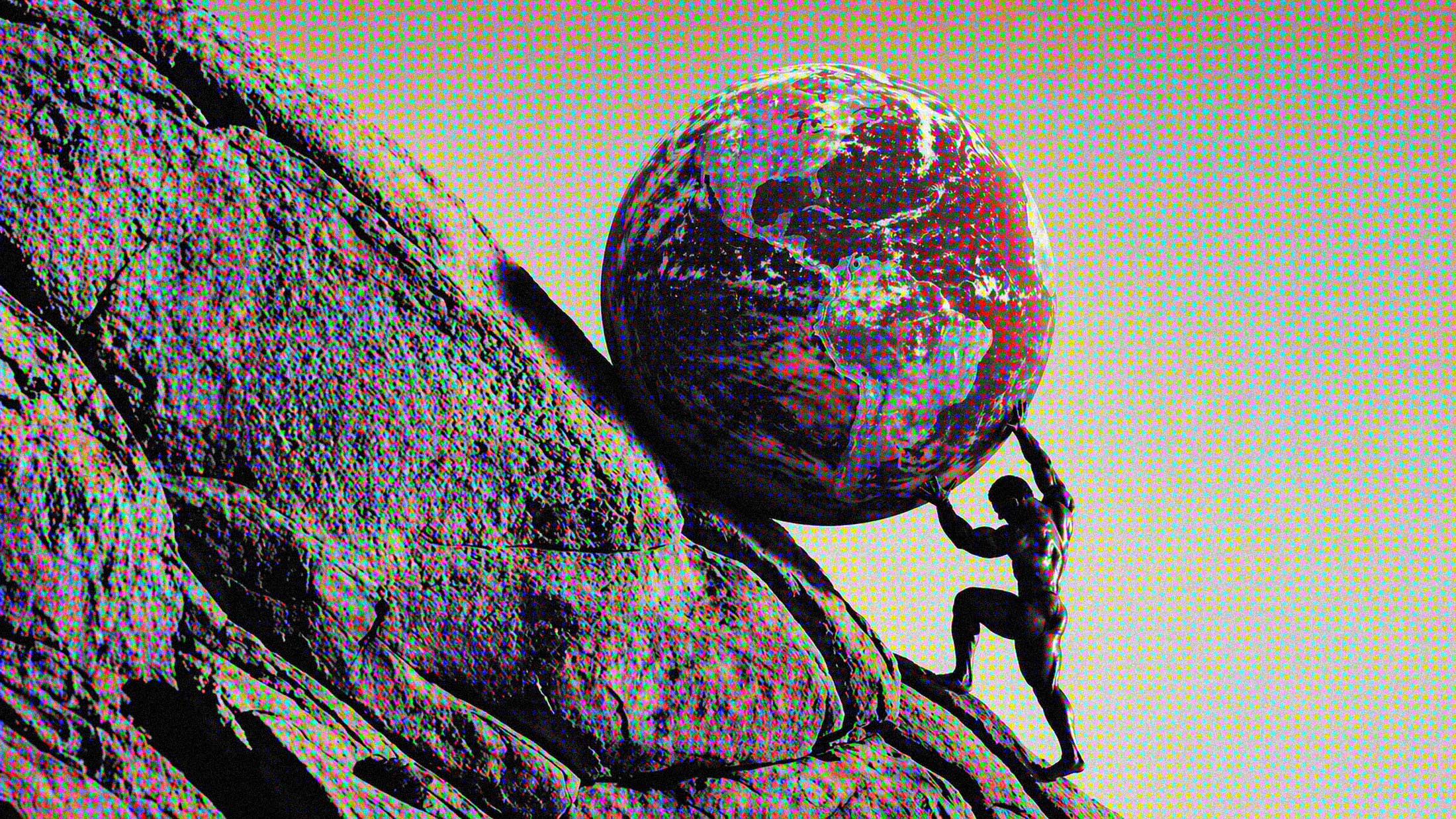
Sisyphus With a Different Boulder
In Greek mythology, Sisyphus was condemned to roll an immense boulder up a hill for eternity. Every time he neared the summit, the stone would slip and tumble back down, forcing him to begin again. The gods designed this punishment specifically to humble him, to make him experience repeated failures forever.
Albert Camus famously reimagined this myth. He argued that Sisyphus could find meaning in the struggle itself. The struggle toward the heights is enough to fill a man's heart, he wrote. One must imagine Sisyphus happy.
Elon Musk is a modern Sisyphus, but with a crucial difference. His boulder is not a stone. It is humanity itself. All eight billion of us, stuck on this beach, waiting to be pushed toward the stars.
And unlike the mythological figure, Musk appears to believe the summit is reachable.
SpaceX's board recently approved what compensation experts are calling the most unusual pay package in corporate history. Under this structure, Musk stands to receive 200 million super-voting shares if SpaceX reaches a $7.5 trillion valuation and establishes a permanent human colony on Mars with at least one million people. An additional 60.4 million shares would vest if the company operates space-based data centers providing 100 terawatts of computing capacity. The awards carry 10 votes per share, cementing his control over the company.
The measuring stick, as one executive pay expert put it, is whether something has been done in human history. These targets have not. That is the point.
Musk will receive nothing unless these milestones are met. No shares vest. No wealth accumulates. The structure is binary: push the boulder to the top, or own nothing beyond a nominal $54,080 annual salary.
The Caravel and the Starship
This impulse to push outward is not new. It predates capitalism, predates nation-states, predates the written record. But certain moments in history crystallize the pattern more clearly than others.
In the fifteenth century, Prince Henry the Navigator of Portugal assembled cartographers, mathematicians, and shipbuilders at Sagres on the southern tip of Portugal. He funded expedition after expedition down the African coast, losing ships and men to storms and disease, yet pressing forward. Under his direction, a new type of ship emerged: the caravel. Lighter and more maneuverable than the square-rigged vessels of the Mediterranean, the caravel could sail into the wind, making it largely independent of prevailing currents.
This was a technological breakthrough with civilizational consequences. Portuguese mariners rounded Cape Bojador in 1434, shattering medieval superstitions about a sea of darkness filled with monsters. By the time Henry died in 1460, his sailors had reached Sierra Leone. Within forty more years, Vasco da Gama would sail around Africa to India, and the global age would begin.
Spain followed suit. In 1494, the two Iberian powers signed the Treaty of Tordesillas, dividing the world between them along a line 370 leagues west of the Cape Verde Islands. Everything east went to Portugal. Everything west to Spain. Two small nations at the edge of Europe had decided to split the planet.
It sounds absurd now. But they did it. Within a generation, Cortés conquered the Aztecs, Pizarro toppled the Incas, and Portuguese trading posts stretched from Brazil to Japan. The technological edge provided by better ships, better navigation, and better weapons multiplied the power of a few thousand men into empire.
Henry the Navigator never sailed on a single expedition. He pushed from the shore, funding and directing, never boarding the ships himself. Sound familiar?
Capitalism as Catalyst
There is a tendency in certain circles to treat capitalism as a historical aberration, something to be transcended or abolished once we reach some higher stage of development. This misunderstands what capitalism actually is: a mechanism for channeling human ambition into coordinated action at scale.
The Spanish and Portuguese were not motivated purely by abstract curiosity. They wanted gold. They wanted spices. They wanted trade routes that would make their nations wealthy beyond imagination. The Treaty of Tordesillas was not a document about scientific exploration. It was a real estate deal covering half the planet.
Yet in pursuing those material goals, they opened the world. The profit motive pushed ships past Cape Bojador just as surely as scientific curiosity did. Probably more so.
The same dynamic operates today. SpaceX is not a charity. Musk is not funding Mars colonization out of pure altruism. The company is preparing for what could become the largest IPO in history, targeting a $1.75 trillion valuation and aiming to raise up to $75 billion. Starlink, the satellite internet constellation, has already crossed 10 million subscribers and generates over $10 billion in annual revenue. That recurring revenue funds the Starship program. Commercial success enables civilizational ambition.
Critics will point to the self-interest embedded in this structure. Of course Musk wants to be rich. Of course he wants control. But the incentives are aligned in a way that forces something genuinely new to happen. He cannot extract the wealth without building the colony. The payment requires the accomplishment.
This is how large-scale human projects actually get done. Not through committee deliberation or international consensus, but through individuals and organizations pursuing their own interests in ways that happen to drag the rest of us forward. The Portuguese crown funded Henry's expeditions because it wanted gold and to outflank Muslim trade routes. The American government funded Apollo because it wanted to beat the Soviets. The means matter less than the movement.
The Adversarial Universe
Here is the uncomfortable truth that underlies all of this: the universe is trying to kill us.
Not consciously. Not malevolently. But the second law of thermodynamics does not care about human flourishing. Entropy increases. Complexity decays. Stars burn out. Planets cool. Species go extinct. The long-run equilibrium of the cosmos is cold, dark, and empty.
Life itself is a rebellion against this tendency. Every organism that maintains its structure, reproduces, and adapts is pushing back against the universal drift toward disorder. We are temporary eddies in a current that flows inevitably toward heat death.
The dinosaurs did not survive the asteroid that struck 66 million years ago. They had no technology, no ability to predict the impact, no capacity to divert it or flee to another world. They were stuck on their beach, and the tide never came.
We are different. We have the intelligence to see the threat and the capability to do something about it. Not with certainty. Not easily. But the possibility exists. A species that spreads to multiple planets cannot be wiped out by a single asteroid, a single pandemic, a single nuclear exchange, or a single climatic shift. Redundancy is survival.
This is not metaphor. The risks are real and calculable. Asteroid strikes, supervolcanic eruptions, gamma-ray bursts, engineered pathogens, runaway artificial intelligence, nuclear war. The list is long. The probability of any single event in a given year is low. The probability over thousands of years approaches certainty.
We are the whale on the beach. The tide we need is technology at a scale we have not yet achieved.
The Push Continues
SpaceX's compensation structure represents something genuinely novel in corporate history: executive pay tied to science-fiction outcomes. Not revenue growth. Not earnings per share. Not market capitalization alone. Actual civilizational milestones.
One million people on Mars is not a financial metric. It is a statement about what a company believes is possible and worth pursuing. The same goes for 100 terawatts of orbital computing capacity. These are targets that exist outside the normal boundaries of business strategy.
Whether Musk achieves them is an open question. Whether SpaceX achieves them is an open question. The timelines are uncertain. The technical challenges are immense. The costs are staggering. Reasonable people can disagree about the probability of success.
But the attempt matters. The structure of incentives matters. The fact that one of the world's most valuable private companies is now explicitly organized around extraterrestrial colonization is historically significant regardless of the outcome.
Henry the Navigator died in debt, having invested more than he ever recovered. His expeditions did not find the gold they sought. But they found something more valuable: knowledge of the world beyond the known horizon. That knowledge enabled everything that followed.
Sisyphus pushed his boulder because the gods condemned him to do so. Musk pushes humanity because he believes the summit exists and can be reached. The struggle is the same. The motivation is different. And unlike the Greek myth, this story has not yet been written.
The whale is still on the beach. The tide is rising, slowly. The question is whether it rises fast enough.