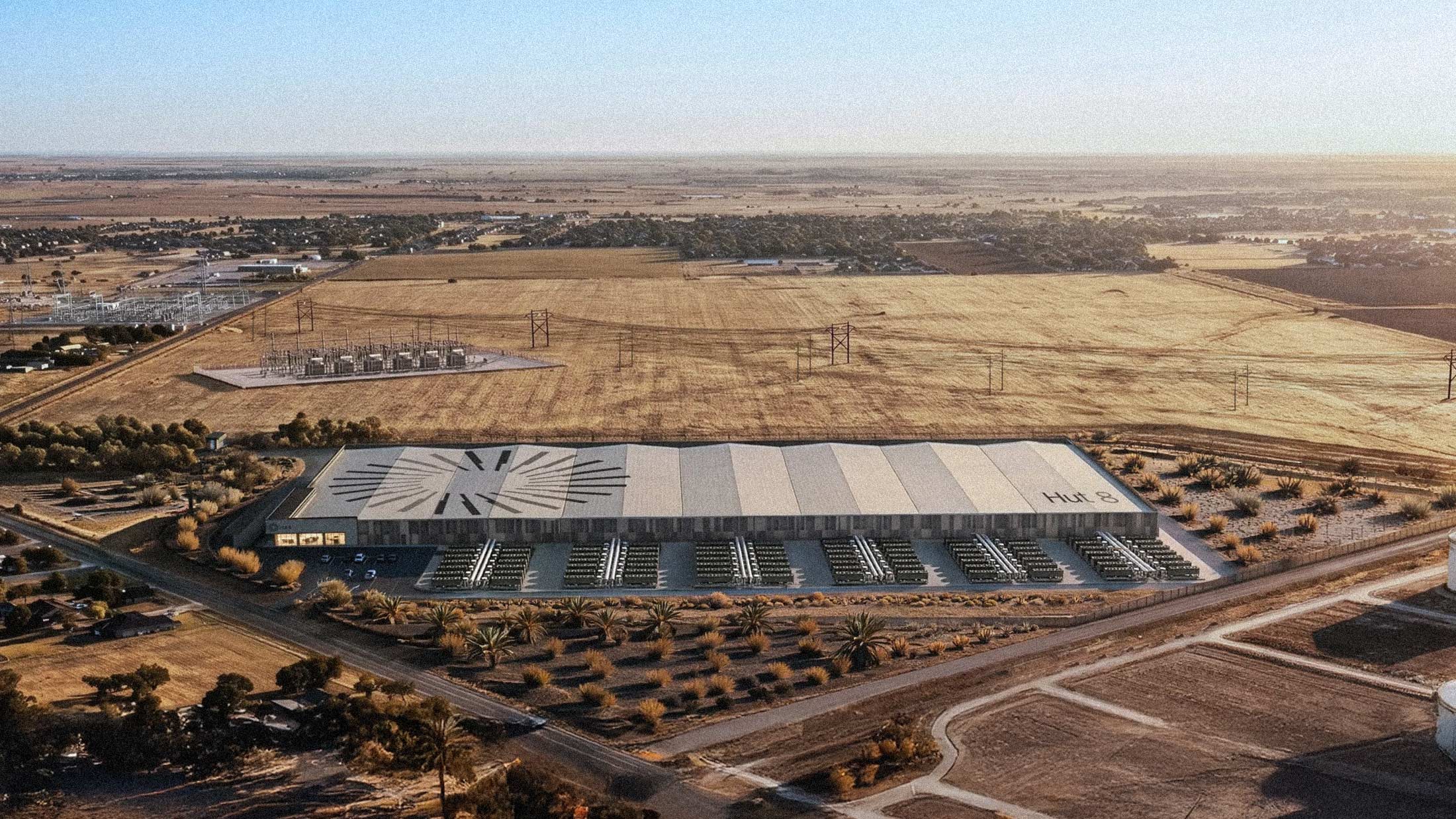
Hut 8 announced today the commercialization of the first phase of its Beacon Point data center campus in Nueces County, Texas, through a 15-year lease worth $9.8 billion for 352 megawatts of IT capacity. The tenant, an undisclosed company with a high investment-grade credit rating, will use the facility for AI training and inference workloads at hyperscale.
The deal includes three five-year renewal options that could push the total contract value to approximately $25.1 billion. There is a built-in 3% annual rent escalator. Hut 8 expects an average annual net operating income contribution of $655 million once the campus stabilizes.
The Power-First Model
Beacon Point is the second AI data center campus commercialized under Hut 8's greenfield development model, following River Bend in Louisiana. The company has secured an interconnection agreement for 1,000 MW of utility capacity at the site through AEP Texas, with initial energization expected in Q1 2027 and first data hall delivery in Q3 2027.
The facility will be designed to NVIDIA's DSX reference architecture for gigawatt-scale AI infrastructure. Hut 8 originally scoped the first data hall for 224 MW of IT capacity, but as NVIDIA's DSX architecture advanced toward commercial deployment with higher rack-level power densities, the company redesigned it to support 352 MW. That is a 57% increase within the same land and utility footprint.
The 352 MW lease requires approximately 500 MW of utility capacity and represents only the first phase at a campus built to support up to 1 GW. This leaves significant runway for expansion.
The transaction brings Hut 8's total contracted AI data center capacity to 597 MW with aggregate base-term contract value of approximately $16.8 billion and average annual NOI of around $1.1 billion. The company also closed a $3.25 billion offering of investment-grade senior secured notes to finance River Bend, marking the first single-sponsor data center project to access the investment-grade construction bond market.
Energy as the Bottleneck
The deal illustrates a broader shift in AI infrastructure. Power is now the defining constraint. According to NVIDIA, energy represents "the biggest bottleneck for AI infrastructure buildouts, with over $300 billion in equipment backlogs and more than 200 gigawatts of projects waiting in U.S. interconnection queues."
Gartner projects global data center electricity consumption will rise from 448 terawatt hours in 2025 to 980 TWh by 2030, with AI-optimized servers accounting for 44% of total data center power usage by decade's end, up from 21% in 2025. The IEA forecasts electricity consumption from accelerated servers will grow by 30% annually. U.S. data center capacity is expected to scale from roughly 24 GW in 2026 to 100 GW by 2030, according to Wood Mackenzie.
This dynamic is redefining site selection. What used to be a function of latency and fiber access is now a search for available megawatts. As one analyst put it, power availability has superseded all other factors like tax incentives and labor availability.
What Enables More Deals Like This
Several technology and policy developments could accelerate this model. First, NVIDIA's DSX reference architecture makes gigawatt-scale AI factories more repeatable by combining digital twins with standardized power, cooling, and controls architectures from partners like Vertiv, Siemens, and Jacobs. The approach compresses delivery schedules by up to 50% compared to traditional construction.
Second, the emergence of flexible AI factories that can adjust power consumption in response to grid conditions could unlock up to 100 gigawatts of capacity across the U.S. power system. This coordination helps projects secure larger and faster grid connections.
Third, new clean on-site power alternatives are emerging. Small modular reactors, battery energy storage systems, and even ocean wave power are being pursued as options to supplement or bypass grid constraints. Meta has signaled interest in space solar and 100-hour batteries to feed its own AI infrastructure.
Hut 8's model relies on identifying sites with favorable power characteristics before AI tenants materialize. CEO Asher Genoot noted that the company identified the Beacon Point site using a "power-first approach" and commercialized it through a hyperscale AI lease structured on triple-net, take-or-pay terms.
In the near term, natural gas will remain the dominant fuel source for data centers. But the players who can secure gigawatt-scale power agreements with reliable interconnection timelines will set the terms for the AI infrastructure buildout. Hut 8 is betting that being early to those sites is worth more than being close to existing network hubs.