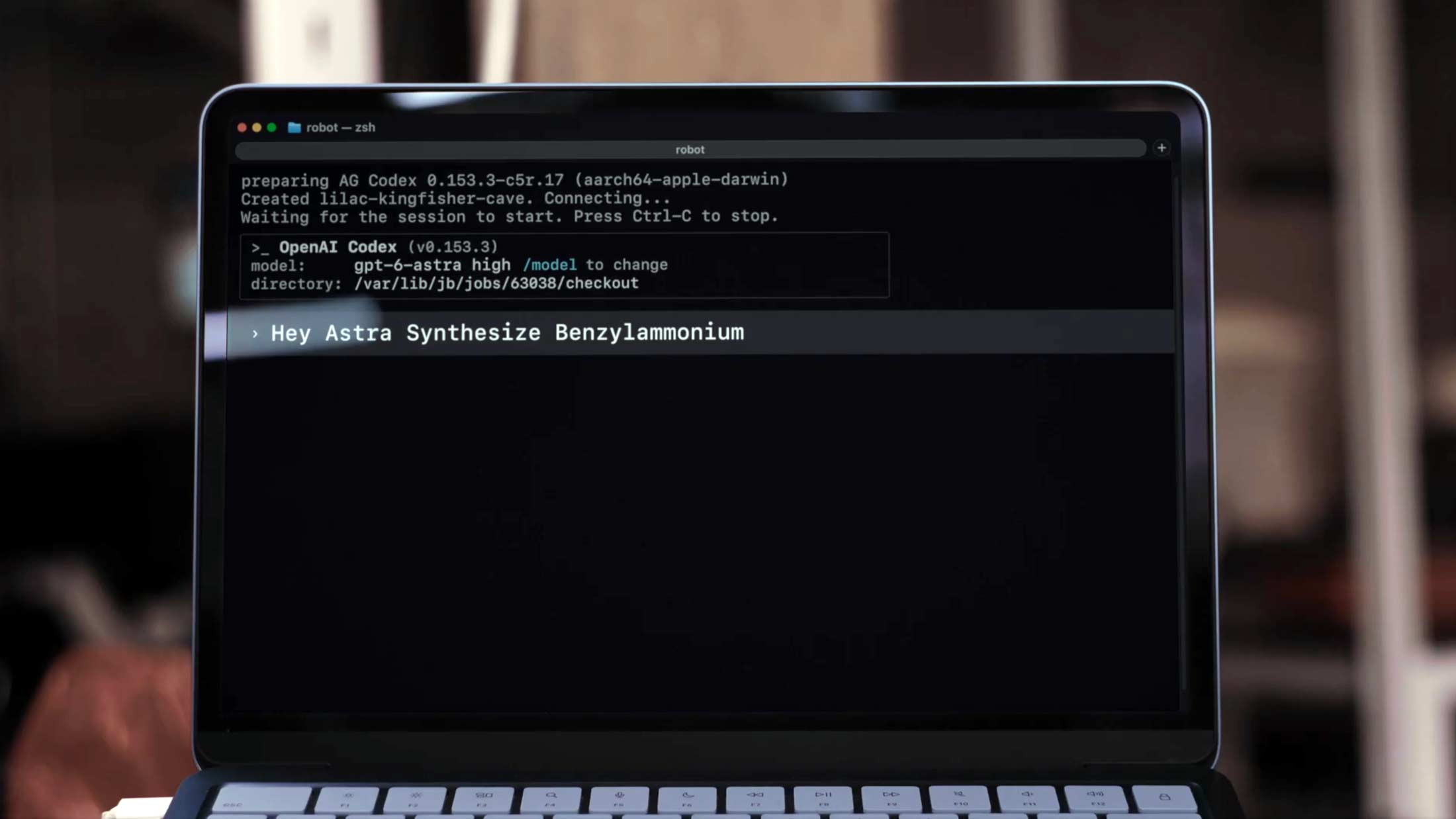
OpenAI announced GPT-5.5 on Thursday, codenamed "Spud," releasing its latest AI model that is better at coding, using computers and pursuing deeper research capabilities. The release continues OpenAI's rapid cadence of model updates. GPT-5.5 lands seven weeks after the release of GPT-5.4, which arrived on March 5.
OpenAI president Greg Brockman called the new model "a new class of intelligence" and "a big step towards more agentic and intuitive computing" during a press briefing. According to Brockman, GPT-5.5 is a "faster, sharper thinker for fewer tokens" compared to 5.4, and can handle multi-step workflows more autonomously with less user input.
Benchmarks and Performance
According to benchmarks provided by OpenAI, GPT-5.5 scored 82.7% on Terminal-Bench 2.0, which tests command-line workflows, compared to 75.1% for its predecessor GPT-5.4. On the Expert-SWE internal evaluation for coding tasks, the new model achieved 73.1% versus 68.5% for the previous version.
According to OpenAI's official blog, GPT-5.5 outperformed or tied with human workers on about 85 percent of GDPVal benchmarked tasks, compared to Anthropic's Opus 4.7's 80 percent and OpenAI's previous flagship model GPT-5.4's 83 percent. The model also demonstrates improved performance in scientific research applications, achieving 25.0% on GeneBench compared to GPT-5.4's 19.0%, and 80.5% on BixBench for bioinformatics analysis.
GPT-5.5 has retaken the crown for OpenAI, achieving the state-of-the-art across 14 benchmarks compared to 4 for Claude Opus 4.7 and 2 for Google Gemini 3.1 Pro. Though it should be noted that on SWE-Bench Pro, Opus 4.7 reached 64.3%, which is one area where Anthropic's model still has the upper hand.
What's New
OpenAI says the newest model "understands what you're trying to do faster" and can "carry more of the work itself" compared to earlier models. Specifically, GPT-5.5 is better at multi-part tasks that require multiple steps, like planning, using tools, and checking its work.
The improvements are targeted at what Brockman calls "intelligence-bottlenecked" work. Mark Chen, chief research officer at OpenAI, said that GPT-5.5 was better at navigating computer work than its predecessors, and also said that the model "shows meaningful gains on scientific and technical research workflows," noting that the company feels it could really "help expert scientists make progress."
Instead of step-by-step prompting, users can hand GPT-5.5 messy, multi-part tasks and let it plan, use tools, check its work and work toward a result. Enterprise testers appear to be taking notice. The Bank of New York's CIO Leigh-Ann Russell said the improvements are meaningful: "What we're actually seeing from 5.5, that I think is really important for a highly regulated institution, is the response quality—but also a really impressive hallucination resistance. A bank needs to have very high accuracy, so this becomes critical, and we are seeing a step change with this model."
Pricing and Availability
GPT-5.5 is rolling out to OpenAI's paid subscribers, including its Plus, Pro, Business and Enterprise users, in ChatGPT and Codex. GPT-5.5 includes both Thinking and Pro model variants. The model is deploying to Plus, Pro, Business, and Enterprise users in ChatGPT, while 5.5 Pro is headed to Pro, Business, and Enterprise users.
In the API, GPT-5.5 will cost $5 per 1 million input tokens and $30 per 1 million output tokens and will feature a 1 million token context window. GPT-5.5 Pro will cost $30 per million input tokens and $180 per million output tokens. The company said the model will come to its application programming interface "very soon," but that those deployments require "different safeguards."
Safety and Security
OpenAI emphasized that the model underwent extensive testing before release. "GPT-5.5 underwent extensive third-party safeguard testing and red teaming for cyber and bio [risks], and we've been iterating on our cyber safeguards for months with increasingly cyber capable models," Mia Glaese, OpenAI's vice president of research, said during the briefing.
OpenAI has classified GPT-5.5's cybersecurity capabilities as "High" under its preparedness framework, though the company says it did not reach the "Critical" level. This comes amid heightened scrutiny of AI capabilities in security contexts. The cybersecurity risks presented by AI have been top of mind for tech executives and government officials since Anthropic announced its Mythos model earlier this month. The company decided to limit Mythos' rollout because of its ability to identify weaknesses and security flaws within software.
The Bigger Picture
The release positions OpenAI against a field of increasingly capable competitors. Brockman said that the model was an additional step toward creating a "superapp" — a multi-purpose program that combines ChatGPT, Codex, and AI browser into one unified service that can aid enterprise customers.
OpenAI also shared updated platform metrics: there are 4 million active Codex users and 9 million paying business users on ChatGPT. ChatGPT also has more than 900 million weekly active users and over 50 million subscribers.
The pace of iteration shows no signs of slowing. The company has continued to churn out new models at a crisp pace, a trend that company staff said should be expected to continue for the foreseeable future. "We see pretty significant improvements in the short term, extremely significant improvements in the medium term," said Jakub Pachocki, OpenAI's chief scientist.