Germany's Proxima Fusion has published what it claims is the world's first integrated concept for a commercial stellarator-based fusion power plant. The design, called Stellaris, appeared in the peer-reviewed journal Fusion Engineering and Design and represents a deliberate departure from the tokamak approach that has dominated fusion research for decades.
Stellarators use twisted magnetic fields generated by external coils to confine superhot plasma, eliminating the need for the large internal plasma current that tokamaks require. That current is the source of most tokamak instabilities. Without it, stellarators can theoretically run continuously rather than in pulses. The catch has always been complexity: stellarator coils are geometrically nightmarish to design and build.
Building on Wendelstein 7-X
Proxima's design builds directly on the Wendelstein 7-X research stellarator at the Max Planck Institute for Plasma Physics in Greifswald. W7-X, completed in 2015, is the most advanced quasi-isodynamic stellarator in the world and the product of over €1.3 billion in German and EU funding. In May 2025, the machine achieved a world record for the triple product in long plasma discharges, sustaining the key fusion parameter for 43 seconds at temperatures exceeding 20 million degrees Celsius, with peaks reaching 30 million degrees. The energy turnover increased to 1.8 gigajoules over six minutes.
Proxima spun out of the Max Planck Institute in 2023 as its first commercial offshoot. The founding team includes six former IPP scientists, and the company has since recruited engineers from SpaceX, Tesla, McLaren Formula 1, and Google.
The Stellaris Design
Stellaris is designed to produce significantly more power per unit volume than any previous stellarator concept. The key enabler is high-temperature superconducting magnet technology, which allows for much stronger magnetic fields and therefore a smaller reactor. Since fusion power scales with the fourth power of the magnetic field, this compactness matters enormously for construction speed and cost.
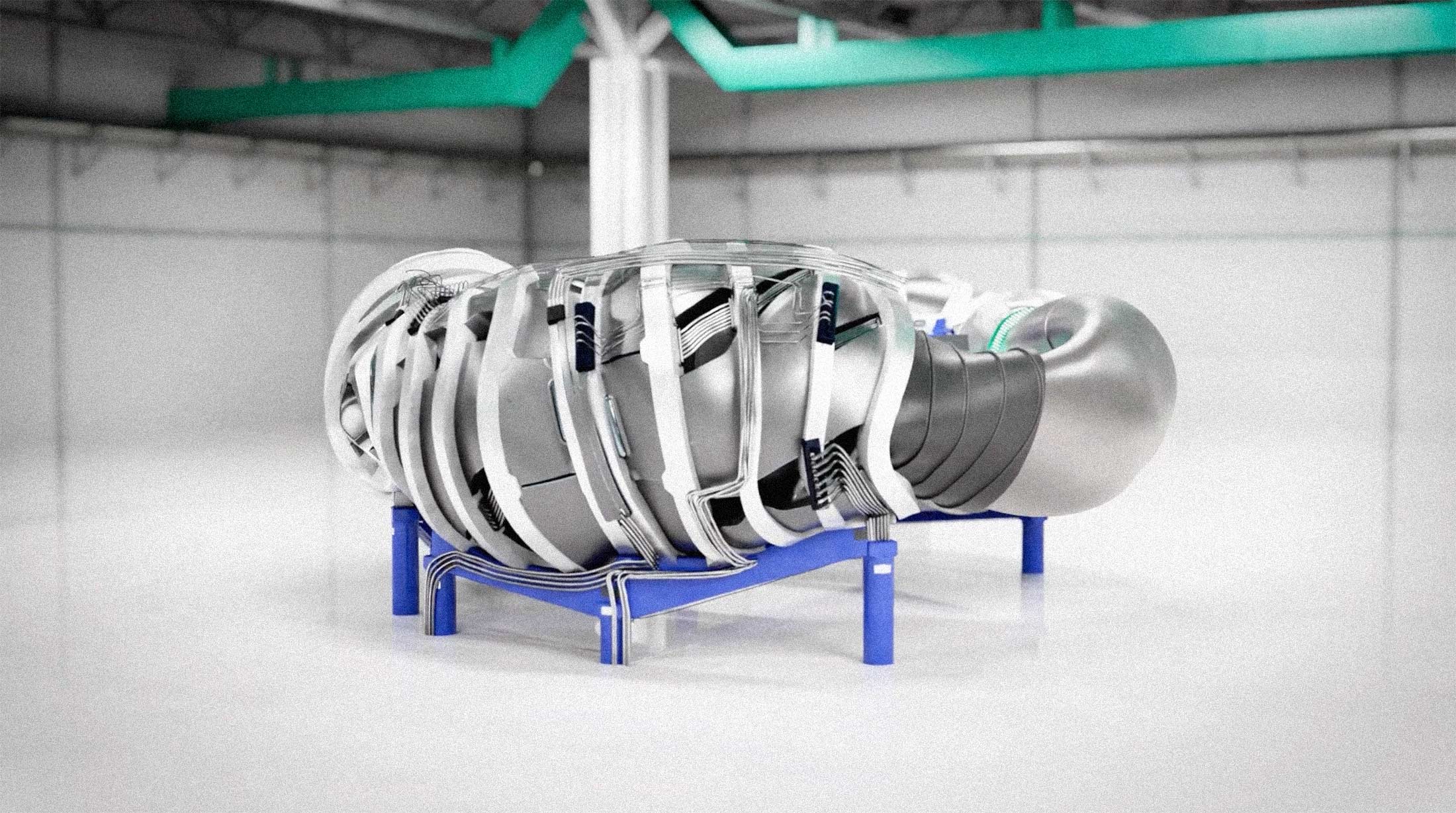
The company says Stellaris is the first quasi-isodynamic stellarator design to integrate electromagnetic, structural, thermal, and neutronics simulations in a single coherent framework. It includes a neutron blanket concept adapted to the complex stellarator geometry, support structures designed to handle full-power operational forces, and a heat exhaust system based on the island divertor concept already demonstrated on W7-X.
Francesco Sciortino, Proxima's co-founder and CEO, described Stellaris as "the first peer-reviewed concept for a fusion power plant that is designed to operate reliably and continuously, without the instabilities and disruptions seen in tokamaks."
The Path to Commercial Power
Proxima has laid out an aggressive timeline. In 2027, the company plans to complete a Stellarator Model Coil demonstration to validate HTS technology for stellarators. A demonstration reactor called Alpha is targeted for the early 2030s, with the goal of becoming the first stellarator to demonstrate net energy gain. Alpha will be built near the Max Planck Institute in Garching at an estimated cost of €2 billion.
The commercial Stellaris plant would follow later in the decade at the former Gundremmingen nuclear power plant site in Bavaria, which is currently being decommissioned by RWE. In March 2026, Proxima signed a memorandum of understanding with the Free State of Bavaria, RWE, and IPP to advance the project. Bavaria's minister-president committed up to €400 million through the state's High-Tech Agenda, and the partners are pursuing federal funding under Germany's €2 billion Fusion Action Plan.
Proxima raised a €130 million Series A in June 2025, reportedly the largest private fusion investment in European history. The company plans to finance about 20% of total project costs through private international investors.
Whether stellarators can actually beat tokamaks to commercial relevance remains an open question. ITER, the massive tokamak under construction in France, won't begin deuterium-tritium fusion experiments until the 2030s at the earliest and has been plagued by delays and cost overruns. Proxima's bet is that the stellarator's inherent stability advantages and continuous operation capability will ultimately prove more practical for grid-scale power generation. The company has competition from Tennessee-based Type One Energy, which published its own stellarator design in early 2025.
The physics argument for stellarators has strengthened considerably. Wendelstein 7-X has now demonstrated that optimized stellarator designs can achieve confinement quality comparable to tokamaks for long plasma durations. The engineering challenge remains formidable, but the energy sector's appetite for non-intermittent clean power sources continues to grow.