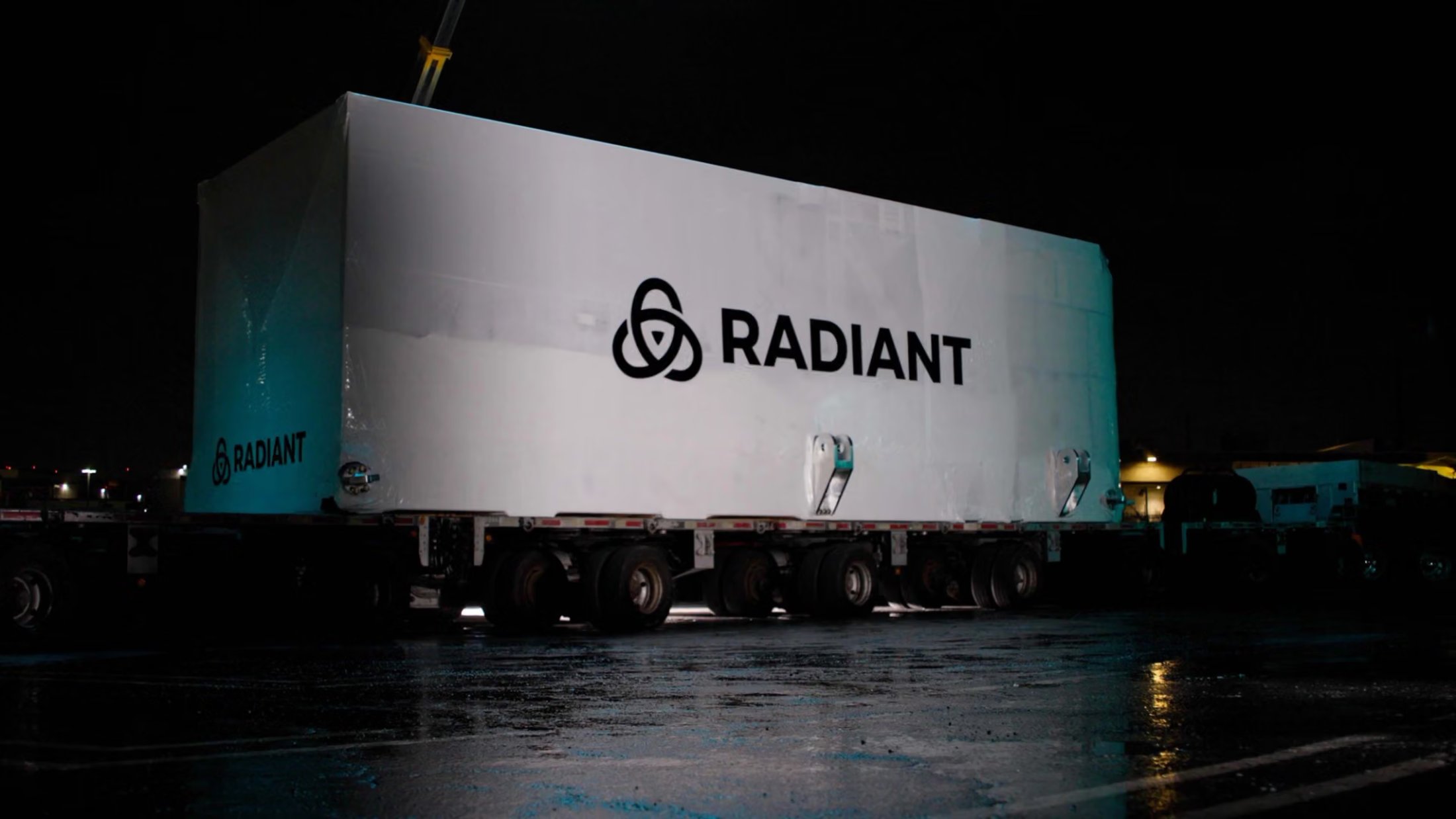
On October 29, Radiant Industries announced the Department of Energy had approved its Documented Safety Analysis for the Kaleidos microreactor, a regulatory milestone the company describes as a first for the microreactor industry. The DSA covers operation at power, not merely the zero-power criticality tests that other entrants in DOE's pilot program have completed.
"This approval for full power demonstration is a first within the microreactor industry," said Dr. Rita Baranwal, Radiant's Chief Nuclear Officer. "We are testing the design of our commercial reactor, the same unit — from fueling through 150 hours of continuous operation without operator assistance and beyond."
What Comes Next
With the DSA approved, Radiant moves to the DOE's Readiness Review, which will assess whether the reactor and the team responsible for operating it are prepared to begin nuclear operations. Assuming that clears, the company will fuel Kaleidos and begin a five-phase test campaign at Idaho National Laboratory's DOME facility.
The campaign is designed to accumulate 60 effective full-power days over several months, culminating in at least 150 hours of continuous full-power operation without operator intervention. Radiant shipped the reactor from its El Segundo, California facility to INL in August. Standard Nuclear delivered TRISO fuel to the site in July.
The 1-megawatt electric generator also provides 1.9 megawatts of thermal power for facility heating or desalination. The company says the reactor arrives at a customer site as a sealed, fueled unit that can be plugged in immediately.
Military Contracts Stack Up
In August, Radiant won a binding agreement totaling up to $750 million from the U.S. Army, in partnership with the Defense Innovation Unit, to develop and deploy 15 Kaleidos units through the Janus program. The company has described the award as one of the largest contracts DIU has ever issued. Planned deployments include Fort Benning and Buckley Space Force Base.
The DOE previously selected Radiant for two allocations of high-assay low-enriched uranium, the fuel grade required for compact advanced reactors. A long-term agreement with Standard Nuclear covers TRISO fuel fabrication through the early 2030s.
Radiant closed a $300 million Series D led by Draper Associates and Boost VC in December 2025, valuing the company at $1.8 billion. The round brought total funding past $500 million. Unlike NuScale Power and Oklo, the two most prominent publicly traded small modular reactor developers, Radiant remains private.
Public Markets Tell a Different Story
The timing is awkward for nuclear-sector investors. NuScale and Oklo have each lost roughly 60 percent of their value year-to-date, battered less by reactor setbacks than by rising Treasury yields and investor unease over long timelines to revenue. On October 20, Barclays downgraded NuScale to Underweight and cut its price target, sending shares to a new 52-week low. Oklo touched its own 52-week low the same week.
Both companies have hit regulatory milestones. Oklo's Groves test reactor reached first criticality in August, and the company was selected for DOE's Nuclear Energy Launch Pad program in October. Neither news item arrested the slide, which analysts attribute to macroeconomic pressure on pre-revenue companies rather than deteriorating fundamentals.
Radiant's approval sharpens that split. The most significant microreactor milestone of the year belongs to a company public investors cannot buy.