Researchers have demonstrated a new type of LiDAR that does two things conventional sensors cannot do at once: map three-dimensional space and identify what objects are made of, all within microseconds. The system, described in a recent arXiv preprint, combines ghost imaging techniques with hyperspectral sensing to create what amounts to a real-world tricorder for industrial and autonomous applications.
How It Works
Traditional LiDAR excels at measuring distance and building 3D point clouds but cannot determine material composition. Hyperspectral imagers, meanwhile, can identify chemicals by their spectral signatures but struggle with speed. Merging the two has historically required either wavelength-scanning or spectrometer-based detection that throttles performance.
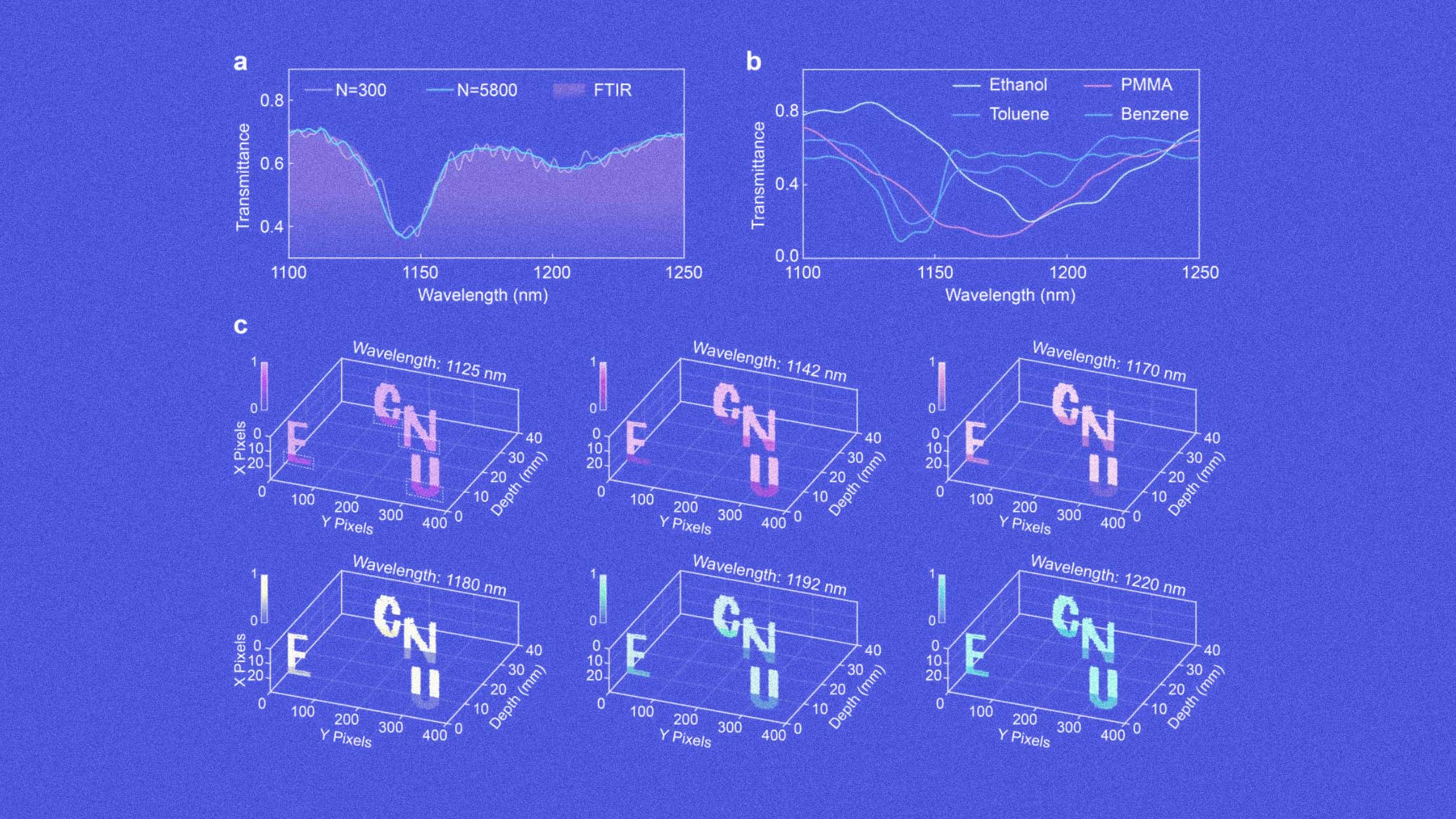
The new approach sidesteps these limitations by using a stochastic broadband laser paired with single-pixel detection. By integrating spatiotemporal encoding with spectral ghost imaging in a time-of-flight framework, the system achieves pulse-resolved recovery of both spatial and spectral information simultaneously.
The performance numbers are striking. The researchers report a line-scanning rate of 60.5 MHz, translating to a point rate of 1.8 GHz and ranging precision of 0.02 millimeters within a 10-microsecond integration window. Each voxel carries a full spectrum at 1.4 nanometer resolution across the 1100-1250 nanometer band. That spectral data enables chemical identification on the fly.
Ghost Imaging's Unlikely Journey
Ghost imaging itself has an unusual history. The technique produces images by correlating information from two detectors: a conventional multi-pixel sensor that never sees the object and a single-pixel bucket detector that does. First demonstrated in 1995 using quantum-entangled photons, the approach has since been validated with classical light sources and computational methods.
The U.S. Army Research Laboratory helped pioneer remote ghost imaging applications starting in 2007, aiming to deploy the technology across ground systems, satellites, and unmanned aerial vehicles. Researchers there received a patent in 2013 for what they called quantum imaging technology.
What makes ghost imaging attractive for this application is that it allows high-resolution images to be formed from far fewer measurements than the Nyquist limit would normally require. Combined with compressive sensing algorithms, researchers have previously demonstrated 3D ghost imaging LiDAR capable of reconstructing scenes at 1.0 kilometer range. The new hyperspectral variant adds chemical identification to that spatial mapping.
Consumer and Industrial Implications
The immediate applications are industrial. LiDAR already forms the backbone of autonomous vehicle perception, with companies like Valeo mass-producing automotive systems and firms like Aeva partnering with Nikon to bring micron-level accuracy to metrology and manufacturing. Adding material identification to existing spatial sensing could transform quality control, enabling production lines to verify chemical composition without stopping to sample.
For autonomous vehicles, knowing whether a road obstacle is metal, plastic, or organic matter could meaningfully change collision avoidance calculations. Current sensor fusion approaches combine cameras, radar, and LiDAR to approximate object classification, but none of these directly measure material properties.
The technology also has obvious relevance to robotics, where understanding material composition could improve grasping decisions and environmental interaction. A robot that knows it's reaching for glass rather than plastic can adjust grip force accordingly.
The Path to Miniaturization
Getting this into consumer devices is another matter. Hyperspectral sensing has been creeping toward smartphones for years. Researchers have demonstrated low-cost smartphone-based hyperspectral systems using 3D-printed attachments for around £100, capable of capturing visible wavelength spectral data for applications like food authentication and skin analysis. Companies have predicted that spectral cameras could become mainstream in phones by 2026.
The new ghost imaging LiDAR operates in the near-infrared band, which has advantages for safety and atmospheric transmission but presents different integration challenges than visible-light smartphone cameras. The spectral range of 1100-1250 nm is useful for chemical identification but requires specialized detectors.
Still, the trajectory is clear. LiDAR has already shrunk from rooftop-mounted spinning drums to solid-state chips that fit behind a car's grille. Hyperspectral sensors have followed a similar miniaturization curve. The new research suggests these two paths may eventually converge in a single compact sensor.
What Comes Next
The researchers achieved their results in a laboratory setting. Translating that to ruggedized hardware that can survive automotive or industrial environments will take additional engineering. The single-pixel detection approach, while elegant, requires computational reconstruction that adds latency even if the raw data acquisition is fast.
For now, the demonstration proves the physics work. A sensor that maps space and identifies chemistry simultaneously, at gigahertz point rates, represents a genuine advancement over current perception technology. Whether it reaches factory floors or consumer devices first will depend on which industry finds the value proposition most compelling.