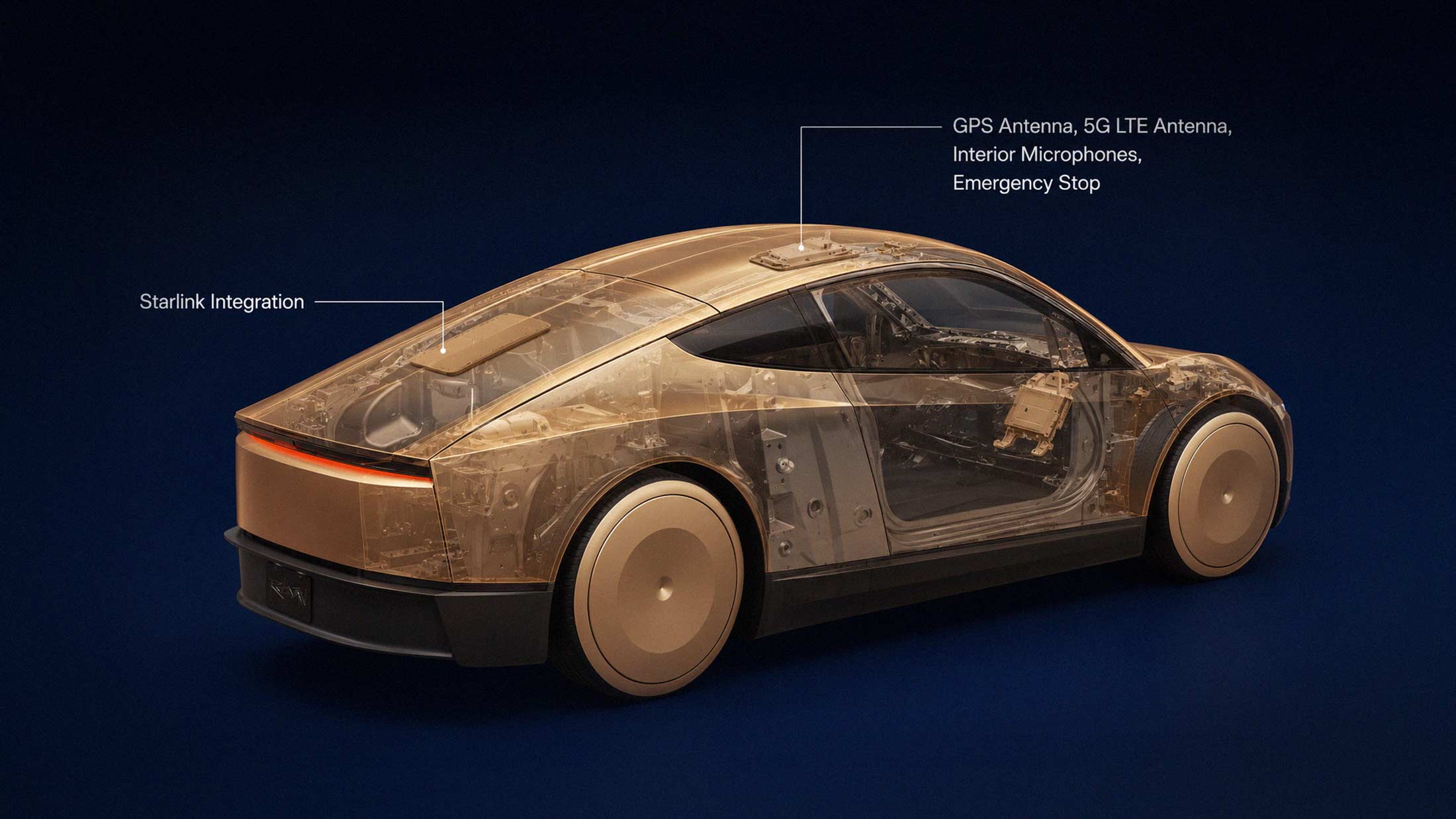
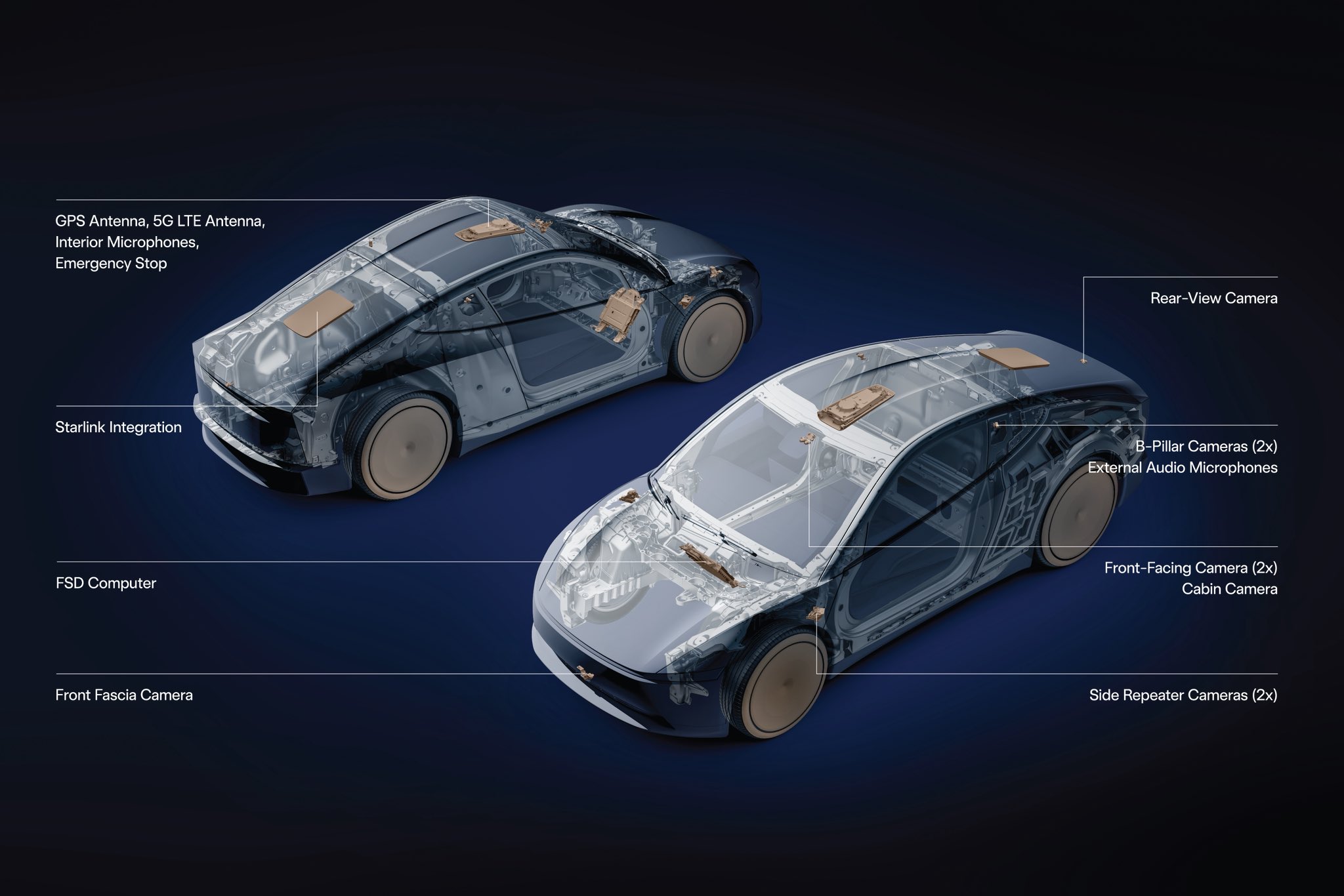
Tesla has officially confirmed that its Cybercab robotaxi will ship with Starlink V5 satellite connectivity baked directly into the vehicle. The announcement, revealed through showroom infographics at the company's renovated Santana Row location in California, ends months of speculation about prototype units that had been spotted with Starlink Mini antennas bolted to their rear liftgates.
Elon Musk framed the integration around passenger entertainment: "Watch 4K streaming video while Cybercab takes you anywhere you want," he posted on X. The pitch positions Tesla's driverless two-seater as something fundamentally different from existing ride-hailing options. While Uber and Lyft passengers depend on their own data plans, a Cybercab passenger would tap directly into SpaceX's low-Earth orbit network for onboard Wi-Fi.
Watch 4K streaming video while Cybercab takes you anywhere you want https://t.co/xVBVWkk5fX
— Elon Musk (@elonmusk) July 21, 2026
What Starlink V5 Actually Delivers
SpaceX unveiled Starlink V5 just last week. The new terminal offers peak download speeds of up to 375+ Mbps while using roughly half the power of its predecessor. That efficiency gain matters for an electric vehicle. The V5 draws between 35 and 50 watts, compared to 75 to 100 watts for the V4. For a robotaxi fleet running trips continuously, lower power consumption per terminal translates to more miles of range per charge.
According to Tesla's published diagram, the V5 terminal sits alongside GPS antennas and 5G LTE hardware in the Cybercab's roof structure. The compact design fits production form factors without the external mounting that appeared on test prototypes. Production units rolling off the line at Gigafactory Texas are built without steering wheels or pedals, and the 21-inch center screen becomes the only interface passengers interact with during their ride.
The Timing Question
Here's the tension: Starlink's advantage shows up in rural areas and cellular dead zones. Tesla's unsupervised robotaxi service currently operates in small geofenced zones in Austin, Houston, Dallas, and a limited area in Miami. These are dense metros with strong cellular coverage. Satellite's real value kicks in where terrestrial networks thin out. That is not where the Cybercab is driving today.
This is where Electrek's analysis cuts through the marketing. As the outlet noted, a robotaxi that loses cellular connectivity in a dead zone creates a legitimate operational problem. Satellite fallback could prevent fleet vehicles from going dark. That redundancy is real. But Tesla is running a handful of cars in well-covered cities. The company has not yet scaled to the point where this connectivity problem actually matters.
There is also a simpler read. Bolting a Starlink terminal into every Cybercab creates a recurring subscription line for SpaceX, paid for by Tesla's fleet. Musk's companies have a documented history of routing capital and business between each other, and this integration fits that pattern.
What Comes Next
Volume production of the Cybercab began at Gigafactory Texas in April 2026, with over 500 units reportedly active in testing as of this month. The vehicle is expected to be priced under $30,000 for private buyers, with mass consumer sales projected for 2027. Tesla has not disclosed whether Starlink connectivity will be bundled as standard equipment or offered as an optional subscription tier.
The technical integration appears solid. Embedding satellite connectivity into a purpose-built robotaxi solves a real problem for fleet operators worried about edge cases. Whether passengers actually need to stream 4K video during a ten-minute ride across Austin is a different question. But Musk has long understood that consumer-facing features sell the vision, even when the engineering rationale points elsewhere.
For now, the Starlink-equipped Cybercab remains a symbol of an autonomous future that still depends on regulatory approvals and software validation. The hardware is increasingly ready. The business model is still being assembled.