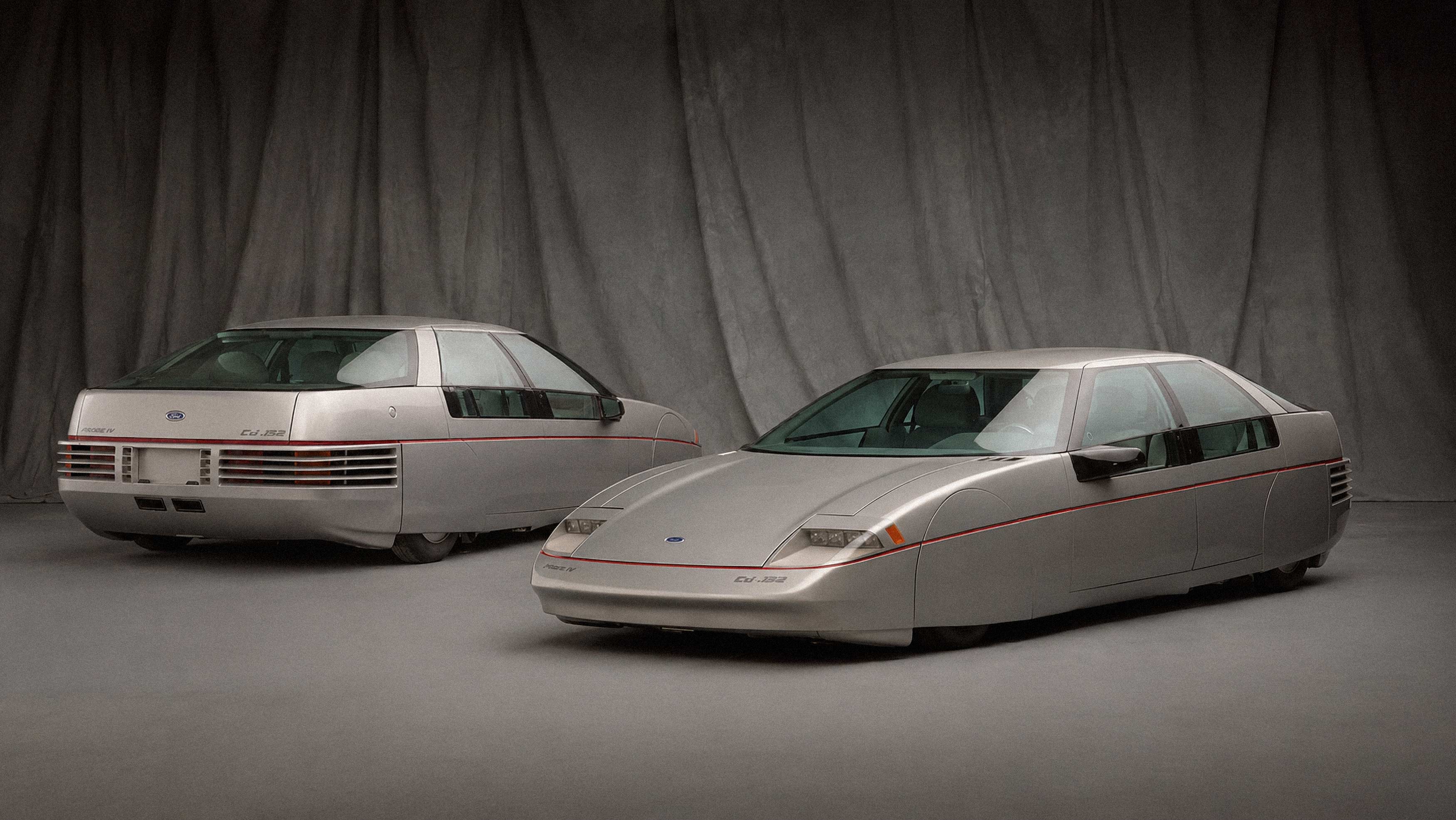
In January 1983, Ford design executive Don Kopka stood on the floor of the Detroit Auto Show and unveiled something that looked less like a car and more like a prophecy. The Ford Probe IV was a silver teardrop stretched over four doors, built by Ghia in Turin and engineered to slip through the air with almost no resistance at all. Its drag coefficient of 0.152 matched that of an F-16 fighter jet. Today's most aerodynamic EVs struggle to get below 0.20.
A car built for the wind tunnel
The Probe IV was the fourth in a series of aerodynamic research concepts Ford had been developing since 1979, in the wake of two oil crises that had exposed how badly Detroit's fleet guzzled fuel. The project aimed to see how far aerodynamics could push fuel economy before the compromises became unacceptable.
The answer, at least for the Probe IV, was far. The radiator and air conditioning hardware sat in the rear luggage compartment to eliminate the drag created by a traditional front grille. Special Goodyear tires with an aerodynamic tread pattern were developed exclusively for the concept. The wheels wore shrouds that flexed with membrane-like material so the front tires could still steer. Flush windows, concealed wipers, covered headlights. Even the emblems sat flush to the body. At highway speeds, the car's automatic attitude-control system dropped the nose by four inches while lifting the rear by six, presenting the optimal angle of attack to the oncoming air.
Under the hood sat a turbocharged 1.6-liter four-cylinder tilted 70 degrees to fit beneath the aggressively low hoodline, producing around 122 horsepower. Not a lot by modern standards, but paired with a body this slippery, it was enough. The occupants reclined in velour sling-style seats that shaved an inch and a half off roof height, staring at instruments through a transparent steering wheel.
The tech that trickled down
The Probe IV never became a production vehicle. Ford built two units, both essentially rolling sculptures with fiberglass bodies over wood frames and steel subframes. One of them recently surfaced on Facebook Marketplace in Texas after being presumed lost for years. It had no powertrain. It had missing wheel covers. The roof sagged where it met the rear glass. Still, it was the real thing, and someone will eventually give it a new home.
What did go into production were the Probe IV's ideas. The concept was a test balloon for aerodynamic thinking that ultimately landed in the Ford Sierra and, more importantly, the 1986 Ford Taurus. That car arrived with its "jelly bean" shape, flush composite headlights, a grille-less nose, and a commitment to form following function. The Taurus was credited with saving Ford from bankruptcy and triggering an aerodynamic design revolution across American automakers. The styling cues and engineering lessons Ford had validated in the Probe series became the foundation for the company's most important sedan in half a century.
Concept cars as appetite tests
This is the particular function that concept cars serve in the technology sector and in automotive design specifically. They are not prototypes in the traditional sense. Most are barely functional. Many cannot safely exceed 10 miles per hour. But they answer a question that focus groups and surveys cannot: will people look at something this strange and feel drawn to it rather than repelled by it?
Concept cars gauge customer reaction to radical designs that might never otherwise exist. General Motors designer Harley Earl, who created the Buick Y-Job in 1938, is credited with inventing the format. Since then, concepts have served as "development accelerators," as one DS design director put it. They are experimental playgrounds where designers and engineers push boundaries without production constraints, marketing exercises that build brand identity, and early proofs-of-concept that test whether the public has appetite for novel aesthetics.
The Probe IV proved that extreme aerodynamics could exist in a five-door package that seated four adults. It proved that a car could look like a visitor from another decade and still evoke genuine desire. It warmed up the marketplace. Ford then built the Taurus knowing it could take risks and survive.
Concept cars occupy a strange role in industrial history. They often never drive anywhere useful. They end up in museums or on collector lots or, in the case of the Probe I, destroyed in a trailer fire on the way to a show. But their residue is everywhere, in the production cars that absorbed their lessons, in the technologies that matured from their experiments. The Probe IV is a reminder that progress often starts as a thing too weird to build.