President Donald Trump signed a National Security Presidential Memorandum on Thursday that replaces the nation's National Space Transportation Policy for the first time since 2013. The goal is nothing short of transformation: enable more than 1,000 launches and reentries on American soil every year by 2030. That figure represents roughly a fivefold increase from 2025's total of 178.
The memorandum directs federal agencies to expedite permitting and environmental reviews, develop transparent cost recovery policies for shared infrastructure, publish range schedules to maximize allocation of launch resources, and co-develop transportation systems with private industry. NASA Administrator Jared Isaacman has been instructed to build a lunar logistics architecture that supports commercial transportation to and from the Moon's surface, while also exploring commercial avenues for sending humans to Mars.
White House Office of Science and Technology Policy Director Michael Kratsios framed the approach as "commercial-first," pairing launch targets with goals of returning astronauts to the Moon by 2028 and establishing initial lunar base elements by 2030. The administration also stated that government agencies should avoid competing with private launch providers unless national security or public safety demands it.
Startups See Their Window
For early-stage companies working on lunar infrastructure, the timing could not be more favorable. GRU Space, a Y Combinator-backed startup founded in 2025 by UC Berkeley graduate Skyler Chan, is racing to build what it calls the first permanent off-Earth structure: a hotel on the Moon clad in bricks manufactured from lunar regolith.
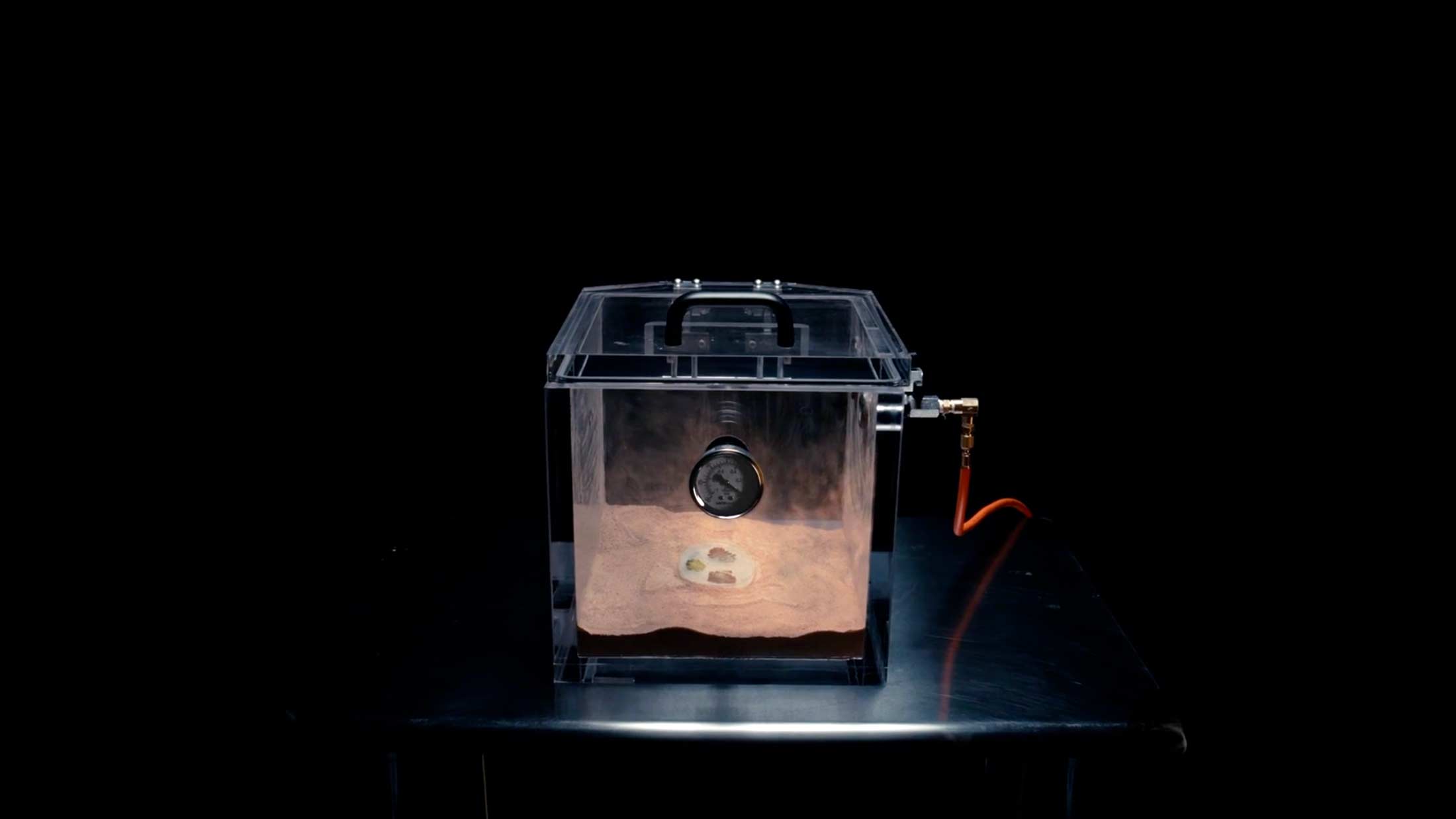
The San Francisco company's "Moon Factory" uses a patent-pending process to autonomously process lunar soil and convert it into structural bricks. According to the company, traditional habitats must be built on Earth and launched at costs reaching hundreds of thousands of dollars per kilogram. GRU's approach would bypass that constraint entirely.
GRU Space has outlined an aggressive three-mission roadmap. In 2027, it plans to land a small-scale version of its factory and inflatable habitat on the lunar surface as a demonstration. A 2029 mission aboard a CLPS lander will validate the "moon brick" technology at larger scale. By 2031, the company aims to deploy a subscale inflatable structure inside a lunar pit, taking advantage of natural radiation shielding. If all goes to plan, the first iteration of the hotel opens in 2032.
The startup has already drawn investor interest. According to CB Insights, GRU Space has raised $600,000 in pre-seed funding. The company has received backing from investors associated with SpaceX and Anduril and was selected for Nvidia's Inception Program for Startups. Reports indicate GRU has secured $500 million in letters of intent and an invitation to the White House. Prospective guests can place a $1 million deposit to reserve a spot. The Trump family reportedly holds a reservation.
The Broader Lunar Rush
GRU Space is not operating in a vacuum. The commercial lunar industry has expanded rapidly over the past five years. Multiple American companies now maintain active lunar lander programs through NASA's Commercial Lunar Payload Services initiative. Intuitive Machines is targeting Reiner Gamma for its IM-3 mission. Firefly's Blue Ghost Mission 2 is scheduled for the lunar far side. Astrobotic is preparing its Griffin lander for the south pole.
Seattle-based Interlune won a $6.9 million NASA contract in April to develop a payload that will test helium-3 extraction from lunar regolith. The startup, founded by Apollo 17 moonwalker Harrison Schmitt and former Blue Origin president Rob Meyerson, has built a full-scale excavator prototype in partnership with Vermeer. Interlune already has purchase agreements with the U.S. Department of Energy and quantum computing infrastructure company Maybell Quantum for helium-3 delivery beginning in 2029.
The FAA has also moved to clear the regulatory path. In late July, the agency published a proposed rule that would waive requirements under 13 environmental statutes for commercial space licenses and permits. The proposal has drawn legal challenges from environmental groups, but it reflects what FAA Administrator Bryan Bedford described as a necessity: "we will not keep pace with this rapid growth unless we streamline, modernize, and strengthen our regulatory approach."
What Actually Has to Happen
The memorandum sets ambitious targets, but execution will depend on permitting throughput, spectrum allocation, and the buildout of physical infrastructure. The Interior Department has 90 days to identify federal lands for an additional reentry site. Within 180 days, the Pentagon and NASA must develop scheduling criteria to maximize use of federal launch facilities.
SpaceX already accounts for the vast majority of U.S. commercial launches. Elon Musk's company has stated aspirations of 30 or more Starship flights per day by 2030. That alone would exceed the administration's annual target by an order of magnitude. Whether smaller players can secure their share of the expanding launch calendar remains an open question.
For companies like GRU Space and Interlune, the policy creates an environment where lunar construction and resource extraction are treated as legitimate commercial activities rather than aspirational science projects. The shift is significant. Whether it amounts to a "golden age" depends on what gets built.