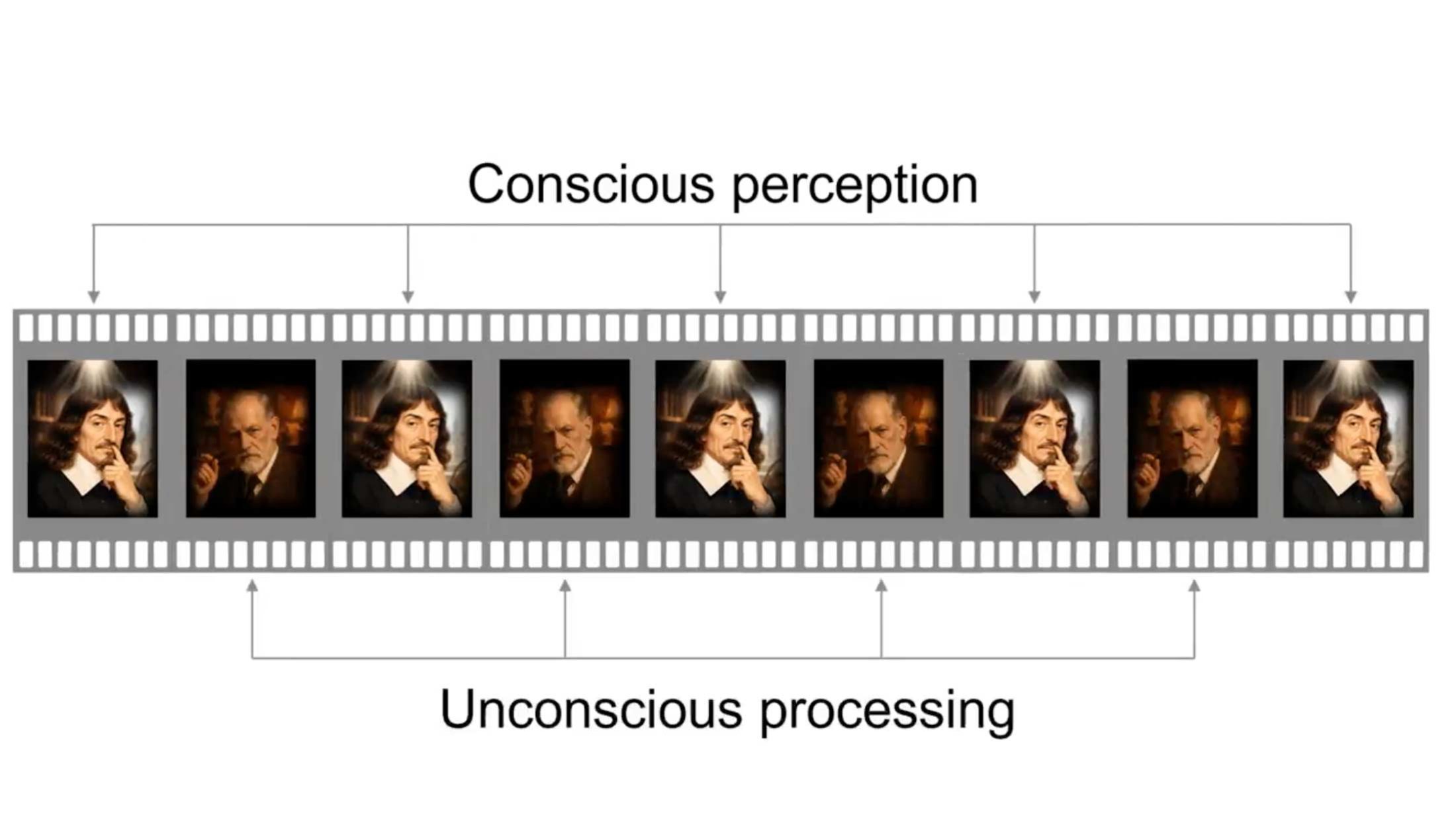
Doris Tsao's lab at UC Berkeley has posted a preprint claiming that the brain rapidly alternates, roughly 15 times per second, between representing what a subject consciously perceives and what is suppressed from awareness. The finding, if it holds up to peer review, complicates decades of research aimed at pinpointing where in the brain consciousness resides.
The paper, led by postdoctoral researcher Janis Hesse, used Neuropixels probes to record from thousands of neurons in two rhesus macaques. The monkeys were shown a binocular flash suppression display, in which one face is presented to one eye, then a second face is flashed to the other eye. The flashed face is consciously perceived while the first remains continuously present but is suppressed from awareness.
The 60-Millisecond Cycle
Rather than finding a stable neural signature of consciousness, the researchers observed that the same neurons carried both the perceived and the suppressed face, switching representation approximately every 60 milliseconds. During what the authors call "conscious micro-epochs," neural activity reliably tracked the perceived image, allowing accurate reconstruction of the consciously seen face. During "suppressed micro-epochs," the signal flipped: the same neurons now tracked the suppressed face.
Recordings in both inferotemporal cortex, a region associated with high-level visual processing, and prefrontal cortex yielded qualitatively similar results. "Together, these findings show that both inferotemporal and prefrontal cortex rapidly interleave conscious with suppressed content," the authors write in the abstract, "indicating that conscious access requires temporal selection beyond localization."
Tsao, announcing the preprint in a thread on X, described it as revealing "a pure correlate of conscious awareness in the brain during rivalry." She wrote that neural activity across both brain regions "alternates between a conscious mode and an unconscious mode ~ 15 times every second."
What This Means for Consciousness Research
For decades, neuroscientists have debated where in the brain consciousness emerges. Some theories, like the Global Neuronal Workspace model developed by Stanislas Dehaene and Jean-Pierre Changeux, emphasize prefrontal and parietal regions as critical hubs that broadcast information to the rest of the brain. Others have argued that posterior sensory areas are sufficient.
The new preprint suggests the debate may have been framed too narrowly. The authors note that their findings "expose a limitation of searching for the neural correlates of consciousness within the average activity of specific brain regions, whether toward the front or back of the brain." If the same neurons encode both seen and unseen content at different moments, studies that average activity over time would produce only weak signals, potentially explaining why prior experiments found modest perceptual modulation in high-level visual cortex.
The computational analysis for the study was conducted in collaboration with Tatiana Engel, an associate professor at Princeton Neuroscience Institute whose work focuses on how distributed neural circuits give rise to cognition.
The Broader Research Line
Hesse and Tsao have been studying the neural correlates of consciousness together for years. In a 2020 paper published in eLife, the pair demonstrated that macaque face patch neurons encode both consciously perceived and suppressed stimuli using a "no-report" paradigm, which infers the animal's conscious percept from eye movements rather than trained button presses. That methodological innovation helped rule out the possibility that observed neural activity reflects the act of reporting rather than perception itself.
The new preprint builds on that foundation with higher-resolution temporal analysis. The authors also connected face patch recordings with prefrontal cortex, finding the same rapid switching pattern in both regions. This suggests consciousness may depend not on which brain area is active, but on the timing of activity within those areas.
Tsao, who is also Chief Scientist for Neuro at Astera Institute, has previously expressed the view that understanding cooperative information processing between brain areas is key to solving the problem of consciousness. The new data appears to support that intuition, pointing toward temporal coordination as a critical variable.
The preprint has not been peer reviewed. Co-authors include Frank Lanfranchi, Conor McGrory, and Yuelin Shi of UC Berkeley.