The Appalachian Mountains hold enough lithium to sever America's dependence on foreign imports for more than three centuries. The U.S. Geological Survey on Tuesday released new research estimating the region contains 2.3 million metric tons of undiscovered, economically recoverable lithium, enough to replace 328 years of U.S. imports at last year's consumption level.
That figure translates to real-world impact: batteries for 130 million electric vehicles or 1.6 million grid-scale storage systems. The findings, published in Natural Resources Research, represent the most comprehensive federal assessment of lithium potential in the eastern United States.
Where the Lithium Lies
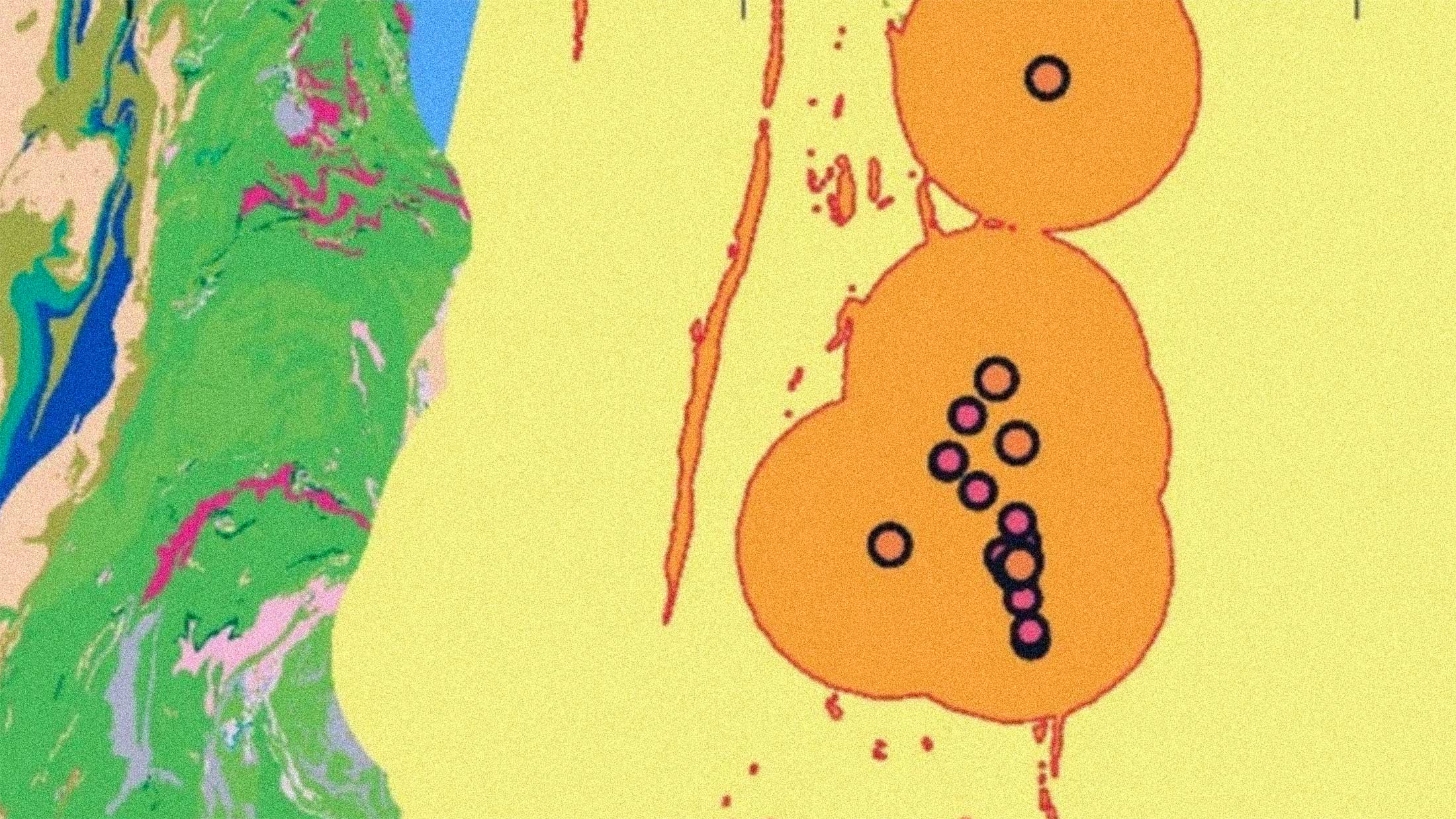
The southern Appalachians hold an estimated 1.43 million metric tons of lithium oxide, concentrated in the Carolinas, while the northern Appalachians hold an estimated 900,000 metric tons, concentrated in Maine and New Hampshire. The lithium is present in pegmatites, large-grained rocks similar to granite.
These pegmatites formed from the same geologic forces that built the mountains more than 250 million years ago, when high heat and pressure during mountain-building caused deep crustal rocks to melt. This occurred when plate tectonics forced Africa, Europe, and North America together into the supercontinent Pangea.
USGS Director Ned Mamula framed the discovery in strategic terms. "This research shows that the Appalachians contain enough lithium to help meet the nation's growing needs—a major contribution to U.S. mineral security, at a time when global lithium demand is rising rapidly," he said, adding that "USGS mineral science is the leading edge in the effort to restore America's mineral independence."
A Return to Appalachian Roots
The region has history with lithium extraction. The Kings Mountain area of North Carolina was the site of the first large-scale lithium pegmatite mining in the United States. During World War II, Solvay Process Company operated a flotation plant there for spodumene concentrate, processing 300 short tons of ore daily. Production ceased when wartime demand collapsed.
Kings Mountain is believed to have one of the largest lithium resources in the world. Albemarle Corporation is now seeking permits to reopen and expand the site, backed by grants from both the Department of Energy and Department of Defense.
The energy demands of AI infrastructure and grid storage have intensified pressure on lithium supply chains. Lithium demand is projected to increase more than 48 times by 2040 due to electric vehicle production and other energy storage needs, according to the USGS. World production capacity for lithium is projected to double by 2029.
The China Problem
The strategic value of domestic lithium cannot be separated from the geopolitical context. The United States had one sole producer of lithium and relied on imports for more than half the lithium used last year. While Australia is the world's largest producer of lithium, China is second, and accounts for the majority of world lithium refining and consumption.
Despite holding less than 7 percent of the world's lithium reserves, China has managed to secure an 80 percent share of global lithium chemical production, 78 percent of cathode production, and 70 percent of cell manufacturing for the electric car industry. The U.S. imports nearly three-quarters of its lithium-ion batteries from China.
This concentration of refining capacity means that even abundant domestic ore requires processing infrastructure that largely doesn't exist in the United States. Chinese domestic plants are projected to account for 81% of global spodumene refinery production by 2027. Australia, the world's largest lithium miner, is only able to refine around 25% of its domestic production.
Probability and Uncertainty
The USGS assessment comes with appropriate scientific caution. The estimates present a 50% confidence level. In the northern Appalachians, for example, it is equally likely that there are more than 1.4 million metric tons of lithium oxide as it is that there is less.
The range of possibilities is wide. There is 90% confidence of at least 90,000 metric tons, and a 10% probability that there are as much as 7.4 million metric tons that remain undiscovered in the northern Appalachians alone. The median estimate was then screened for economic recoverability based on global lithium mining experience and lithium prices.
A team of USGS geologists worked on both northern and southern assessments, combining geologic maps, tectonic history, geochemical sampling, geophysical surveys, and records of mineral occurrences. They conducted simulations using a global dataset for lithium pegmatites to estimate how many undiscovered deposits exist and their potential yield.
The Path Forward
Identifying resources is one thing. Extracting them is another. The USGS emphasized that "everything else follows on the science: permitting reform and other policy changes to support investment in clean, responsible mining to 21st century standards, and mining workforce training for new American jobs."
Environmental questions loom over any mining expansion. A Duke University study of the historic Kings Mountain site found elevated concentrations of lithium, rubidium and cesium in mine-associated waters—levels uncommon in natural waters and not federally regulated. Traditional contaminants like arsenic and lead were below EPA standards, but the findings underscore the need for monitoring as critical mineral production scales up.
The USGS notes that the period of import replacement will inevitably shorten with projected increasing consumption rates, emphasizing that further research could be completed to better delineate regions of high lithium resource potential.
Details from the southern assessment covering the Appalachians from Maryland to Alabama will be published separately. The combined picture suggests the eastern United States harbors mineral wealth that could reshape domestic supply chains for decades—assuming the political will and industrial capacity materialize to extract it.