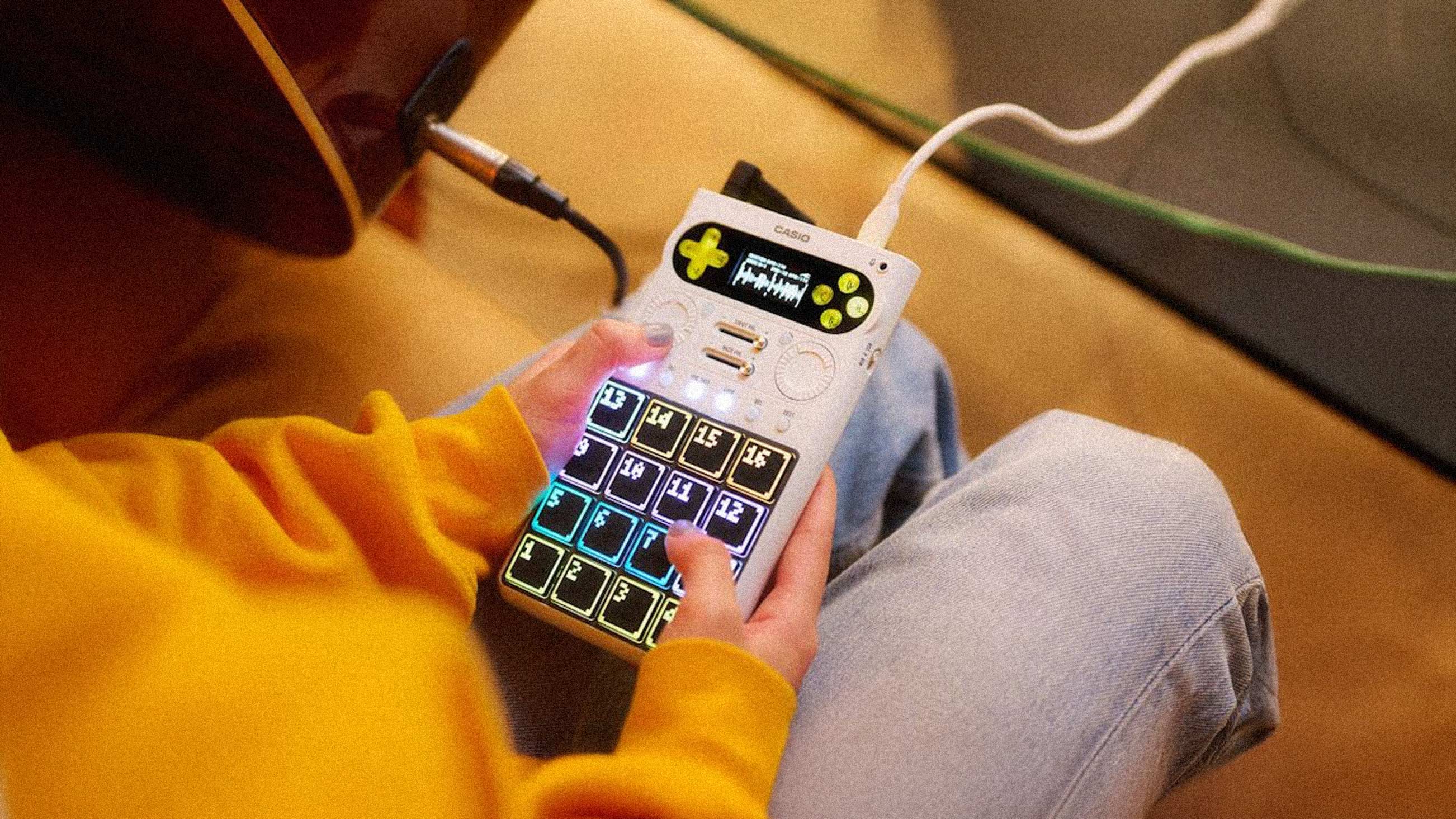
Casio has announced the SXC-1, a handheld sampler that represents the company's most serious return to the category since the SK-1 keyboard landed in 1985. Pre-orders open today, shipping starts May 28. Casio has left pricing open for retailers, shorthand for an aggressively positioned product.
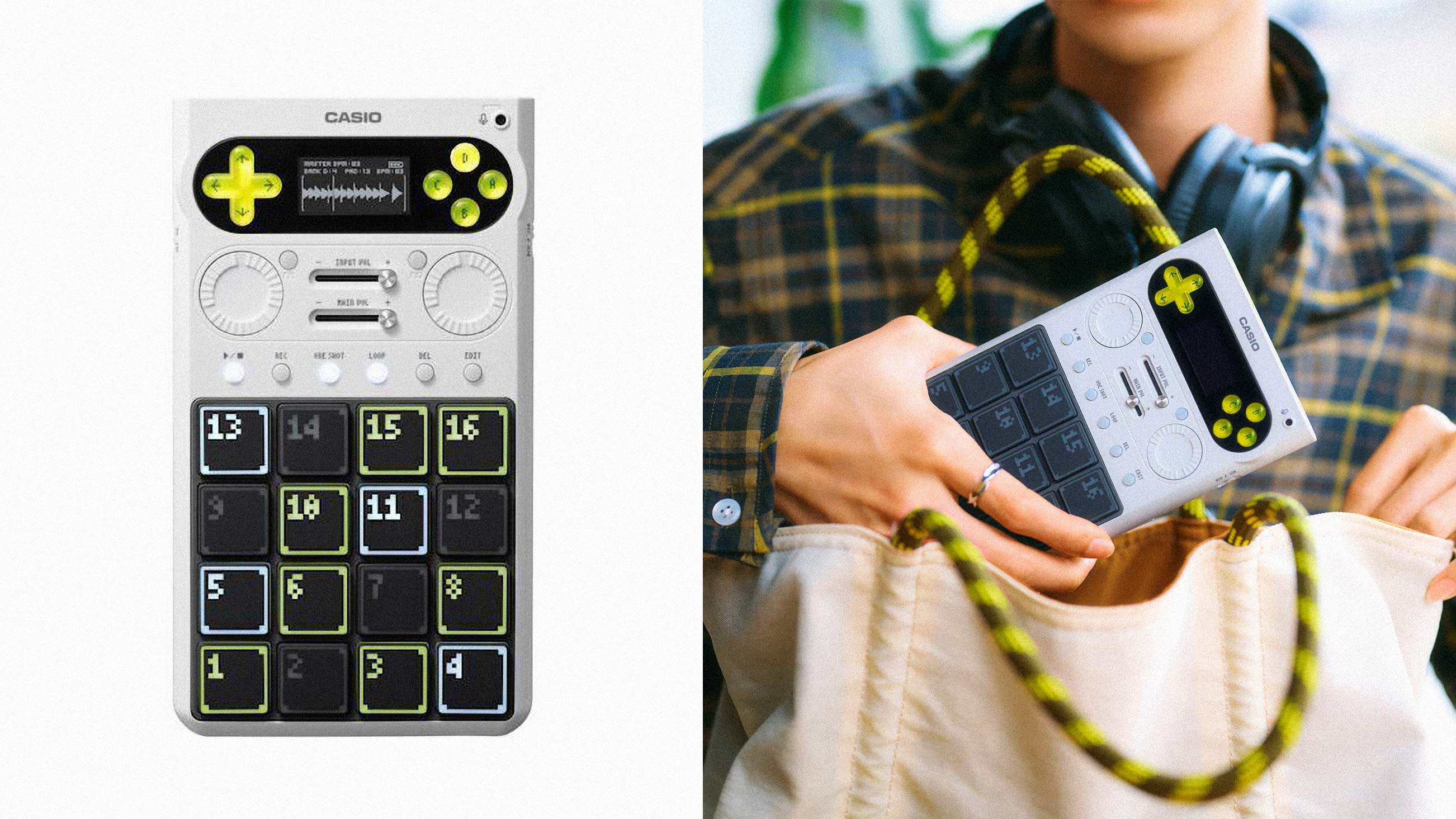
The SXC-1 is a self-contained beat sketchpad. It has sixteen velocity pads arranged in a four-by-four grid, a 1.3-inch OLED display, a built-in microphone and speaker, and 64 GB of internal memory. Recording runs at 16-bit 48 kHz in WAV format with 16-voice polyphony, which puts it on equal audio footing with most standalone samplers currently shipping. The unit weighs 315 grams without batteries, runs about two hours on four eneloop AA cells, and offers a main output, a headphone jack, an external line input, and USB-C for both power and data. A companion smartphone app handles waveform editing and firmware updates.
The SK-1 Lineage Is Not Decorative
Casio has stocked the device with 208 built-in sounds, and the list includes material sampled directly from two of the company's 1980s classics: the original SK-1 keyboard and the MT-40. That choice is deliberate. The SK-1 is the product that taught a whole generation of musicians what a sampler was in the first place, and preserving those sounds inside a new device aimed at beginners is how Casio signals lineage without having to actually rebuild a keyboard it cannot manufacture at modern prices.
A Beat Sync feature auto-matches the tempo of imported audio, and a timeline sequencer ties pads into full arrangements. Real-time effects sit on top. These are the features that pull the product out of novelty territory into something a producer could actually sketch with. The prototype spec shown at NAMM 2026 referenced ten banks of sixteen samples each, though Casio has noted those figures are non-final.
The Teenage Engineering Comparison
The reference point everyone has reached for since the SXC-1 prototype surfaced at NAMM is Teenage Engineering's PO-33 K.O.. The Swedish brand has effectively owned the approachable handheld-sampler category for years, and its aesthetic of clean geometry and playful interaction has become the default reference for the segment. The SXC-1 does not compete on minimalism. It is a denser, more button-heavy object, closer to a Game Boy than a Pocket Operator, with backlit color pads in a grid reminiscent of Casio's old drum machines.
But in workflow, price bracket, and target audience, Casio is moving into a lane Teenage Engineering has largely occupied alone. The SXC-1 is smaller and cheaper than the EP-133 K.O. II, more capable than the PO-33, and aimed explicitly at producers who have never touched a sampler before. That gap has been open for a while.
What Casio brings that Teenage Engineering cannot match is scale. Casio music products sit on shelves at almost every mainstream consumer electronics retailer in the world. The distribution relationship is something no boutique brand can replicate quickly. If the SXC-1 prices aggressively, and Casio's legacy sampler strategy suggests it will, the product has a real chance of introducing sampling to a substantially larger audience than any competing handheld currently reaches.
The Honest Caveats
Pricing has not been confirmed, and the category is now crowded enough that a poorly priced SXC-1 will disappear fast. The prototype's ten banks of sixteen samples is modest compared to some competitors and may feel constraining for anyone moving past basic patterns. Two hours of battery life is short by current standards for portable gear. The deliberately simple interface is the right call for beginners but may frustrate users who already own more capable hardware.
None of those caveats disqualifies the product. Casio's wager is that the handheld sampler category still has room for a beginner-focused device with real lineage and real polish, and that a 315-gram tool from a legacy consumer brand can matter to a generation that grew up on software. Pre-orders opened today. The product ships May 28.