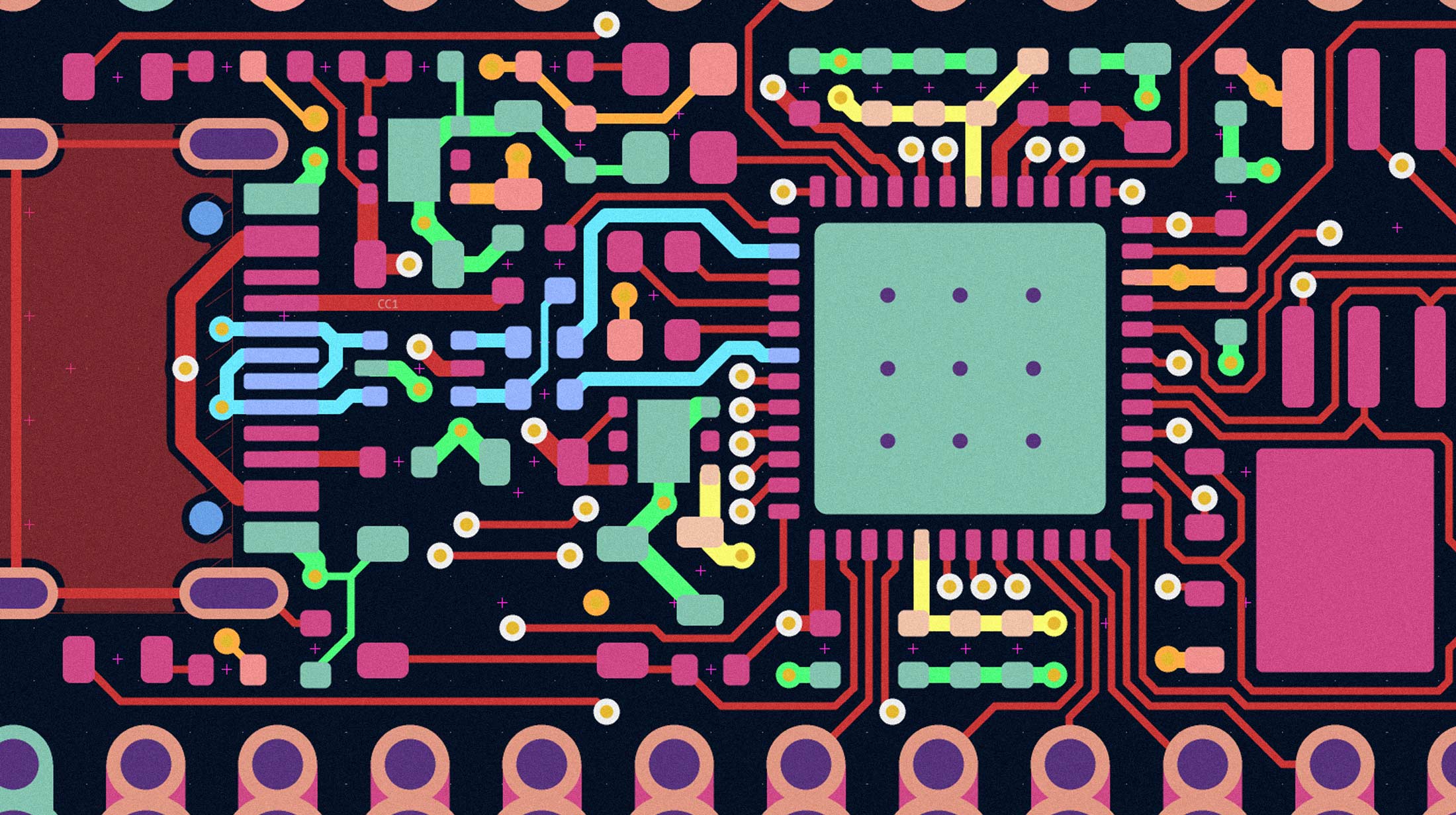
Somewhere beneath the Franco-Swiss border, CERN engineers have spent decades designing custom electronics for experiments that probe the fundamental structure of matter. Now the organization is sharing one of the more practical byproducts of that work: a library of more than 17,000 component symbols and footprints for KiCad, the open-source PCB design software.
Following guidance from its Electronics Design Automation Committee (EDAC) and Open Source Programme Office (OSPO), CERN is releasing the complete library under an open-source license. The library is released under the CERN OHL Permissive license, which allows users to mix the designs freely with proprietary work, provided acknowledgment is given.
Why This Matters for Hardware Designers
Anyone who has designed a PCB knows the tedium of component library creation. Every chip, connector, and passive component needs both a schematic symbol and a physical footprint before you can use it in a design. Non-standard and complicated land patterns reduce working efficiency by requiring significant time expenditures on creation and verification. Worse still is the possibility of undiscovered errors during footprint creation found during assembly when a component won't solder down.
Assembly houses report that footprint errors rank among the top causes of PCB manufacturing issues. A pad that's slightly too small might look fine in simulation but fail during reflow. These problems are expensive to diagnose and fix, particularly after you've already ordered stencils and components.
The CERN release gives external users access to the same component resources used internally by CERN hardware designers for schematic capture and PCB layout development. These are parts that have been validated in real-world applications, many of them in mission-critical scientific instrumentation.
The gcc Analogy
CERN has been contributing to KiCad since 2013, and their stated ambition is revealing. "We think that KiCad can do to PCB design what the gcc compiler did to software: ensure there are no artificial barriers to sharing so that design and development knowledge can flow more freely," the organization has written on its Open Hardware Repository project page.
The analogy is apt. Before gcc, software developers often depended on proprietary compilers tied to specific platforms. The GNU Compiler Collection became infrastructure that enabled decades of open-source software development. CERN's BE-CO-HT section started contributing resources to KiCad in 2013 to help foster open hardware development. From 2013 until approximately 2018, CERN provided two developers part-time to help improve KiCad.
Much of the work involved massive refactoring of the code base to give KiCad a better structure to grow and adapt. CERN also helped organize donations and fundraisers to pay for additional contract developers. Well over 1,400 hours of developer time has been provided by CERN.
A Broader Open Science Commitment
Since releasing the World Wide Web software under an open-source license in 1994, CERN has continued to pioneer open source. This has included promoting open-source hardware through the CERN Open Hardware Licence, supporting open-access publishing through SCOAP³, and promoting open data through the LHC experiments' Open Data Portal.
The CERN Open Hardware Licence itself is worth understanding. The license comes in three variants: strongly reciprocal (CERN-OHL-S), weakly reciprocal (CERN-OHL-W), and permissive (CERN-OHL-P). Version 2.0 is approved by the Open Source Initiative, which matters for institutional adoption.
The license allows people to freely access, modify, and redistribute design files, and also makes it possible for them to build and commercialize hardware based on those designs. The permissive variant chosen for this library release imposes minimal restrictions on downstream use.
Practical Considerations
The libraries are available via a GitLab repository at the Open Hardware Repository and are currently offered for KiCad version 9.x. Official 10.x compatibility is reportedly on the way.
With KiCad, users can share their designs without any restrictions, ensuring that no one is barred from participating in a project because they cannot afford a software license. This library release extends that philosophy to the component data itself. A hobbyist working on a weekend project now has access to the same validated parts catalog as the team designing detector readout systems for the Large Hadron Collider.
For the garage tinkerer building Raspberry Pi projects or the startup prototyping sensor boards for next-generation robotics, this represents thousands of hours of saved labor. CERN says this significantly promotes collaboration, enabling wider participation, faster iterations, and broader dissemination of hardware design knowledge.
The release is also a useful data point for organizations weighing the costs and benefits of open-sourcing internal tooling. CERN's contribution to the KiCad ecosystem reaffirms its commitment to open-source hardware as a way of sharing hardware designs efficiently. Particle physics may seem remote from everyday electronics, but the infrastructure that enables it turns out to be highly transferable.