We may earn a commission if you buy through links on this page. It never affects our coverage. Prices are as reported at publication and may have changed. As an Amazon Associate we earn from qualifying purchases.
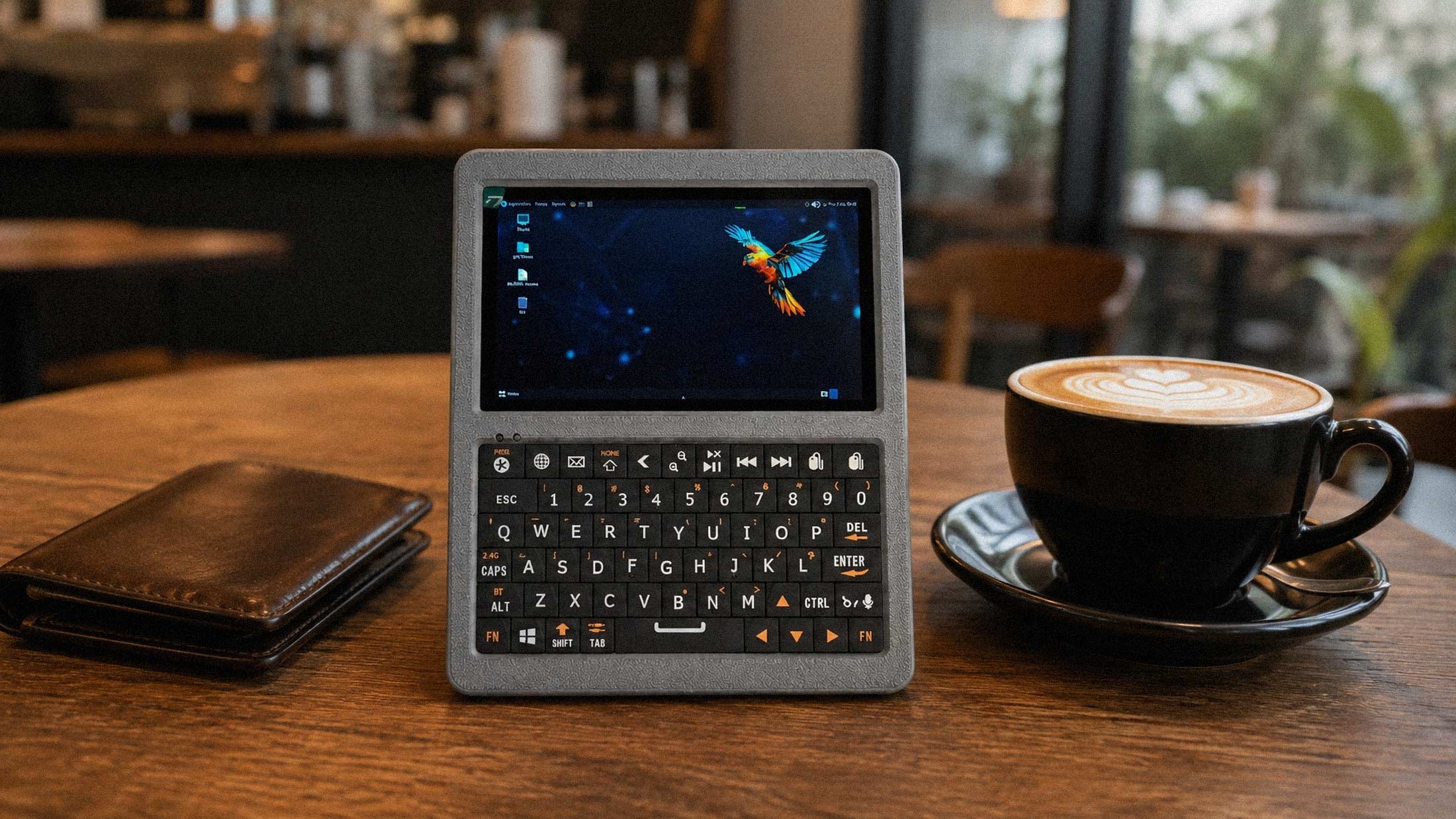
Carbon Computers has released the Pi Slate, a handheld Linux device built around the Raspberry Pi 5 and designed for people who want a portable computing platform that runs outside the walled gardens of mainstream tech. The device joins a growing roster of commercially available cyberdecks that have started to move beyond hobbyist curiosity into actual field use.
The Pi Slate integrates a 5-inch 1920×720 touchscreen, a backlit RGB keyboard with an integrated cursor, and a 10,000 mAh battery offering 3–5 hours of portable runtime. It supports modular expansion for HATs including LoRa radios, software-defined radio modules, AI accelerators, and M.2 storage. Cooling support, antenna mounts, and an optional modular back with a kickstand round out the package.
Pricing and Configurations
The Pi Slate is now available for pre-order on the Carbon Computers store with a 1–2 week lead time. The barebones kit starts at $282.08 and includes the chassis, display, keyboard, battery, and internal wiring. You supply your own Raspberry Pi 5 and cooling. Fully assembled versions range from $423.58 to $706.60 depending on configuration. Optional add-ons such as GPS, LoRa, and SDR radio kits are sold separately.
The company also sells the Pi Flux, a more rugged sibling with extra mounting space for antennas, radios, and other modules. The Pi Slate is the slimmer, more portable variant intended for users who value carryability over maximum modularity.
Specifications
| Feature | Pi Slate |
|---|---|
| Processor | Raspberry Pi 5 |
| Display | 5-inch, 1920×720 touchscreen |
| Keyboard | Backlit RGB with integrated cursor |
| Battery | 10,000 mAh (3–5 hours runtime) |
| Expansion | HAT support (LoRa, SDR, AI accelerators, M.2 storage) |
| OS Support | Raspberry Pi OS, Ubuntu, Kali, Parrot OS, TwisterOS, Batocera |
| Barebones Price | $282.08 |
| Assembled Price | $423.58 – $706.60 |
Target Users
Carbon Computers markets the Pi Slate for cybersecurity professionals, penetration testers, IT students, developers, and hobbyists. Use cases span IT fieldwork, networking diagnostics, IoT prototyping, and mobile development environments. The accessible microSD slot enables quick OS swapping, meaning users can switch between Raspberry Pi OS for general use and Kali Linux for security testing in seconds.
The Cyberdeck Moment
The Pi Slate arrives during a broader surge of interest in portable Linux cyberdecks. As CNX Software noted, there has been significant activity around devices like the ClockworkPi DevTerm, uConsole, and PocketTerm35 in recent years. Social platforms have amplified the trend. TikTok in particular has helped introduce cyberdecks to younger users, with creators describing them as a form of technological self-expression.
The term "cyberdeck" originated in William Gibson's 1984 novel Neuromancer. For decades it remained a retro-futurist fantasy. What changed is the availability of affordable single-board computers, compact displays, and lithium batteries. This supply chain maturation has enabled companies like Carbon Computers to productize what was once a purely DIY endeavor.
The timing matters. As edge AI accelerators become smaller and cheaper, cyberdecks have gained a new use case: running local inference models that do not require cloud connectivity. The Pi Slate's HAT expansion slot supports AI accelerators, suggesting the company anticipates this application. Users have already reported pairing devices like the HackBerry Pi CM5 with cloud-based LLMs over hotspot connections, though running local agentic AI remains impractical on current Raspberry Pi hardware.
Edge computing spending is projected to reach approximately $265 billion globally in 2025, growing to around $450 billion by 2029, according to IDC. Much of that growth is driven by AI workloads that require low latency and local inference. Cyberdecks occupy a narrow but real slice of this trend: personal, portable devices for users who want control over their compute environment and do not want to depend on Big Tech's infrastructure.
The price point of the Pi Slate puts it in awkward territory. At $282 for the barebones kit, or $423+ assembled, it costs more than a budget Chromebook. The audience is people who have specific requirements that a Chromebook cannot meet: custom Linux environments, physical radio modules, offensive security tooling. For that cohort, the Pi Slate offers a turnkey solution that saves hours of assembly and debugging.
The device ships with Raspberry Pi OS as the default, with documented support for Kali, Parrot OS, Ubuntu, TwisterOS, and Batocera for retro gaming. Whether the market for pre-built cyberdecks scales beyond the existing enthusiast community remains to be seen. For now, the Pi Slate is a nod to computing's past packaged for people who want to tinker with its future.