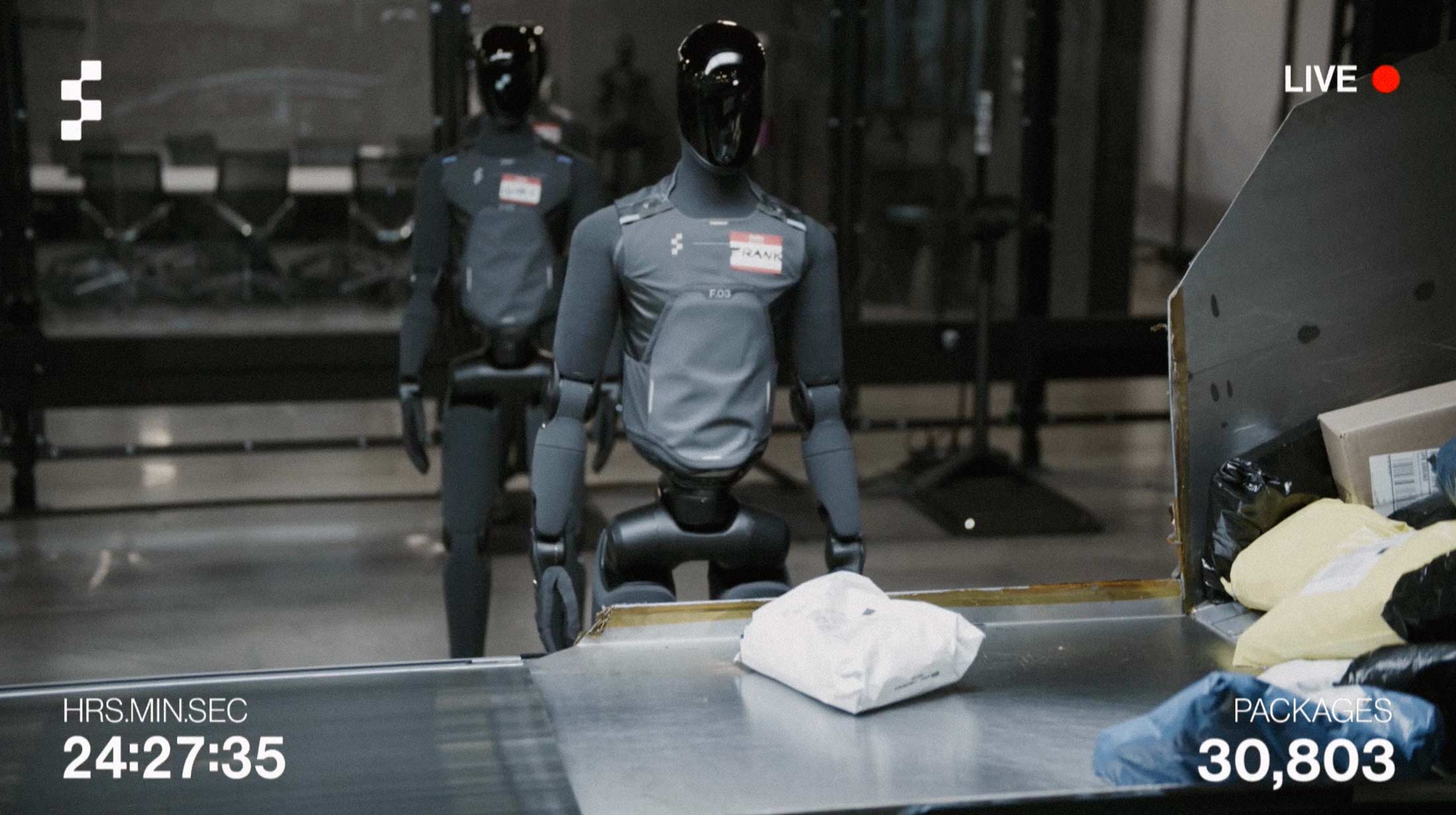
What started as an 8-hour endurance test has turned into something more significant. Three Figure 03 humanoid robots, running the company's in-house Helix-02 neural network, have now been sorting packages continuously for over 24 hours without a single failure.
Day 2 is Live: Watch humanoid robots Bob, Frank, and Gary running 24/7. This is fully autonomous running Helix-02 https://t.co/zaRVkoLa4e
— Brett Adcock (@adcock_brett) May 14, 2026
"Our original goal was an 8-hour run," Figure CEO Brett Adcock posted on X. "After zero failures yesterday, we decided to keep going. We're now over 24 hours of continuous autonomous operation without a failure. This is uncharted territory."
The task itself is deceptively mundane. Each robot detects a barcode, picks up a package, reorients it barcode-face-down onto a conveyor, and repeats. Humans average around three seconds per package. Adcock says the robots are now operating at comparable speed, reasoning directly from camera pixels rather than following pre-programmed motions.
How the System Works
The robots run entirely on onboard inference. There is no teleoperation, no cloud connection, no human in the loop. Every action comes directly from Helix-02, the vision-language-action model Figure unveiled in January 2026. That release replaced what the company said was more than 109,000 lines of hand-engineered C++ locomotion code with a neural controller trained on over 1,000 hours of human motion data.
When something goes wrong, the system handles it autonomously. "If the robot gets stuck or the AI policy goes out of distribution, Helix triggers an automatic reset," Adcock explained. "You'll occasionally see this happen during the livestream." If a robot encounters a software or hardware issue, it walks itself to maintenance and another robot takes its place.
The livestream began on May 13 after robotics veteran Scott Walter publicly challenged Figure to prove its autonomous labor claims. Walter argued that humanoids would have "limited utility" until they could match human speed and demonstrate an 8-hour shift without intervention. Adcock responded with a meme and a promise: livestream tomorrow.
Bob, Frank, and Gary
The test was supposed to be simple. It became something else.
Livestream viewers started naming the robots. Bob, Frank, and Gary are now wearing name tags on the stream. "Frank the tank, 10k packages!" one viewer posted as the count climbed. Figure leaned into the moment rather than fighting it.
The demonstration landed in the middle of an escalating competitive push. Meta acquired Assured Robot Intelligence on May 1. Apptronik raised $520 million in February and is deploying its Apollo robot with Mercedes-Benz and GXO Logistics. Tesla continues to push Optimus. Agility Robotics has Digit units active at Toyota Canada.
Figure's manufacturing has scaled to match its ambitions. Its BotQ facility in California has increased production from one Figure 03 per day to one per hour over the past 120 days. The company says it has delivered more than 350 third-generation units.
What the Stream Does and Doesn't Prove
A livestream is evidence, not a coronation. The robots are working a single prepared task in a controlled environment. They have not proven cost, safety certification, maintenance burden, or performance across varied conditions. A robot may excel at one task and still fail in a messy loading dock or a crowded retail aisle.
But the relevant question for logistics operators is narrower: can this machine work long enough, reliably enough, and cheaply enough to compete with human labor? Twenty-four hours without a failure, even on a single task, shifts the conversation. Previous demonstrations ran for one hour. Edge AI systems that run locally, without cloud dependency, change the economics of deployment.
Adcock acknowledged the statistics work against them. "We haven't had a failure yet, but statistically we probably will at some point." The livestream continues. Bob, Frank, and Gary are still working.
Figure's valuation stands at $39 billion. It has raised more than $1 billion. Previous deployments at BMW's Spartanburg facility contributed to the movement of more than 90,000 parts and supported production of over 30,000 vehicles. The compute economics of agentic AI will ultimately determine whether humanoids leave the demo floor and enter paid operations.