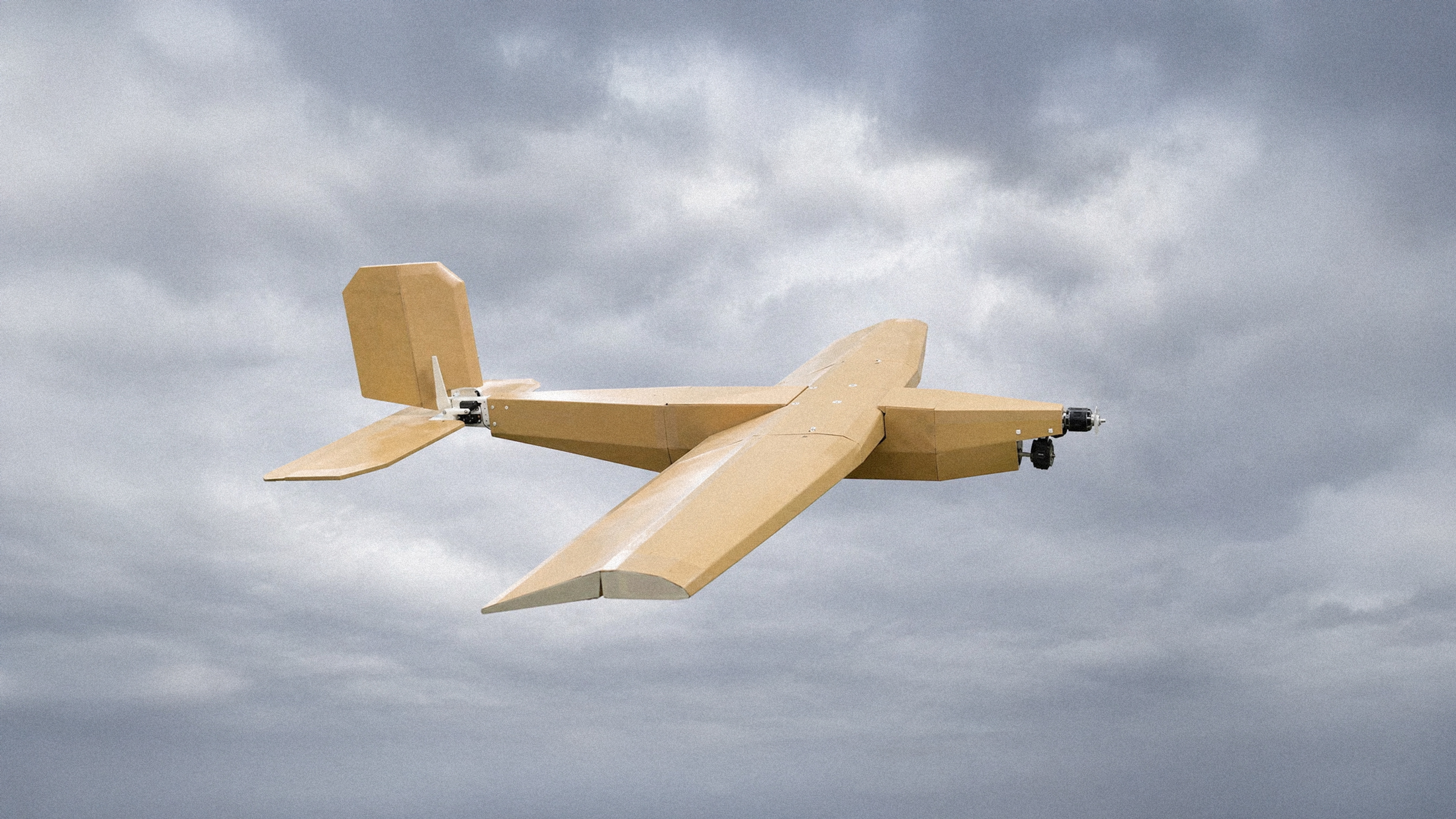
The AirKamuy 150 looks like a school science project. It is mostly corrugated cardboard, ships flat, and snaps together without tools in about five minutes. It also hits 120 km/h, flies for up to two hours, and has already seen operational use with the Japan Maritime Self-Defense Force. The platform currently serves as an aerial target for gunnery and missile defense training.
The Nagoya-based startup behind the aircraft, AirKamuy, was founded in August 2022 by graduates of Nagoya University's Department of Mechanical and Aeronautical Engineering. CEO Takumi Yamaguchi originally set out to build search drones for mountain rescue operations. The pivot to defense came after Russia's invasion of Ukraine clarified how modern militaries actually use unmanned systems: in volume, expendably, and at price points that make attrition math work.
Specifications and Manufacturing Logic
The AirKamuy 150 achieves a 150 km range while carrying payloads up to 1.5 kg. Operational speed ranges from 45 to 120 km/h, and the airframe is coated in a water-repellent finish that allows flight in winds up to 10 m/s. More than 500 units fit inside a standard 20-foot shipping container.
Unit cost sits under $3,000, roughly one-tenth the price of conventional fixed-wing drones used by the Japanese military. The company has suggested mass production could push that figure below $2,000. The economics matter because the cardboard structure uses biodegradable resins and can be manufactured at any standard cardboard factory. AirKamuy's unofficial slogan: every cardboard factory can become an arsenal.
The material also happens to reduce radar reflection compared to metal or carbon fiber airframes. For a platform designed to be shot at, that low-observable quality is mostly irrelevant. But the company has publicly discussed reconnaissance applications where reduced detectability becomes useful.
Where It Fits in Japan's Defense Strategy
Defense Minister Shinjiro Koizumi has met with AirKamuy and articulated Japan's ambition to become the world's leading user of drones and unmanned assets. The Japan Ground Self-Defense Force has established dedicated drone-focused offices. These moves feed into the broader SHIELD initiative, which envisions networks of affordable unmanned systems maintaining continuous surveillance over Japan's southwestern islands, where tensions with China remain elevated.
Japan's fiscal 2026 defense budget request allocates 312.8 billion yen for unmanned asset defense capabilities, nearly triple the previous year's figure. AirKamuy remains in discussions with the Ministry of Defense to secure contracts beyond its current aerial target role. Potential applications include maritime surveillance, disaster relief logistics, and swarm operations.
The company exhibited a variant called the AirKamuy 6 at the 2025 Paris Air Show and showed the AirKamuy 150 at DSEI 2025, where its marketing materials explicitly referenced swarm attacks and counter-UAS testing.
The Funding Constraints
AirKamuy raised 100 million yen in pre-seed funding in May 2025, drawing from ANOBAKA, Sparkle Fund, STATION Ai Central Japan Fund, plus loans from Nagoya Bank and Japan Finance Corporation. But the company's CEO says roughly two-thirds of the venture firms approached declined to invest, citing internal restrictions on defense-related businesses. Japan's post-war aversion to military industry remains a barrier for defense tech startups, even as the strategic landscape shifts.
The company also develops a separate aircraft, the Σ-1, a fixed-wing VTOL capable of over five hours of continuous flight and vertical takeoff from ships. Both platforms are intended for dual-use scenarios. Disaster response, infrastructure inspection, and surveillance work all fit the profile.
Broader Context
AirKamuy is not alone in this space. South Korea adopted its own cardboard drone, the PapyDrone-800, in 2024. Australia's Sypaq has demonstrated similar concepts in Ukraine. North Korea has shown cardboard-bodied drones at defense exhibitions. The low-cost drone race in Asia is real, driven by the same wartime economics that made Iranian Shahed drones a cost-effective problem for Western militaries.
For Japan, the appeal is straightforward. The country faces a shrinking labor force and aging population. Its Self-Defense Forces cannot scale manpower the way adversaries can. Cheap, expendable, mass-producible platforms offer asymmetric leverage. Whether cardboard drones represent a temporary stopgap or a lasting shift in military procurement remains unclear. But the AirKamuy 150 is already flying, already being shot at, and already pointing toward a future where warfare happens at price points that conventional defense contractors struggle to match.