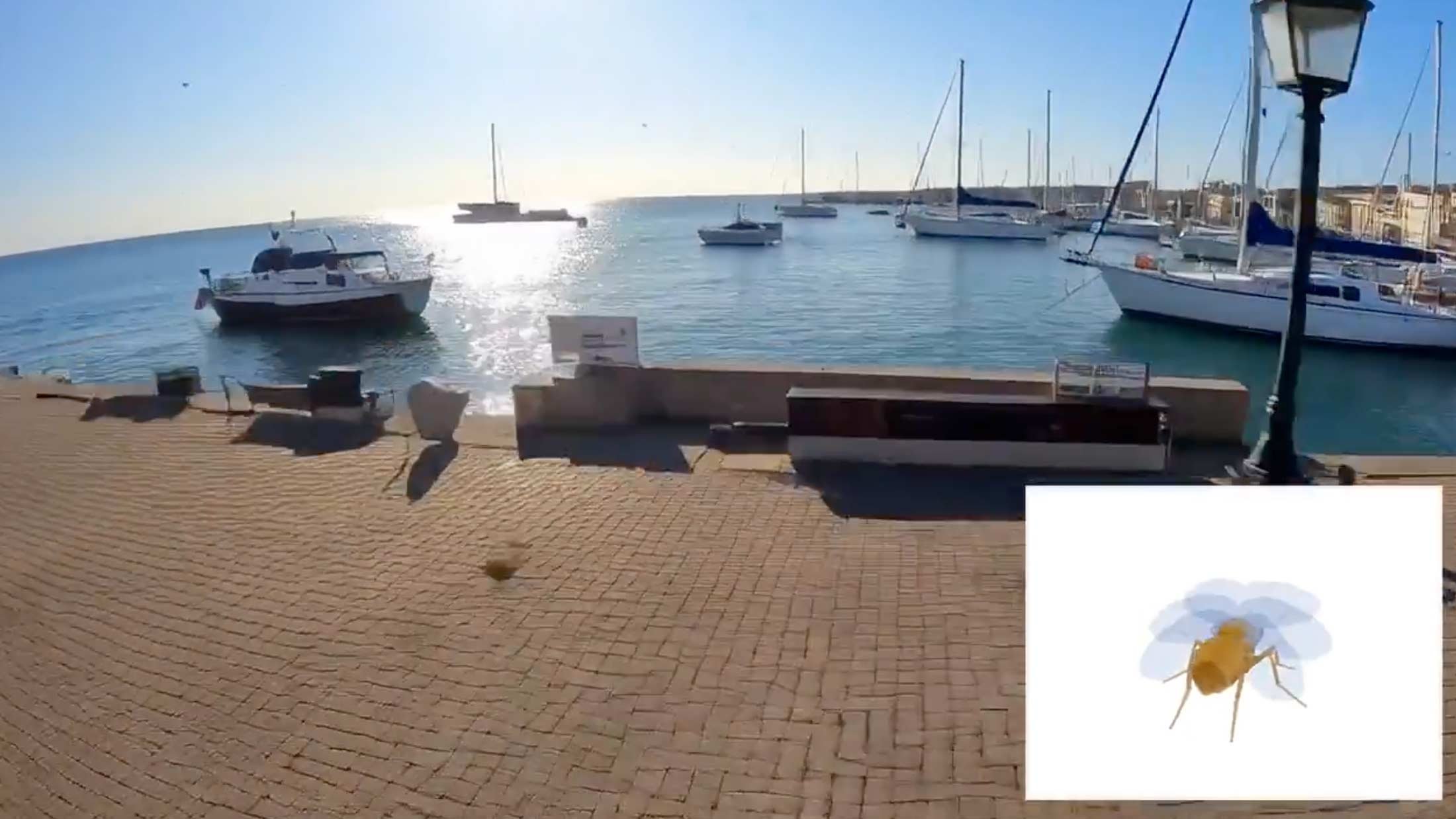
On October 17, Odyssey posted a short video to X showing what it claims is a fruit fly brain operating inside Odyssey-3, the company's flagship world model. The simulated insect appears to move through AI-generated environments on its own.
"We placed the fruit fly brain inside Odyssey-3, a frontier world model," the company wrote. "The lil' guy is now flying around totally imagined, simulated worlds all by itself."
CEO Oliver Cameron followed up: "He's enjoying the market."
The post accumulated over a million views in its first day. Odyssey has not published a paper or detailed technical description of the demonstration. The company did not specify whether the brain model is based on the FlyWire connectome, the MaleCNS dataset, or some derivative, nor did it describe how sensory inputs from Odyssey-3's generated environments feed into the neural simulation.
We placed the fruit fly brain inside Odyssey-3, a frontier world model. The lil’ guy is now flying around totally imagined, simulated worlds all by itself 🫶 https://t.co/lvKrGoTtKr
— Odyssey (@odysseyml) October 17, 2026
Putting the Pieces Together
For anyone following the fruit fly connectome space, the basic architecture is recognizable. In 2024, a large international consortium published the FlyWire connectome, the first complete wiring diagram of an adult fruit fly brain: 139,255 neurons and roughly 50 million synaptic connections. Earlier this year, a Harvard and Princeton-led team extended that map to include the ventral nerve cord, the insect's spinal cord equivalent, creating a complete central nervous system diagram.
Researchers have already placed connectome-based models inside physics simulators. Philip Shiu and colleagues demonstrated that a leaky-integrate-and-fire model constrained by the FlyWire wiring could accurately predict neural responses to taste and touch stimuli. Eon Systems claimed in March that it had closed the sensorimotor loop, placing a connectome brain inside a NeuroMechFly body so the simulated fly could see, process, and move. A hobbyist project called Connectocopter wired the same connectome to a simulated quadcopter.
What Odyssey appears to have done differently is swap out the physics engine for a world model. Instead of driving a body through MuJoCo or another conventional simulator, the fly brain receives sensory input from Odyssey-3's generated frames and outputs motor signals that translate into action within the model's imagination. The world the fly inhabits is not coded by hand; it is conjured frame by frame.
The Company
Odyssey was founded in 2023 by Oliver Cameron and Jeff Hawke, both veterans of the autonomous vehicle industry. Cameron previously ran Voyage, a self-driving startup acquired by GM's Cruise, where he later served as VP of product. Hawke was a founding researcher at Wayve. In June, the company announced a $310 million Series B at a $1.45 billion valuation, with backing from Amazon, AMD Ventures, GV, EQT, and In-Q-Tel.
Odyssey-3 launched as a public research preview on October 8. The model is a 14-billion-parameter autoregressive diffusion transformer trained on internet video, gameplay recordings, and simulated physics. The company claims top scores on the Physics-IQ benchmark and says the model can control robot arms, humanoids, vehicles, and drones using a shared learned representation of how the world works.
Dropping a connectome brain into that system is a natural stunt. If Odyssey-3's world model can sustain a closed sensorimotor loop for a fly, it suggests the model's physics are coherent enough to ground embodied agents more interesting than a joystick-driven avatar. It is also, unmistakably, a marketing play. The fruit fly connectome has become a cultural object in AI circles since the 2024 Nature papers. Every few months, someone wires it into a new toy. Odyssey has now wired it into theirs.