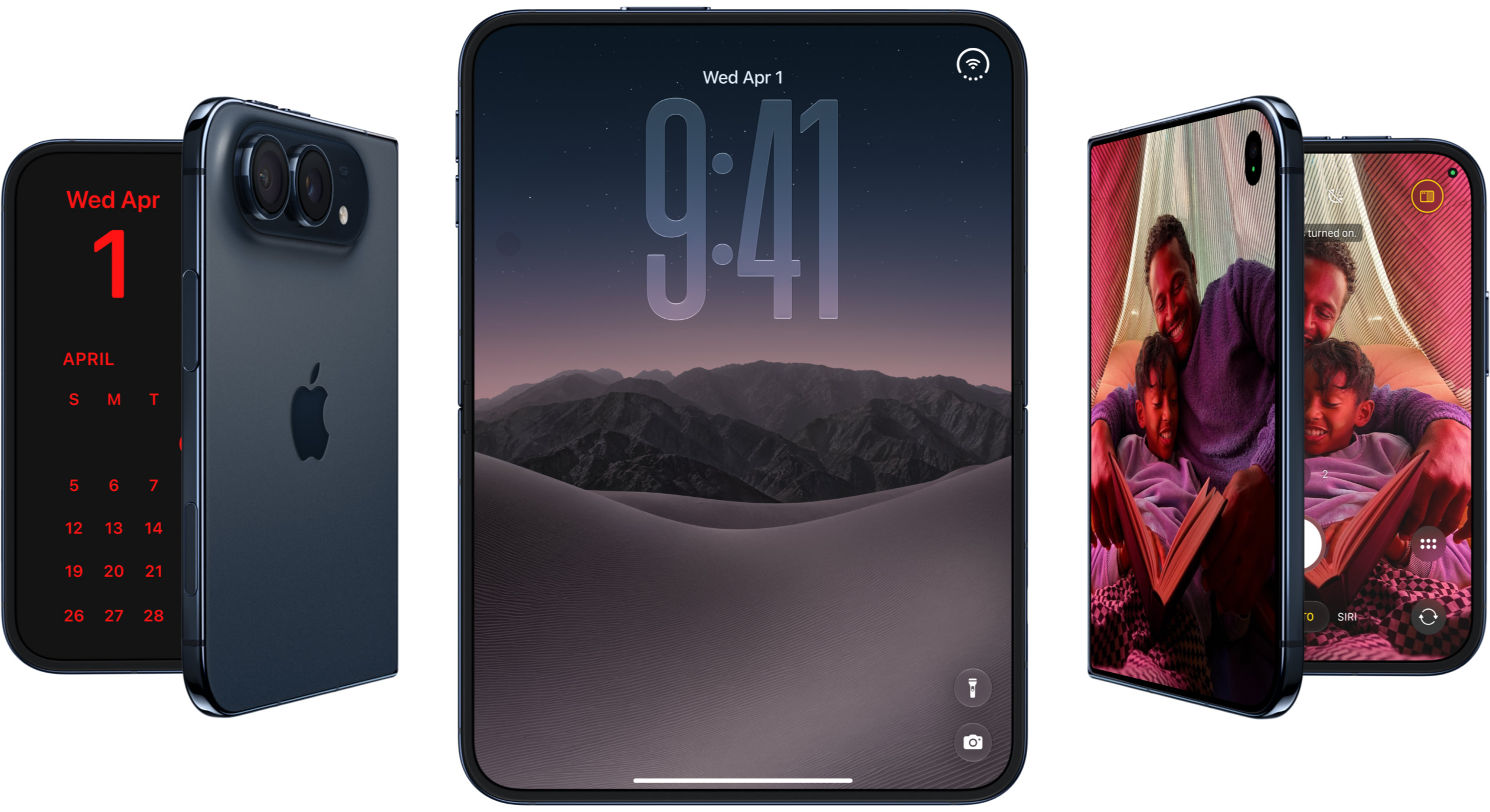
Apple finally entered the foldable phone market today with the iPhone Duo, a device that reflects years of watching competitors fumble the form factor before committing its own resources. The result is a foldable that attacks every weak point in existing designs: the crease, the glare, the fragility, the cheap tactile feel that makes you wonder whether you're holding a flagship or a prototype.
Premium Materials, Not Compromises
The iPhone Duo's chassis is built from grade 5 titanium with a hinge constructed from a titanium and aluminum blend. Where competitors have relied on standard alloys, Apple went further. The antenna splits are reinforced with ceramic fiber inserts that the company claims are three times stronger than grade 5 titanium. Ceramic Shield 2 protects the front display, while the original Ceramic Shield covers the back. This isn't spec-sheet boasting. It's a direct response to foldables that creak, flex, and develop wobble within months of purchase.
The hinge mechanism itself uses what Apple calls a custom variable torque profile that precisely controls opening and closing, paired with a magnet array that delivers a satisfying closure. A titanium plate forms the bottom layer for durability, with carbon fiber support plates adding structural rigidity. During manufacturing, Apple uses AI algorithms to match each individual hinge with its optimal housing for perfect alignment.
The Display That Finally Solved Glare
Johny Srouji addressed what Apple calls "the elephant in the room" during the announcement: the crease and reflections that plague foldable screens. Apple developed a custom nanotexture finish that significantly reduces glare while creating a perceptually flat matte surface that minimizes crease visibility. The multi-layer laminated display design includes a nano texture covered layer with a stiff polymer and Apple-designed coating for scratch resistance.
This is the first iPhone with nanotexture display technology, previously reserved for Apple's desktop products and Pro Display XDR. The 7.6-inch Super Retina XDR inner display and 5.4-inch outer display both share identical aspect ratios, allowing iOS 27 to seamlessly transition between them.
Camera System Built for the Form Factor
The iPhone Duo carries a 48MP Fusion main camera with zero shutter lag, a feature Apple introduced about two years ago. It has sensor-shift optical image stabilization and supports 4K video at 120 frames per second. A 12MP telephoto camera with 2x zoom rounds out the rear system. The 12MP selfie camera sits on the exterior, while a FaceTime camera hides under the inner display.
Because the device can stand on its own in a tent configuration, it's optimized for 4K time-lapse capture without a tripod. The folding form factor also enables dual-screen FaceTime calls where you and your conversation partner each occupy a screen.
iOS 27 Was Built for This
Software is where Apple's vertical integration advantage becomes most apparent. iOS 27 was designed with folding states and hinge angles in mind. Controls on the outer screen move to the side, seamlessly transitioning to the inner display as the device opens. Apps dynamically adjust to position, running side by side with pairing for quick switching. Whether open, closed, on its side, or half-open, iOS reacts as needed.
John Ternus took a pointed jab at competitors during the announcement, saying that "others have created foldables that just feel like two phones stuck together." Apple's answer was to design hardware and software as a unified system.
Pricing and Availability
The iPhone Duo starts at $2,000 for 256GB of storage and climbs to around $3,000 at the top end. It comes in Star White and Night Sky colorways, both built from that grade 5 titanium frame. Touch ID is integrated into the side button, with Apple Watch unlock available for those who prefer it. Face ID is absent.
The device is expected to go on sale as early as October, trailing the iPhone 18 Pro and Pro Max by several weeks. Apple Pencil support is coming later this year, making the iPhone Duo the first iPhone to officially work with the stylus.