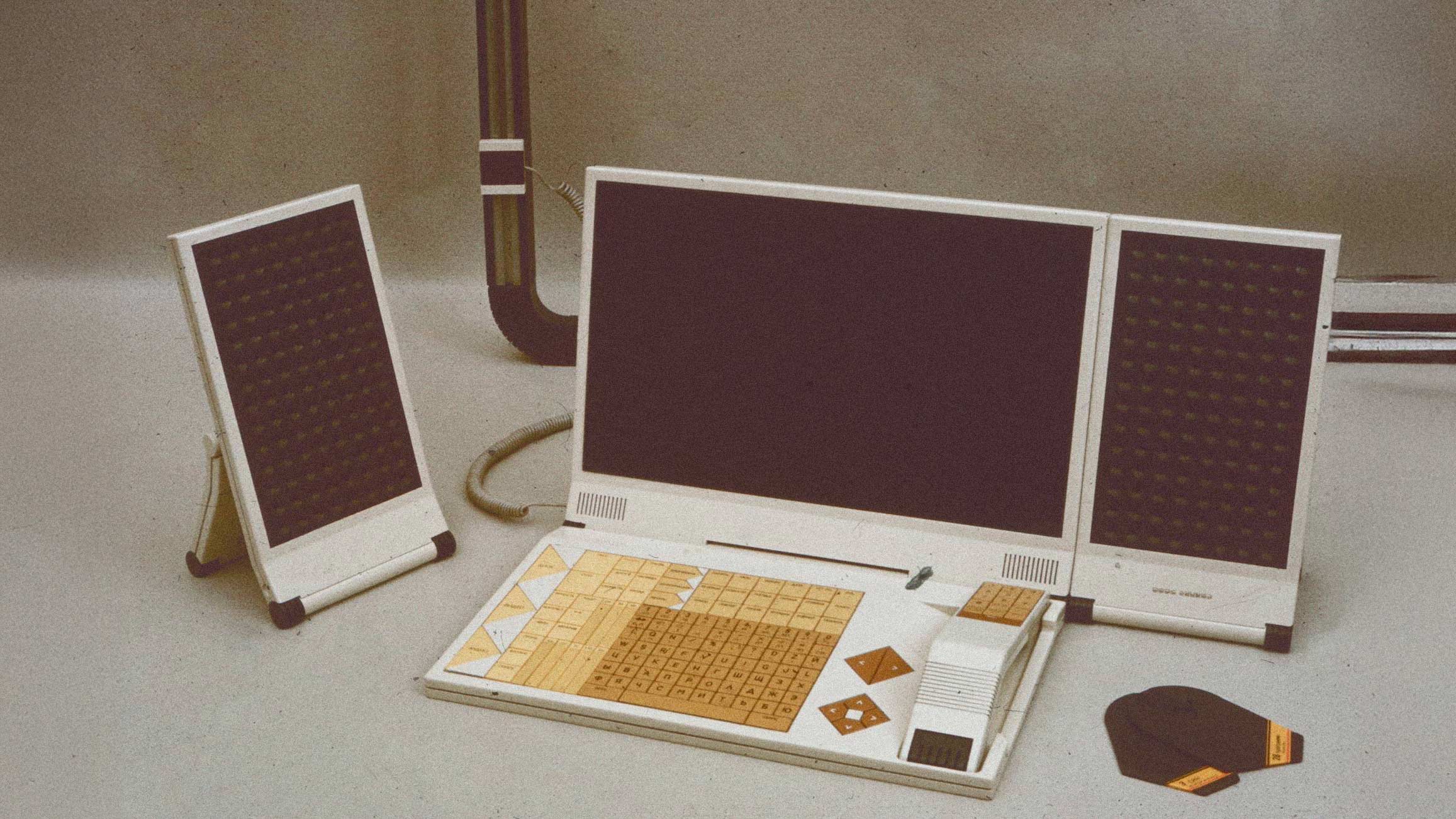
There is something haunting about looking at photos from the Sphinx project. The mockup, unveiled in 1987 in the pages of the Soviet design journal Technical Aesthetics, shows spherical speakers, flat-panel displays, handheld remotes with screens, and a central processor that would control every electronic device in your home. It looks like concept art for a science fiction film, except it was commissioned by the Soviet State Committee for Science and Technology as a real design brief.
The Sphinx (an acronym for Super Functional Integrated Communicative System in Russian) was designed by Dmitry Azrikan alongside A. Kolotushkin and V. Goessen. The assignment from the state was to create a "revolutionary computer," and the team delivered a vision that anticipated the connected home by three decades.
A System Ahead of Its Time
What made Sphinx unusual was its focus on the household as an information network. The system was conceived as a way to replace all the "boxes" in the home environment: tape recorders, televisions, watches, phones. Everything would connect to a central processor with expandable memory blocks that multiple family members could use simultaneously.
The designers imagined large flat-panel displays up to a meter tall for collective family entertainment. Detachable monitors. Speakers that could be placed throughout an apartment. Handheld remotes with built-in displays, speakers, and microphones. The 1987 article in Technical Aesthetics described Sphinx as "not so much a project of an object, as a project of the interaction of consumers with information."
Voice control was part of the specification. The system was intended to work "not only with the help of control panels, but also by voice." It promised home control, information services, and even medical diagnostics.
None of it was built. The mockup was just foam and plastic. The technology required to make Sphinx functional, including wireless peripherals, flat-screen color displays, and sufficient processing power, was far beyond what the Soviet Union or anyone else could manufacture in 1987. The project remained a beautiful artifact of futures that never shipped.
The Dreams That Didn't Die
Sphinx was not alone. The 1980s produced an entire genre of smart home visions that crashed against the hard limits of available technology. In the United States, the Unity Systems Home Manager offered touchscreen control of lighting, HVAC, and security as early as 1985. The X-10 Powerhouse protocol, designed in 1975, let IBM PCs send commands to lamps over electrical wiring. But these systems were prohibitively expensive, required specialized wiring, and remained islands of automation disconnected from any larger network.
Disneyland's House of the Future, sponsored by a plastics manufacturer in the late 1950s, drew twenty million visitors over a decade with its vision of ultrasonic dishwashers and height-adjustable sinks. World's Fairs and trade shows kept promising automated kitchens and robot servants. The ideas were remarkably consistent: centralized control, voice activation, seamless integration. Only the implementations fell short.
What Changed
The technology finally caught up. Inexpensive microcontrollers. Wi-Fi and Bluetooth in everything. Local LLMs that can process natural language commands on a Raspberry Pi. Cloud-optional architectures that keep data at home.
Home Assistant, the open-source home automation platform now running in over two million households, represents a kind of vindication for the Sphinx designers. The project puts local control and privacy first, supports over a thousand device brands, and in the past year has integrated AI in ways that would have seemed fantastical even a decade ago. Users can connect to local LLMs running via Ollama or use cloud providers like OpenAI, Anthropic, or Google. The system decides when to invoke AI and when to handle commands directly, making artificial intelligence a fallback rather than a dependency.
Home Assistant's Assist voice system now supports custom wake words, streaming text-to-speech, and conversations that can be initiated by the home itself. An automation detects the garage door left open and asks if you want to close it. You respond by voice. This is closer to the Sphinx vision than anything Amazon or Google has shipped, and it runs on hardware you own.
Bespoke at Last
The real shift is philosophical as much as technical. Agent-as-a-Service models and decision-making architectures are giving individuals the tools that once required corporate infrastructure. A hobbyist can now build a voice assistant that responds to natural language, summarizes sensor data, recognizes images, and controls every device in their home without sending a single packet to an external server.
Dmitry Azrikan and his team drew spherical speakers and detachable screens because they understood what people wanted: a home that listens, responds, and adapts. They could not build it in 1987. The economics and the engineering simply did not exist.
But the vision was correct. We are building it now, one open-source commit at a time.