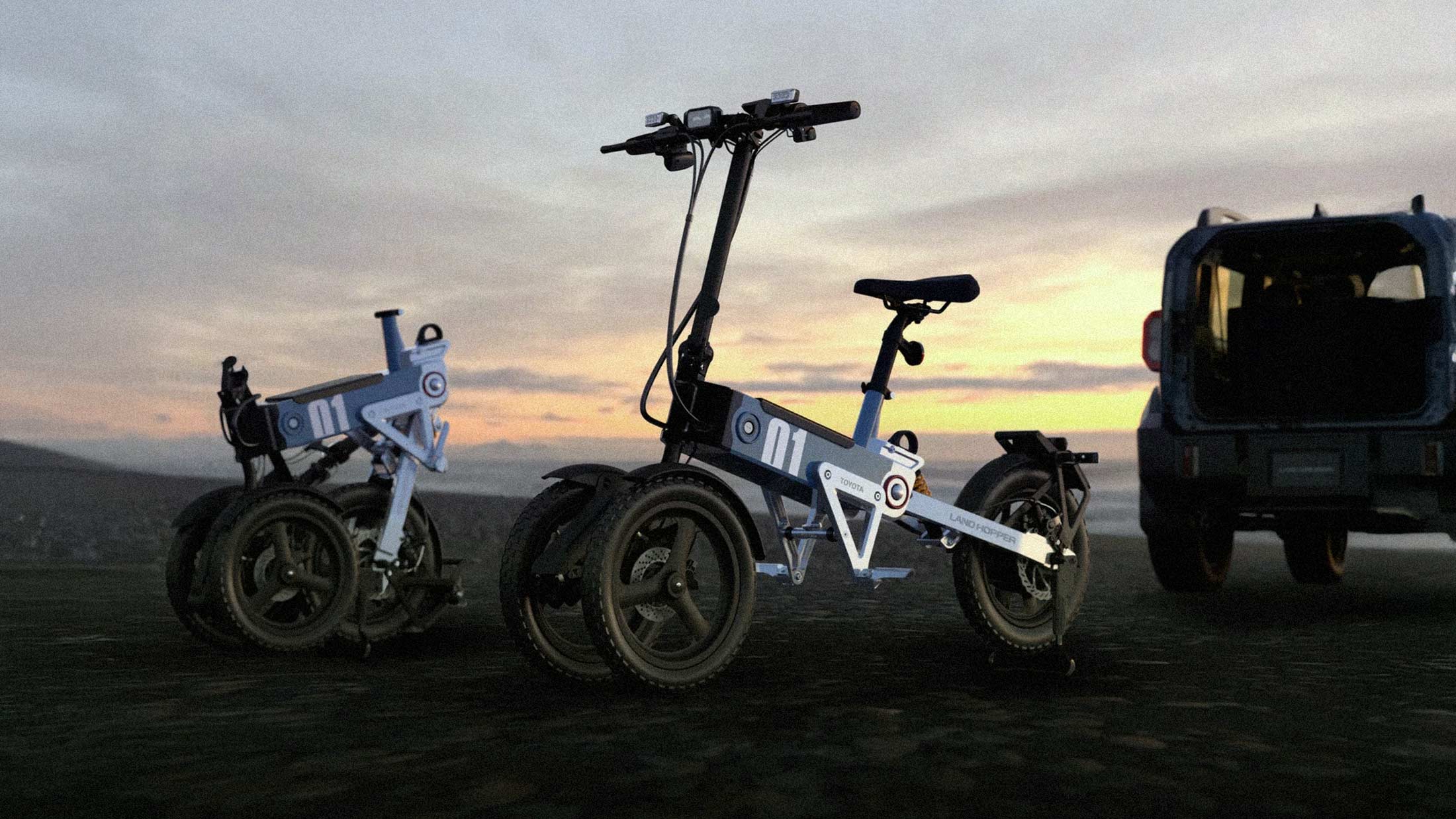
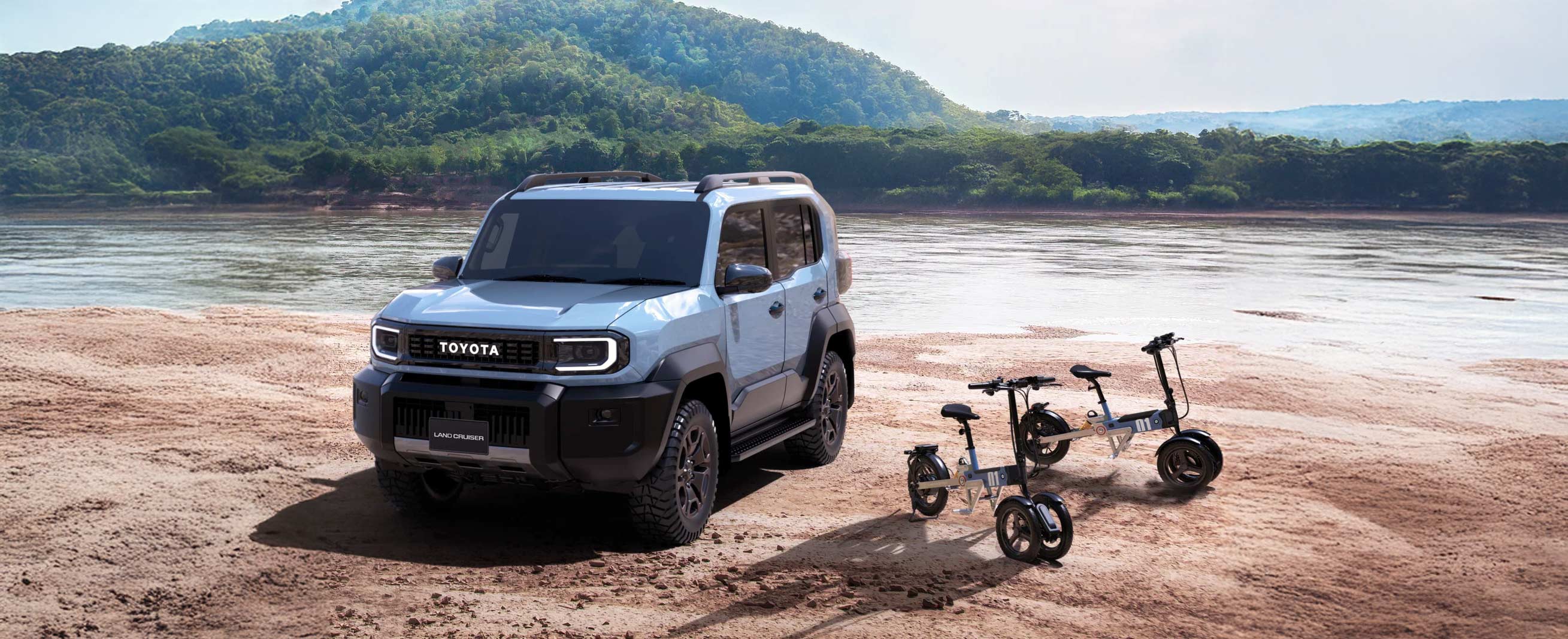
Toyota announced on May 14 that the Land Hopper, a foldable electric three-wheeler, will launch in Japan from spring 2027. The vehicle is positioned as a companion to the Land Cruiser lineup, designed to take riders where larger vehicles cannot go.
The concept is straightforward: drive your Land Cruiser to a trailhead, pull the Land Hopper out of the cargo area, unfold it, and continue onto paths too narrow or rough for anything with four wheels and a differential. Toyota describes it as enabling users to experience the joy of off-road riding on trails, particularly unpaved mountain and forest paths.
A Regulatory Sweet Spot
The Land Hopper is classified as a specified small motorized bicycle under Japan's amended Road Traffic Law. Under this classification, anyone 16 years or older can operate the vehicle without a driver's license, provided the maximum speed is capped at 20 km/h. This regulatory positioning is deliberate. It makes the vehicle accessible to aging Land Cruiser owners who may have surrendered their licenses but still want trail access, and to tourists who cannot legally drive in Japan.
The vehicle uses a dual front-wheel configuration connected to bicycle-style handlebars, with a single rear wheel. This layout provides stable travel from low to high speeds on off-road terrain, according to Toyota. A leaning mechanism allows the front wheels to move independently, creating what the company describes as an intuitive and enjoyable ride unlike any car or bicycle. The seat includes shock-absorbing springs, and the entire unit folds into a shape compact enough for most vehicle trunks.
The Competitive Landscape
The Honda Motocompacto is the obvious comparison. Launched in late 2023 at $995, Honda's electric suitcase-scooter folds into a compact rectangle, hits 15 mph, and covers up to 12 miles on a charge. It weighs 41 pounds and targets urban last-mile commuting. The original Honda Motocompo from 1981-1983 established this category in Japan decades ago.
Toyota has not disclosed technical specifications for the Land Hopper. Range, battery capacity, motor power, weight, and price remain unconfirmed. What distinguishes it from the Motocompacto is the terrain focus. Honda built a city vehicle. Toyota built something for dirt.
The broader micro-mobility market is accelerating rapidly. The global electric scooter market is projected to grow at roughly 12.8% annually through 2034, with Asia Pacific dominating both production and consumption. The e-scooter and moped segment leads the electric two-wheeler market because these vehicles address daily urban mobility needs at low cost with easy maneuverability.
Beyond the Pavement
The more interesting angle is what the Land Hopper signals about Toyota's mobility vision. The company has historically been slow to electrification in its mainline vehicles, but its approach to personal mobility devices shows more flexibility. The Land Hopper sits alongside concepts like the JUU, an electric wheelchair that can climb stairs, and space mobility prototypes developed for lunar exploration.
Pairing the Land Hopper with the new Land Cruiser FJ, which launched in Japan on May 14, positions it as more than a standalone product. It is an ecosystem play. Buy the compact, lifestyle-oriented FJ. Store the Land Hopper in the cargo area. Go places neither vehicle could reach alone.
Whether Toyota will bring the Land Hopper outside Japan remains unclear. The regulatory framework that makes it license-free applies specifically to Japanese law. Markets with different classifications for low-speed electric vehicles would require separate certification. Technical specifications, pricing, and availability outside Japan have not been announced.