The International Space Station's days are numbered. NASA has committed to operating the ISS through 2030, after which the agency plans to transition to commercially owned platforms in low-Earth orbit. That leaves roughly four years to ensure the United States maintains an unbroken human presence in space. Vast, a Long Beach-based aerospace company founded in 2021, is betting it can fill that gap.
The company's pitch is straightforward. Rather than designing a massive station on paper and hoping everything works when it finally reaches orbit, Vast is taking what it calls an incremental, hardware-rich approach. Each milestone tests systems in the real environment before committing to the next phase. It sounds obvious. In aerospace, where development cycles stretch for decades and cost overruns are standard, this is actually unusual.
Vast is ready to support a continuous presence in space for the US and its allies. Through our hardware-rich, stepping-stone approach to building next-generation space stations, we validate our systems early to ensure readiness, starting with the success of Haven Demo. pic.twitter.com/fYVv5cCh3R
— Vast (@vast) May 8, 2026
Haven Demo Proved the Concept
In November 2025, Vast launched Haven Demo aboard SpaceX's Bandwagon-4 rideshare mission. The spacecraft was a proving ground for the systems that will power Haven-1, the company's first space station. Over three months in orbit, Haven Demo completed 49 test objectives, validating guidance, navigation, and control hardware, avionics, solar arrays, radio frequency communications, thermal control, propulsion, and flight software.
"Haven Demo gave us exactly what we needed: real flight data," said Jim Martz, Senior Vice President of Engineering at Vast. "You can model propulsion, radiation effects, and navigation on the ground, but until you operate in orbit, you don't truly know how your systems perform."
The mission ended with a controlled deorbit in February 2026, splashing down in the South Pacific. Vast says it is now the only operational commercial space station company to have designed, built, flown, and safely deorbited its own spacecraft. That claim matters in a competitive landscape where rivals like Axiom Space and Starlab are also vying for NASA's attention and contracts.
Haven-1 Enters Integration
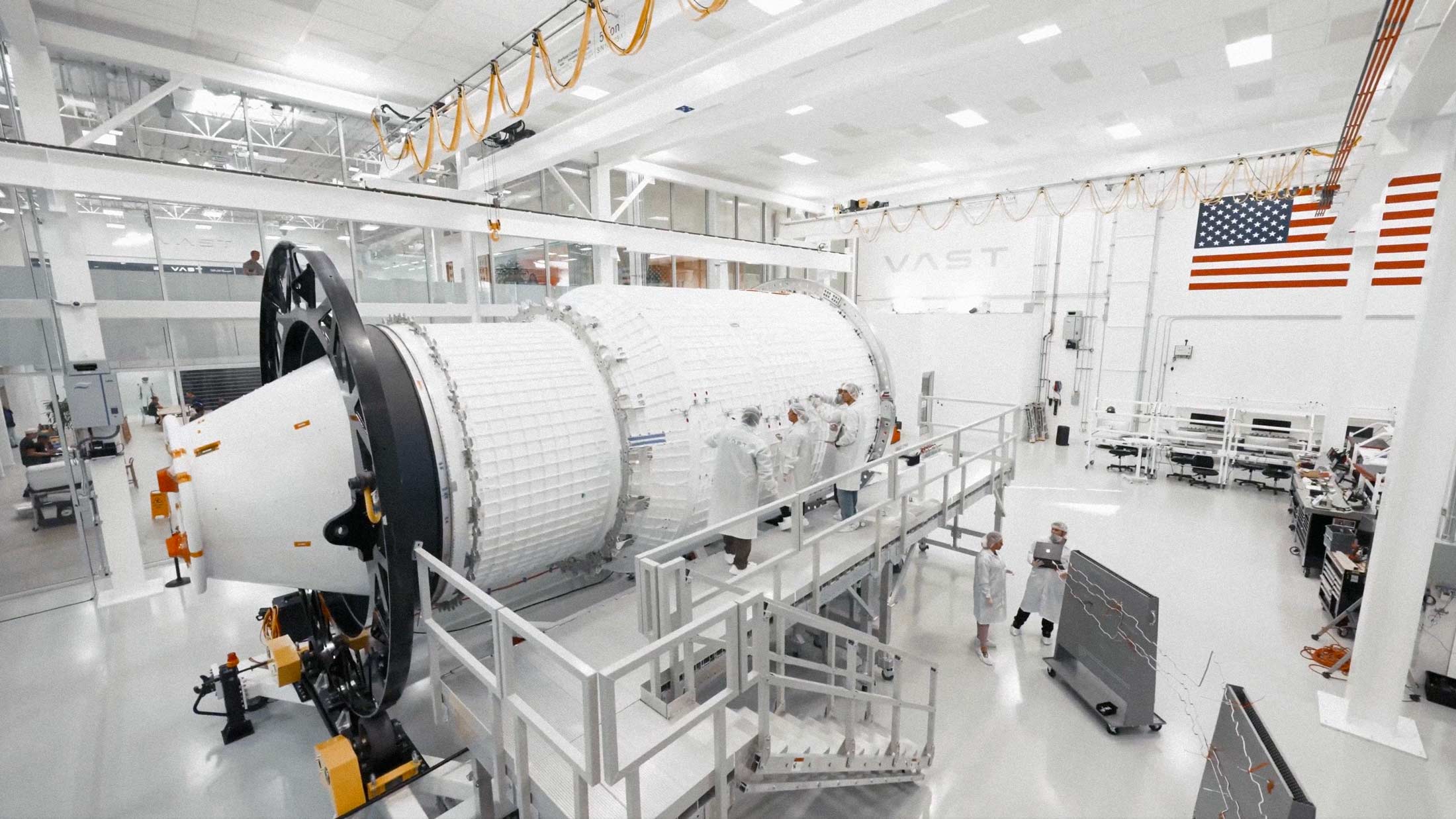
With Haven Demo behind it, Vast has moved Haven-1 into integration at its Long Beach headquarters. The primary structure is the first space station flight article to be built in the United States in over 20 years. It is the third major structure the company has completed in two years.
Haven-1 is designed as a standalone crewed station, scheduled to launch in early 2027 atop a SpaceX Falcon 9. Four crew members will visit aboard a Crew Dragon for missions lasting 10 to 30 days. The station will include a microgravity research facility with 10 payload slots. Partners already lined up include Redwire, Yuri Gravity, Japan Manned Space Systems Corporation, Interstellar Lab, and Exobiosphere.
The station is intentionally modest. With 45 cubic meters of habitable volume and a single docking port, Haven-1 relies on the Crew Dragon for key life support functions. Max Haot, Vast's CEO, has described it as a "minimum viable product." Everything the company learns will feed into Haven-2, a multi-module station intended as the successor to the ISS.
The Funding and the Stakes
In March 2026, Vast announced $500 million in new funding, consisting of $300 million in Series A equity and $200 million in debt. Investors included Balerion Space Ventures, IQT, Qatar Investment Authority, Mitsui & Co., MUFG, Nikon, and founder Jed McCaleb. To date, more than $1 billion has been invested in Vast's space station technologies and facilities.
The company now employs over 1,000 people. In February, NASA selected Vast for the sixth private astronaut mission to the ISS, scheduled for no earlier than summer 2027. Vast is also competing for the second phase of NASA's Commercial Low Earth Orbit Destinations program, with selections expected in 2026.
The strategic objective is clear. Haven-2 is designed to ensure continuous human presence in low-Earth orbit for the United States and its allies. Vast's roadmap extends further, toward future habitats for the Moon and Mars and, eventually, artificial gravity stations generated by rotating modules.
Whether Vast can execute on that vision depends on a series of engineering milestones still ahead. But with Haven Demo validated and Haven-1 in integration, the company has tangible hardware where others have PowerPoint slides.