Anduril Industries has assembled what amounts to a complete autonomous maritime warfare system. The components are purpose-built to work together: extra-large underwater motherships that deploy swarms of smaller attack vehicles and sensor nodes, all networked through a single AI platform. The company's pitch is straightforward: cheaper than legacy submarines, faster to produce, and expendable where crewed vessels cannot afford to be.
The Dive-XL: The Mothership
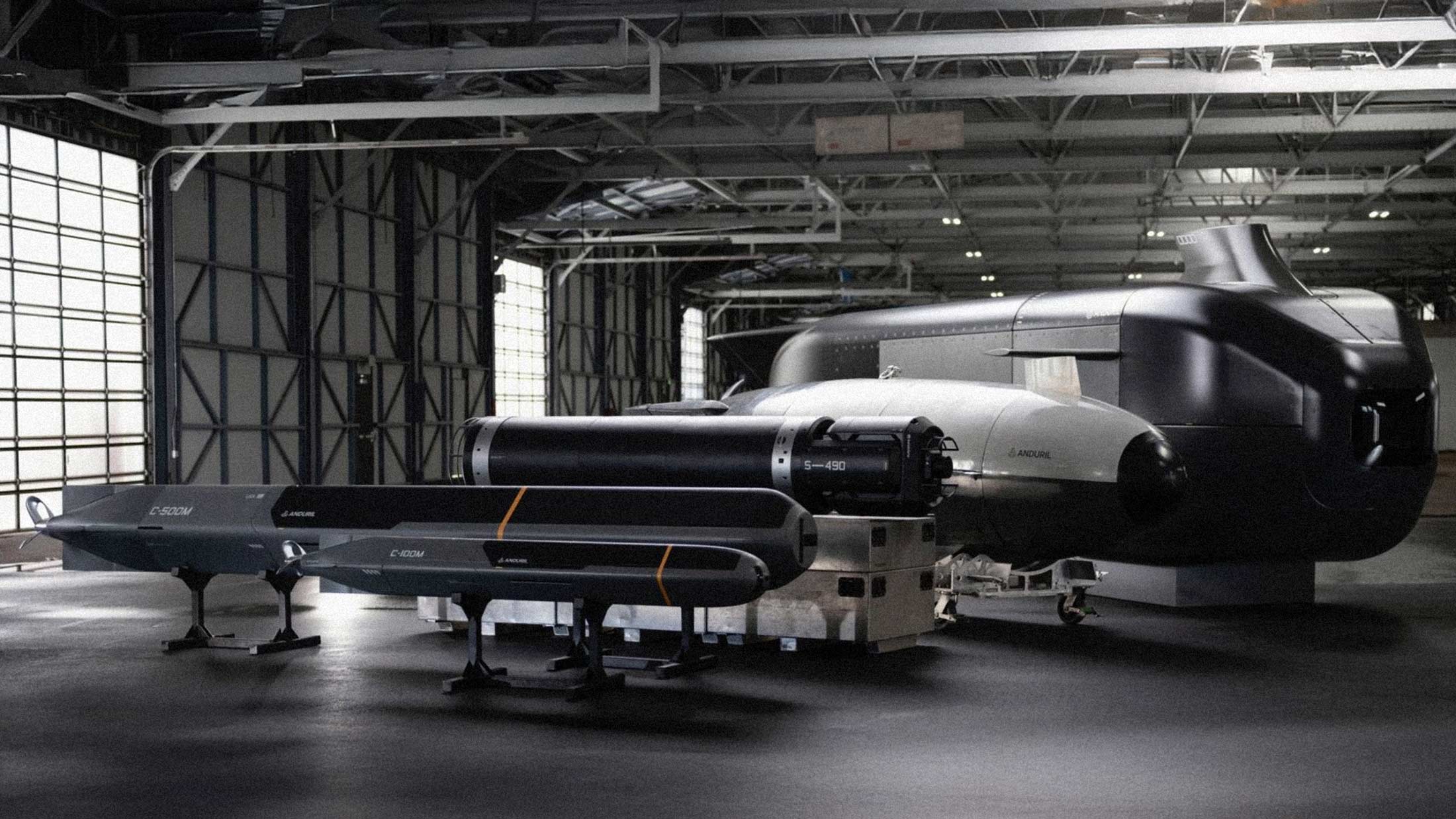
Dive-XL is Anduril's extra large autonomous undersea vehicle, built for long-range, extended-duration defense and commercial missions with large payload capacity. The system has a maximum range of over 2,000 nautical miles and a payload volume of approximately 11.4 cubic meters. The vehicle is propelled by an all-electric powertrain that allows it to speed through the depths without needing to break the surface.
The Defense Innovation Unit and U.S. Navy have selected Anduril for the Combat Autonomous Maritime Platform Project, a significant validation of the platform's operational readiness. Under its auspices, Anduril will complete a long-duration, operationally representative demonstration of Dive-XL within 4 months of contract award.
The Dive-XL shares its architecture with Ghost Shark, the XL-AUV that the Albanese Government is investing $1.7 billion to acquire for the Royal Australian Navy. The XL-AUV went from concept to reality in less than three years, with all three prototypes delivered on budget and ahead of schedule. Anduril is producing Dive-XLs in Sydney, Australia, and has a purpose-built facility in Quonset Point, Rhode Island designed to deliver dozens of Dive-XLs and hundreds of Dive-LDs per year.
Copperhead: The Munition
Copperhead is a family of reusable unmanned underwater vehicles developed by Anduril. The family consists of two size classes of autonomous undersea vehicle, with both utility and munition subvariants of each.
The two classes are designated by weight: the 12.75-inch diameter Copperhead-100 supporting a 100-pound dry weight payload, and the 21-inch Copperhead-500 supporting a 500-pound payload. The Copperhead-500 is comparable in capability to a Mk 48 heavyweight torpedo and the 100 is roughly similar to a Mk 54, according to Shane Arnott, Anduril's Senior Vice President for Engineering. The difference is cost. Copperhead features a rectangular hull form, rather than the cylindrical hull shapes of legacy torpedoes. This was a deliberate decision to simplify development and reduce construction costs. Anduril claims that this production system is intended to produce hundreds to thousands of these systems a year.
A Dive-XL can carry dozens of the smaller Copperhead-M and multiple of the larger size missile. According to Anduril, this makes it possible for a fleet of Dive-XLs to control ocean areas with an unprecedented level of autonomous seapower.
The operational concept resembles what Ukraine demonstrated against Russia's Black Sea Fleet with surface drones, but extended into the undersea domain. Arnott has described Copperheads as tools "as unmanned systems proliferate undersea, or on the surface, both for the bad guys and the good guys."
Seabed Sentry: The Network
Seabed Sentry creates a persistent wireless underwater network for real-time sensing and communications, with AI-enabled compute engineered for the deep sea. The system consists of pressurized carbon-fiber-shelled modules with a payload space of 0.5 cubic meters that can be deployed on the seabed at depths of over 500 meters by autonomous underwater vehicles.
With endurance lasting months to years and a modular, reusable design, Seabed Sentry is built to surpass existing seabed surveillance solutions. Unlike fixed seafloor surveillance systems, Seabed Sentry is a network of cable-less deep-sea nodes that sense, process, and communicate critical subsea information at the edge in real time.
The distinction from Cold War-era systems like SOSUS is significant. These nodes can be quickly deployed where required by AUVs like Dive-XL and then carry out surveillance and reconnaissance for anti-submarine and anti-ship warfare. They can also protect infrastructure like undersea cables and pipelines.
The integrating element is Lattice, Anduril's AI platform. Powered by the Lattice AI software platform and able to support several payload variations, Seabed Sentry can be deployed by AUVs to form a defense grid, supporting the protection of key maritime regions and infrastructure.
The Strategic Picture
The system was specifically designed for an expected conflict with China, which Anduril expects will take place on a very wide waterfront and will require low-cost, high-production autonomous systems and weapons effectors that can themselves be deployed from unmanned platforms.
The company's manufacturing approach mirrors this philosophy: Anduril's autonomous undersea vehicles to date have accumulated over 42,355 kilometers and 6,752 hours of mission time. That operational record matters because the Navy's Boeing Orca XL-AUV program has faced persistent delays. Orca has followed a more bespoke and slower development path, with outside reporting in 2025 noting continued schedule slippage versus early plans.
As Arnott put it in a recent briefing: "The subsea domain currently is patrolled and serviced by a very small number of exquisite capabilities. The Pacific and also the High North, which is the new fight that's starting around the Arctic, are water-based fights."
The question for the Navy is whether Anduril's integrated stack can deliver at the scale and reliability that Pacific operations would demand. The broader trend toward autonomous systems suggests the answer will shape undersea warfare for decades.