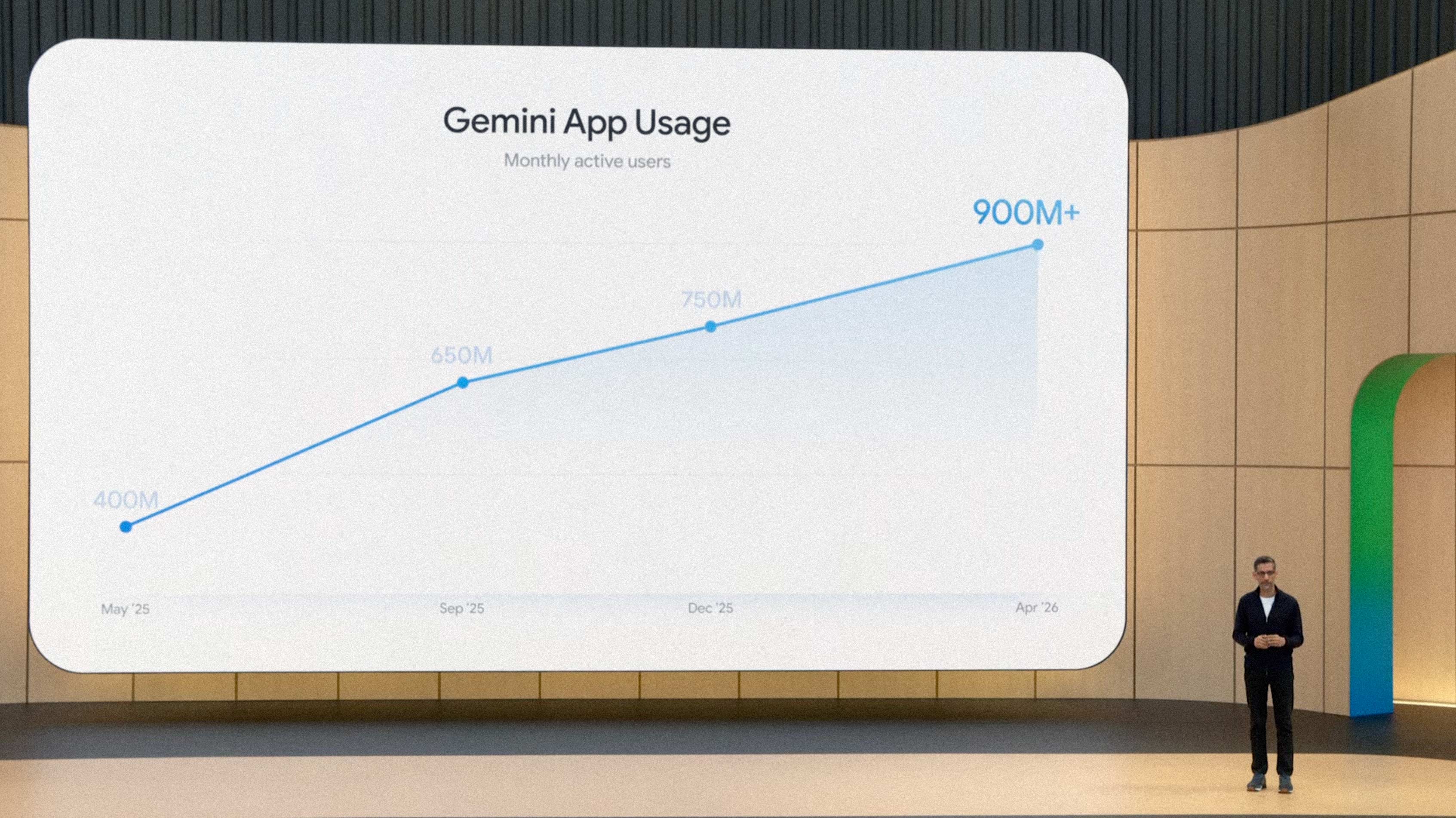
Google's I/O 2026 keynote kicked off today with the kind of staggering numbers designed to remind everyone that Sundar Pichai's company still has distribution muscle. The Gemini app has reached 900 million monthly active users, up from 400 million last year. Daily requests have grown 7x.
More than 50 billion images have now been generated using Nano Banana, Google's image generation model that became a viral phenomenon after its August 2025 debut. That figure represents a tenfold increase from the 5 billion images the original model had generated by mid-October 2025.
The Infrastructure Behind the Numbers
Pichai emphasized the compute scale required to power this growth. Google processing moved from 9.7 trillion tokens per month in May 2024 to 3.2 quadrillion tokens per month. That represents roughly 330x growth in two years, a pace that underscores both the demand for AI services and the infrastructure buildout required to meet it.
The token metric, while impressive, comes with caveats. The headline number mostly reflects computing effort, not real usage or practical value. Reasoning models process significantly more tokens per interaction than traditional queries, inflating the raw count without necessarily indicating proportional user engagement.
Nano Banana's Trajectory
Google first released Nano Banana in August 2025, prompting people to generate millions of images in the Gemini app, especially in countries like India. The model attracted 13 million new users within four days of its debut on the LMArena comparison platform. Its ability to transform photos into figurine-like renderings became a viral trend, first in India and then worldwide.
The company has since expanded the model family. In November, the company released Nano Banana Pro, which allows users to create more detailed and high-quality images. Google unveiled Nano Banana 2 (Gemini 3.1 Flash Image) on February 26, 2026, making high-quality generation available for free to the public for the first time, replacing the previous paywall that limited access to top-tier image creation tools.
The Competitive Landscape
The 900 million Gemini user figure positions Google to close the gap with OpenAI's ChatGPT, which reached 900 million weekly active users as of February 27, 2026. The distinction between monthly and weekly metrics matters: Google's figure captures a longer retention window, while OpenAI's weekly count signals more frequent engagement.
A lot of that growth has come courtesy of the company's Nano Banana image generator, according to Engadget's liveblog coverage of the event. Image generation has proven to be a powerful engagement driver in ways that text-based AI assistants struggle to match. People share generated images. They show them to friends. That virality compounds.
Google's distribution advantage remains formidable. In Q1 2025, the company said all 15 of its products with more than 500 million users use Gemini models, embedding the AI into surfaces most users interact with daily. AI Overviews in Search are used by over 2 billion people, giving Gemini exposure that standalone chatbot apps cannot match.
What the Numbers Don't Say
The metrics shared at I/O are marketing figures, not financial disclosures. Google has not revealed how many of those 900 million monthly users are paid subscribers versus free-tier users encountering Gemini through Search or other bundled products. The company also hasn't disclosed revenue specifically attributable to Gemini, though Cloud revenue grew 63%, exceeding $20 billion for the first time in Q1 2026, driven in part by AI demand.
For context on Google's broader AI strategy, see our coverage of Gemini Intelligence and Googlebooks.
The I/O keynote continues with expected announcements across Android, Cloud, and Google's extended reality efforts. The user numbers serve their intended purpose: framing Google as the company operating AI at a scale no one else can match. Whether that scale translates to sustainable competitive advantage remains the question the numbers cannot answer.