REGENT Craft has demonstrated the ability to charge its Seaglider vessels at remote coastal sites without any connection to existing port or grid infrastructure. The milestone test, completed on May 18, 2026, was a collaboration with Schneider Electric and World4Solar, and the company says it unlocks distributed maritime operations in austere environments where conventional charging networks do not exist.
The immediate implication is commercial: expanding charging options beyond fixed port infrastructure would allow operators to serve a broader range of destinations without requiring significant grid investment. But the more compelling story is military.
What Was Actually Demonstrated
The demonstration validated a three-component charging architecture combining modular battery energy storage units, hardened high-power charging hardware adapted for off-grid maritime environments, and a direct-current coupled architecture that bypasses the multiple energy conversion stages associated with conventional AC charging systems. Schneider Electric adapted its high-power charging technology to integrate with World4Solar's modular battery storage. World4Solar, based in Las Vegas, builds modular freestanding canopy systems designed to transform spaces into autonomous power plants, with integrated battery storage for off-grid operation.
The DC-coupled approach matters because it reduces the number of energy conversion stages, improving efficiency in scenarios where every watt counts.
The Commercial Case
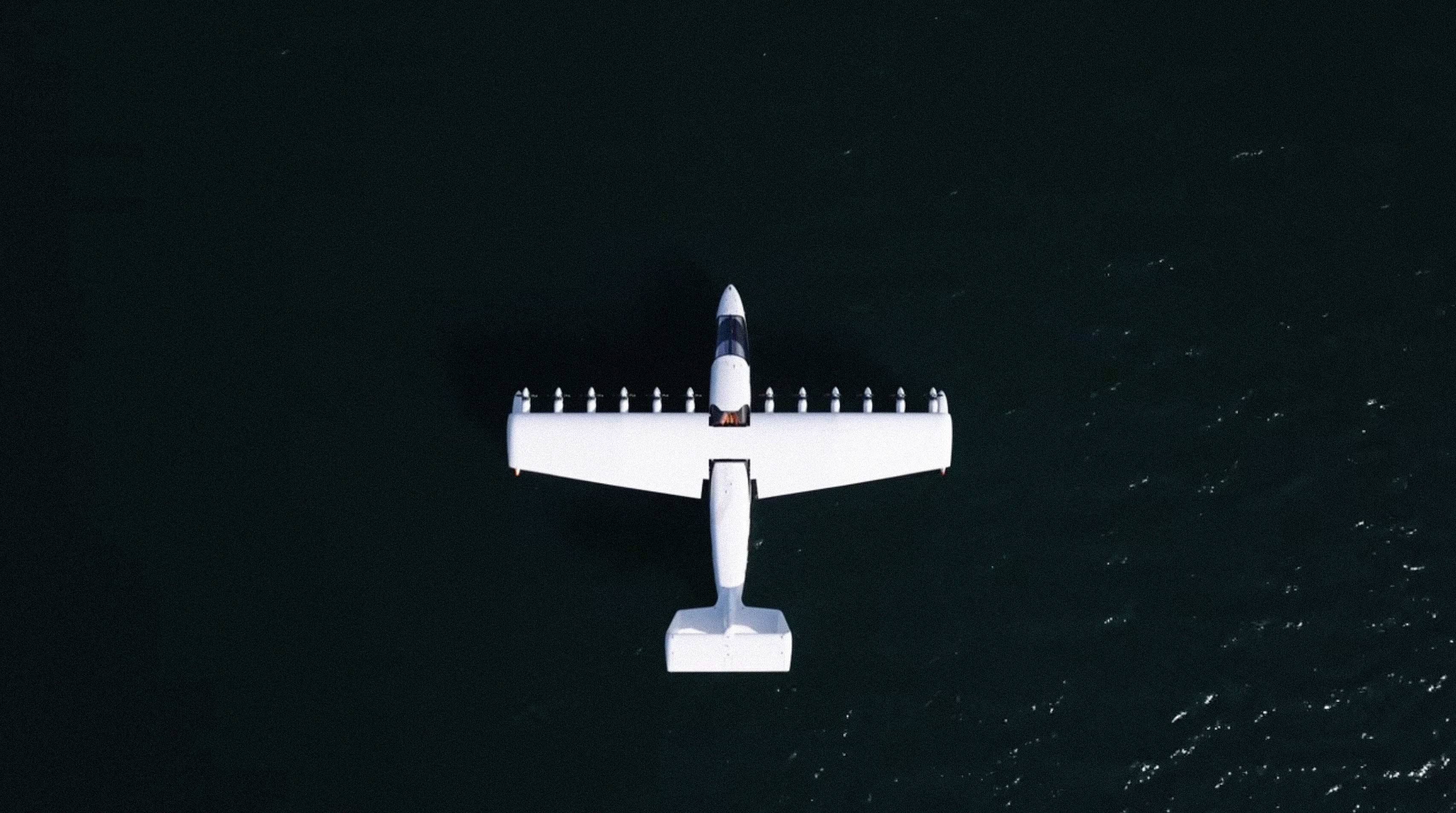
REGENT's flagship Viceroy Seaglider is a 12-passenger vehicle that operates in three modes: floating on its hull, foiling on hydrofoils, or flying in ground effect just above the water's surface. The vessels can travel routes up to 180 miles on a single charge at speeds up to 180 mph. A hybrid model extends that range to 1,400 nautical miles.
The company reports a total commercial order book exceeding $10 billion, alongside $15 million in contracts with the U.S. Marine Corps. Those are company claims, and the commercial order book represents preorders rather than delivered revenue. Still, the scale of stated interest is notable.
For commercial operators, remote charging means routes can extend to island communities and remote coastlines that lack the infrastructure to support electric aviation or maritime operations. CEO Billy Thalheimer has called charging flexibility "critical" to bringing efficient maritime mobility to coastal regions.
The Defense Angle Is More Significant
The demonstration also showed Seagliders could serve as mobile power delivery platforms to support remote expeditionary basing and mission-critical systems in austere environments.
This is where things get interesting. Tom Huntley, General Manager of REGENT Defense, stated that "the ability for Seagliders to not only operate from distributed locations, but also to bring energy forward to support expeditionary basing, communications, sensors, and other mission systems, creates new flexibility for maritime forces."
Power availability is consistently identified as one of the most significant constraints on expeditionary operations in distributed base environments. A unit operating from a remote island or coastal position needs electricity to run radios, sensors, computers, and medical equipment. Historically, that has required diesel generators, fuel resupply chains, and the logistics infrastructure to sustain them, all of which create signatures and vulnerabilities.
The U.S. Marine Corps has been developing its Expeditionary Advanced Base Operations concept, which envisions small units operating from dispersed positions across island chains without the large logistics footprint that traditional amphibious operations require. A vehicle that can both charge at improvised sites and deliver power to those sites fits that doctrine precisely.
REGENT has already extended its collaboration with the Marine Corps Warfighting Lab in an agreement currently estimated at $10 million with opportunities for extension, with the second phase examining Seaglider capabilities across contested logistics and medevac missions.
What the Seaglider Actually Is
For readers unfamiliar: REGENT describes the Seaglider as operating "within a wingspan of the water's surface in ground effect," exploiting the aerodynamic cushion that forms between a wing and a flat surface at close range. It is the same phenomenon that Soviet engineers used in the Ekranoplan vehicles of the 1960s, but REGENT has added hydrofoils for wave tolerance, distributed electric propulsion, and digital fly-by-wire controls to address the problems that plagued earlier ground-effect vehicles.
As a Type A wing-in-ground-effect craft, Seagliders operate exclusively over water within a wingspan of the surface, remaining above sonar and below radar. REGENT says the vehicles can take off and land in waves up to five feet, which previous small WIG vehicles could not do.
The companies involved say Seagliders could be used for troop and supply transport, medical evacuation, ISR, and deployment of uncrewed systems across the Indo-Pacific. The remote charging capability demonstrated this week removes one of the key constraints on that vision: the need for established infrastructure at every operating point.
What Comes Next
Customer deliveries of the Viceroy are expected to commence in 2026 to 2027. A full-scale, crewed prototype was conducting sea trials at Narragansett Bay as of September 2025.
REGENT Defense is now partnering with Fairlead, a Virginia-based maritime manufacturing firm, to scale up production and support the transition of prototypes into operational platforms for the Navy and Marine Corps.
The partnership between REGENT, Schneider Electric, and World4Solar demonstrates a piece of enabling technology. The Seaglider itself remains pre-production, and the order book remains unvalidated by actual deliveries. But for defense planners thinking about contested logistics in the Pacific, a fast, low-signature vehicle that can charge at improvised sites and deliver power forward is the kind of capability that changes how you think about distributed operations.
The race to put infrastructure at sea is heating up across multiple domains. REGENT's remote charging demonstration is one more piece of evidence that the infrastructure constraints of the 20th century may not apply to the platforms of the 21st.