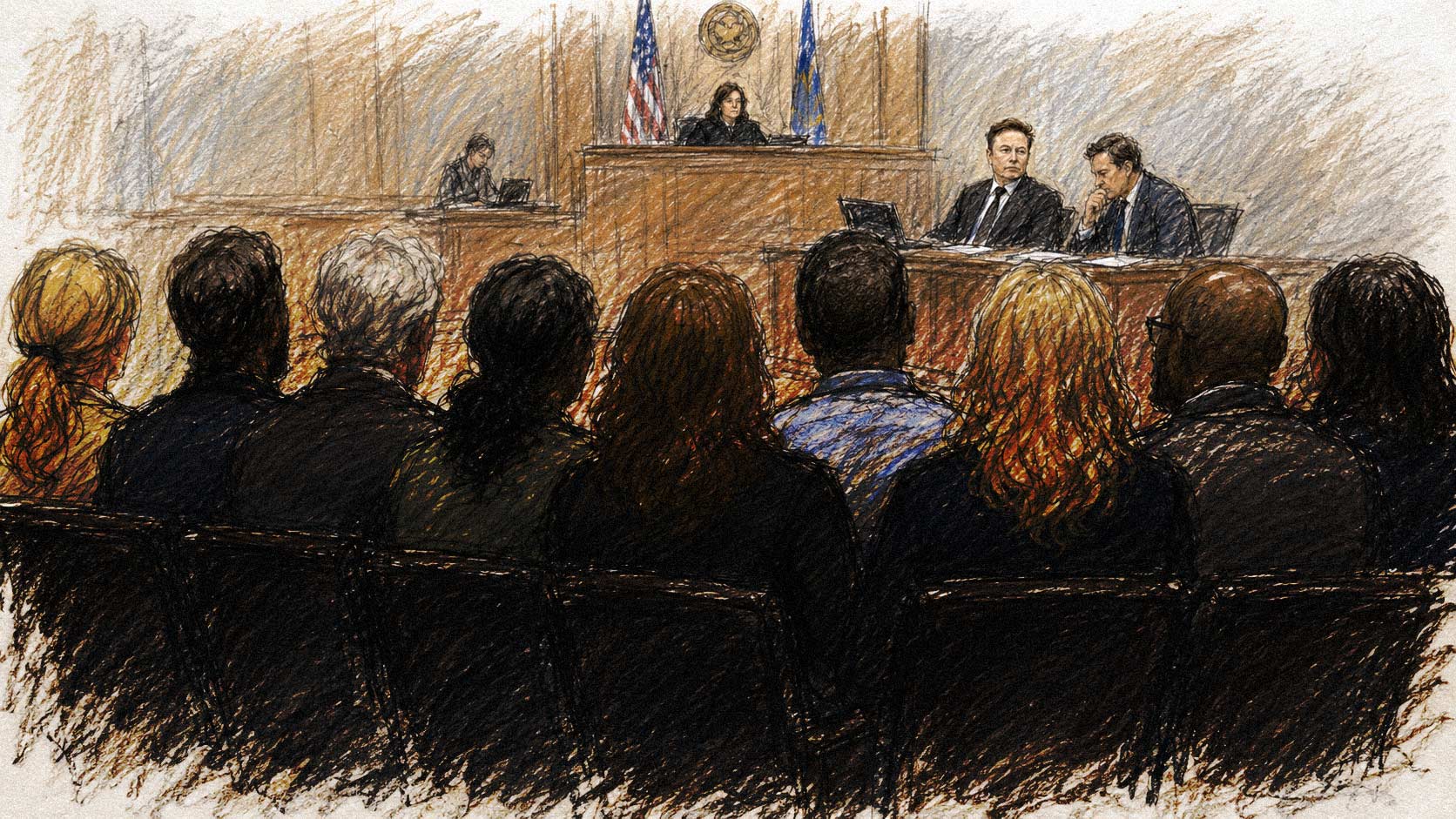
After three weeks of testimony featuring Silicon Valley's most prominent executives, a nine-person federal jury began deliberating this morning in Oakland, California, over whether OpenAI and its leadership violated charitable-trust law when they transformed a nonprofit AI lab into an $852 billion for-profit corporation.
Closing arguments wrapped up on Thursday, May 14, with attorneys for both sides delivering starkly different narratives. Musk's lead attorney Steven Molo told jurors that five witnesses, including former OpenAI chief scientist Ilya Sutskever, former CTO Mira Murati, and former board members Helen Toner and Tasha McCauley, had called CEO Sam Altman a "liar" under oath. OpenAI attorney Sarah Eddy countered that Musk "wanted dominion over AGI" and pointed to testimony suggesting he had once discussed having his children inherit control of the company.
Musk himself was not present for the closing arguments. He was in Beijing accompanying President Donald Trump on a state visit, a detail his attorney apologized for to the jury.
What the Jury Must Decide
The jury's first task is procedural but critical: determining whether Musk filed his lawsuit within the statute of limitations. He initiated the case in 2024, six years after leaving OpenAI's board. Judge Yvonne Gonzalez Rogers has indicated that if the jury finds Musk filed too late, she will likely "direct verdict to the defendants."
If the jury clears that threshold, it must then decide whether OpenAI operated under a "charitable trust" and whether Altman, president Greg Brockman, and the company violated that trust. Microsoft, which has invested more than $13 billion in OpenAI and now holds roughly 27% of the company, faces a separate question: whether it aided and abetted the alleged breach.
A peculiarity of this trial: the jury's verdict is advisory only. Judge Gonzalez Rogers will make the final ruling on liability. As one legal scholar told CNBC, judges typically empanel advisory juries when they want "community judgment" or "cover" in high-profile cases.
If Musk Wins
A verdict favoring Musk would trigger a remedies phase, running in parallel with jury deliberations, during which the judge will consider what damages and structural changes to impose. Musk has sought outcomes that have shifted over time. Most recently, he requested that Altman and Brockman be removed from their positions, and that OpenAI's 2025 recapitalization be unwound. In January, his lawyers claimed he was entitled to up to $134 billion in damages from OpenAI and Microsoft. Musk has since said any monetary award should go to OpenAI's nonprofit foundation.
The structural implications could be severe. If OpenAI were forced to revert to nonprofit status, it would have to abandon its planned IPO, which could arrive as early as Q4 2026 at a potential $1 trillion valuation. The company would also need to unwind or restructure its relationships with major investors including Microsoft, Amazon, SoftBank, and NVIDIA, who have collectively poured more than $120 billion into the company in recent funding rounds.
OpenAI disclosed in investor materials earlier this year that this lawsuit poses a "risk to business." That language was not decorative. A Musk victory could freeze the company's capital structure at the worst possible moment, just as it prepares to go public and as competitors like Anthropic, valued at $380 billion, and Musk's own xAI approach their own IPO windows.
If Musk Loses
A verdict for OpenAI would remove the most immediate legal cloud over the company's path to public markets. It would validate the for-profit restructuring that began in 2019 and was finalized in October 2025, when the nonprofit became a minority equity holder in a newly formed Public Benefit Corporation.
For Altman, who testified that Musk "abandoned" OpenAI and left it "for dead," a win would provide some vindication after a trial that put his credibility on the stand. But the damage to his public image may already be done. Testimony revealed internal tensions, including a November 2023 board firing that saw Altman reinstated under pressure, and a pattern of behavior that several colleagues characterized as manipulative.
For the broader AI industry, a loss for Musk would confirm that the Silicon Valley playbook of converting nonprofits into commercial juggernauts remains legally defensible, at least in California federal court. It would also close a chapter that has distracted OpenAI's leadership at a time when the company is scaling aggressively, generating $2 billion in monthly revenue and racing to maintain its lead against well-capitalized rivals.
The Wildcards
A few uncertainties remain. The statute of limitations question could end the case before the substantive issues are even reached. And even if the jury rules in Musk's favor, Gonzalez Rogers may decline to follow its recommendation, particularly on the more extreme remedies like leadership removal.
There is also the question of appeals. Any ruling of this magnitude will almost certainly be challenged, extending the legal uncertainty for years.
What is clear is that this case has become a test of whether OpenAI's commercial transformation can withstand legal scrutiny, and whether the promises made in its early days carry enforceable weight. A verdict could arrive as early as this week. The trial began on April 28. The jury received its instructions Thursday. By Friday, they may have already reached a decision. Court is not in session on Fridays, which means any announcement would come Monday or later.
In the meantime, OpenAI's planned IPO, Microsoft's $135 billion stake, and the competitive balance of the AI industry all hang on the deliberations of nine Oakland jurors who have spent three weeks listening to billionaires argue about who betrayed whom first.