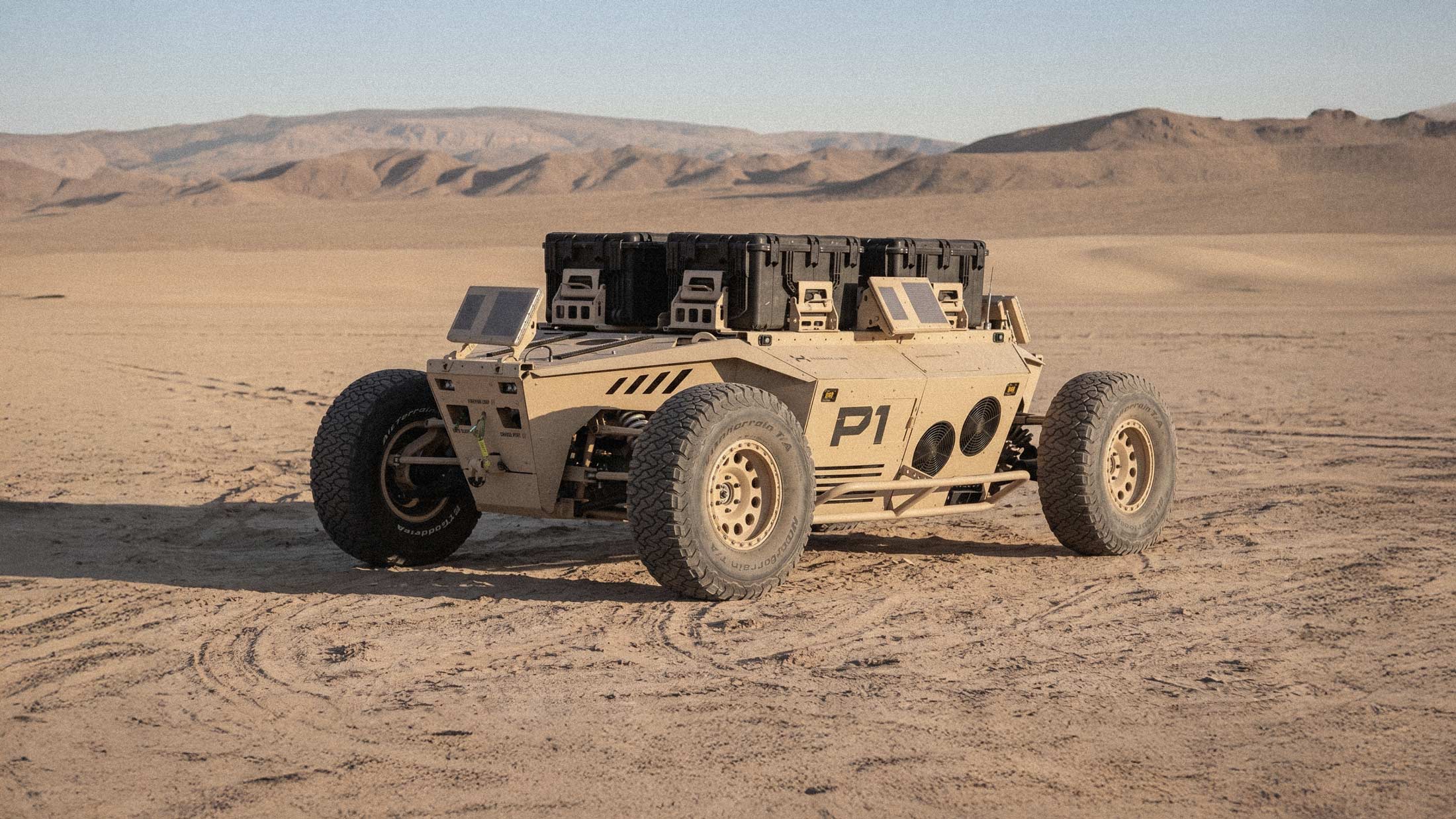
Hypercraft, based in Provo, Utah, has officially launched the Razorback, an autonomous unmanned ground vehicle built as a software-defined platform for contested military environments. The vehicle can haul 2,400 pounds of payload across 280 miles on a single fuel cycle while simultaneously exporting 38 kilowatts of power to forward-deployed equipment.
That 38 kW figure matters. Drone charging stations, directed energy weapons, ISR sensor nodes, electronic warfare systems, and command post equipment all require continuous electrical supply that conventional generator convoys struggle to deliver safely. The Razorback treats each vehicle as a mobile energy node rather than a simple cargo carrier, which fundamentally changes how distributed operations can be sustained.
Key Specifications
- Drivetrain: 300 hp diesel hybrid-electric
- Payload capacity: 2,400 lbs
- Range: 280 miles
- Exportable power: 38 kW
- Chassis: 148-inch wheelbase
- Tires: 37-inch
- Steering: 4-wheel hydraulic with neutral steer capability
- Architecture: MOSA-compliant, central-zonal computing
The Software-Defined Advantage
Hypercraft is positioning the Razorback as a platform that evolves with the threat environment. The open architecture decouples hardware from software, enabling over-the-air updates and rapid mission-set swaps without physical modification. A vehicle configured for contested logistics resupply can be reconfigured for electronic warfare relay or counter-UAS operations through software alone.
The platform runs on a central-zonal computing architecture built around high-performance edge processing. This enables AI integration and autonomy upgrades as the technology matures. The company's vehicle operating system allows upgradable applications that extend service life. Hypercraft also emphasizes the "right to repair, right to develop" model, giving customers the ability to maintain and extend the platform themselves.
Mission Configurations
The company has outlined several core roles for the platform. The counter-UAS configuration integrates Fortem Technology's radar and capture systems for autonomous airspace denial against Group 1 and 2 drone threats. The platform provides 360-degree protection and can also supply power for laser and RF directed energy weapons.
Contested logistics is another primary use case. The vehicle can operate in GNSS-denied environments and can interconnect with other Razorbacks to form tactical microgrids. The casualty evacuation mission set addresses a persistent problem in ground combat: extracting wounded personnel typically requires exposing additional soldiers to the same threat environment. An autonomous platform that can reach forward positions and extract casualties without a crew changes that calculus.
The Target Market
The Razorback is aimed squarely at modern military operations where logistics chains are liabilities and distributed forces need persistent power without large generator convoys. The hybrid-electric drivetrain enables "silent watch" operations and low-acoustic maneuvering, with cold-start capability for entering contested environments without triggering infrared or acoustic detection.
Hypercraft has raised $32.2 million to date and recently announced a partnership with Baker Engineering to develop hybrid-electric vehicles for defense applications. The company's powertrain technology already supports an off-road vehicle deployed by several branches of the U.S. military.
Pricing has not been disclosed.