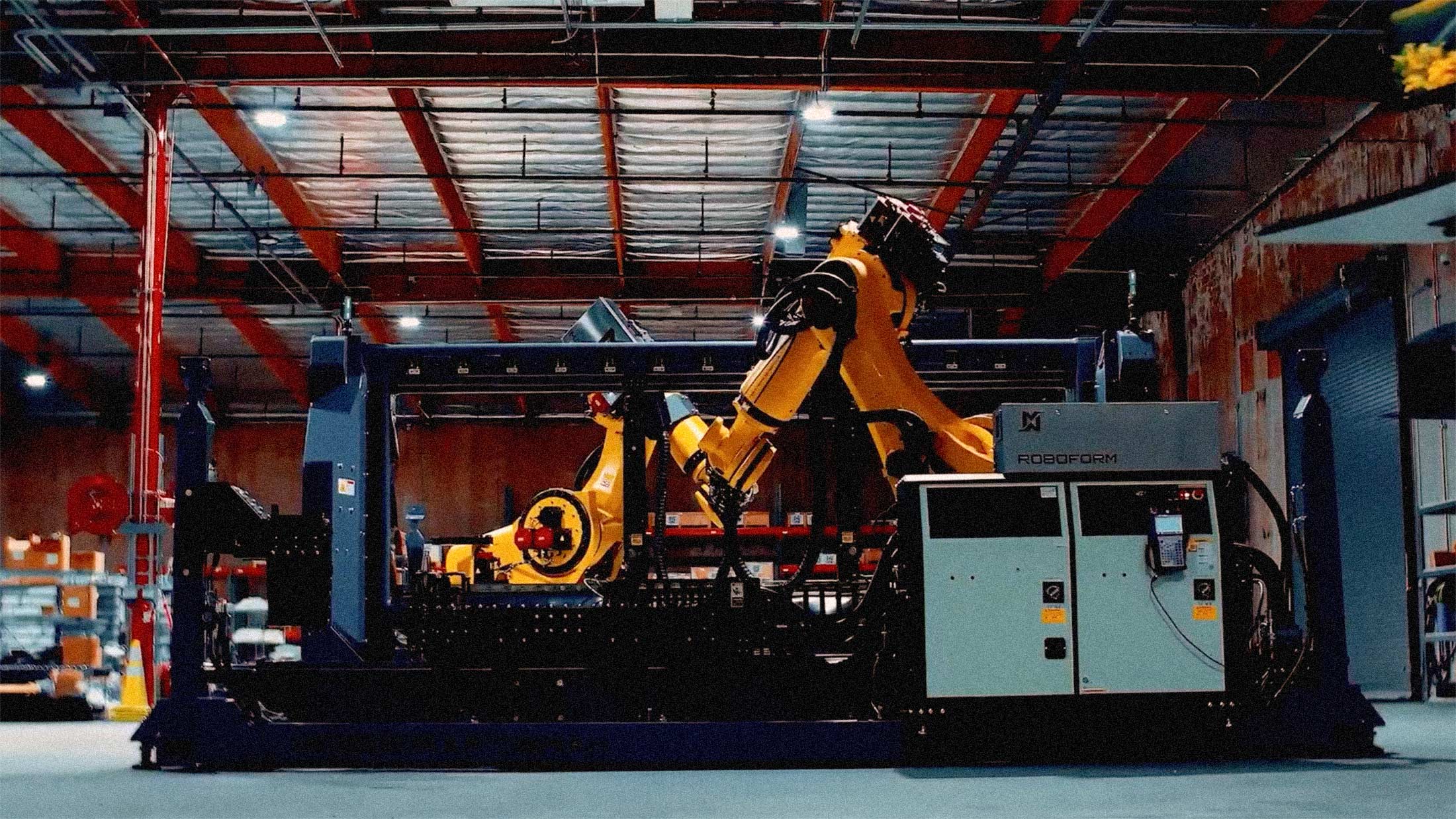
At Machina Labs' 75,000-square-foot facility in Chatsworth, two workers tighten bolts on a newly assembled robotic factory. Seven feet away, an identical system presses sheet metal into the surface of a drone. These compact units, equipped with dual robotic arms and AI-driven controls, produce everything from military drones to automotive body panels to theme park props.
The company, founded in 2019, raised $124 million in Series C funding in February 2026, with participation from Lockheed Martin Ventures, Toyota's Woven Capital, and Balerion Space Ventures. The round is part of a broader surge: U.S. advanced manufacturing companies have raised $16.4 billion in just the first two months of 2026, putting the year on pace to become the second-largest funding year in the sector's history.
The Die Is Dead
Traditional sheet metal manufacturing depends on stamping dies. These are massive custom molds, often weighing over 20 tons, that stamp flat metal into specific shapes. They take months or years to engineer and cost millions of dollars. Once created, the same die must be used millions of times to amortize the investment. Companies then store that tooling for up to 15 years to support replacement parts.
Machina's RoboCraftsman platform eliminates this constraint. Two industrial robotic arms, mounted on linear rails, approach a sheet of metal from opposite sides and incrementally form it into complex geometries. The company compares the process to a potter shaping clay. No dies. No molds. Just code.
According to Machina CEO Edward Mehr, the goal was always to "collapse the gap between design intent" and finished product. The system can form parts up to 12 feet long and 5 feet deep, working with aluminum, steel, titanium, and Inconel up to quarter-inch thickness. If a defense contractor needs to pivot from low-rate aerospace production to field repair components, they upload a new CAD file. The same cell, the same day.
The Deployable Factory
What makes Machina particularly relevant to the reshoring conversation is portability. The company's Deployable System fits into two ISO shipping containers, can be transported on the back of a truck, and becomes operational within hours of arrival. The U.S. Air Force is already using it for sustainment of older aircraft where suppliers and parts no longer exist.
Machina is now building out its first large-scale "intelligent factory" at a 200,000-square-foot facility, housing roughly 50 RoboCraftsman units. The company serves customers including Lockheed Martin, Toyota, and undisclosed theme parks. Mehr says the company's ultimate vision extends beyond Earth. The deployable factory concept was designed with lunar manufacturing in mind.
The Welding Bottleneck
Metal forming is only one piece of complex manufacturing. Welding remains one of the most labor-constrained and expensive operations in fabrication. The American Welding Society projects a massive deficit of skilled workers, and this gap is particularly acute in heavy industry where workpieces are often too large to move to automated cells.
Startups are attacking this problem from multiple angles. Gradient Robotics, a Menlo Park-based company, is building AI-driven robotic welding systems explicitly positioned around American manufacturing needs. Path Robotics, which has raised over $300 million, recently launched Rove, a mobile welding system that pairs its Obsidian AI model with a quadruped robot that can walk to immovable structures in shipyards and construction sites.
These aren't incremental improvements to existing automation. They represent a fundamental rethinking of where and how welding happens.
The Micro-Factory Thesis
The rise of AI-driven robotics is enabling a broader structural shift. The global micro-factory market grew from $6.61 billion in 2025 to $8.01 billion in 2026, a 21.2% compound annual growth rate, according to Research and Markets. The market is projected to reach $17.18 billion by 2030.
The economic logic is straightforward. Traditional offshored mass production requires massive capital investments, long supply chains, and months of lead time. Micro-factories, by contrast, are smaller, decentralized, and highly automated. They can produce customized products close to end markets, reducing logistics complexity and lead times while improving quality control.
For manufacturers, this creates an alternative to the centralized mega-factory model that dominated the past four decades. Instead of routing production through a handful of manufacturing regions like coastal China, companies can deploy networks of compact facilities in regional hubs. The 2025 Reshoring Survey found that OEMs would reshore 30% of their offshore production if domestic skilled labor existed. Technology is now providing a different answer: replace the labor bottleneck with intelligent automation.
The Policy Tailwind
Washington is accelerating this trend. The CHIPS and Science Act, the One Big Beautiful Bill Act's manufacturing provisions, and massive infrastructure investments are creating incentives for domestic production. Defense contracts are increasingly requiring onshore manufacturing for critical systems.
Machina exemplifies the convergence. The company secured private and Department of War contracts worth millions to produce military equipment like drones faster and cheaper than traditional methods allow. Its technology directly addresses the defense industrial base's core challenge: producing complex, low-volume hardware without the multi-year tooling cycle that makes rapid iteration impossible.
The broader implication is that complex manufacturing may become geographically distributed in ways previously impossible. A network of AI-driven micro-factories, each capable of handling multiple operations within a single cell, changes the calculus of where production can occur. The factory of the future may not be a single massive facility. It may be fifty small ones, deployed where they're needed, running software that's updated overnight.