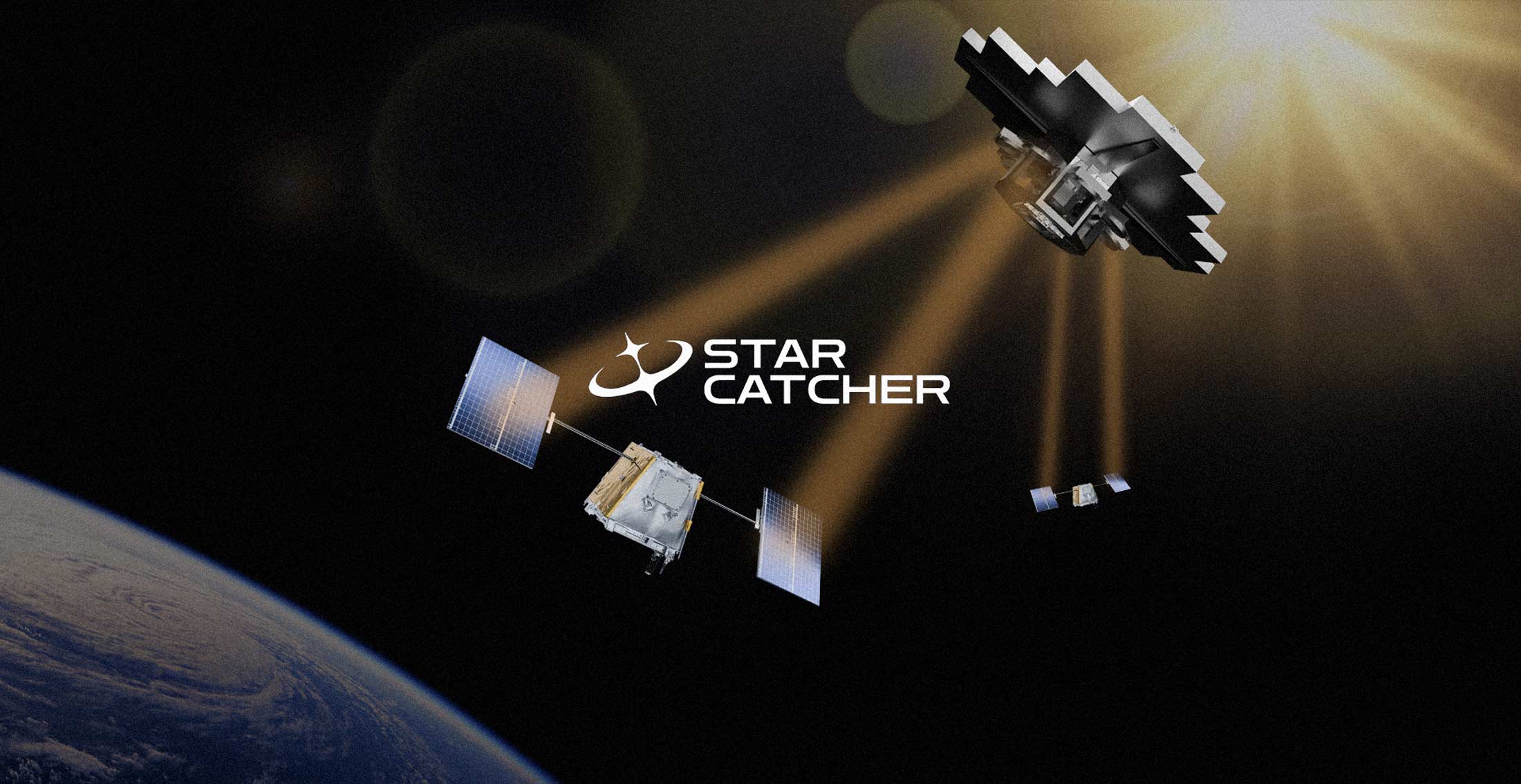
Star Catcher Industries announced today that it has raised $65 million in an oversubscribed Series A round, bringing its total investment haul to $88 million. The Florida-based company is building what it calls the first power grid in space, a network of satellites that would beam concentrated solar energy to other spacecraft via optical power transmission.
The round was led by B Capital and co-led by Shield Capital and Cerberus Ventures. Retired Space Force Gen. Jay Raymond, the first chief of space operations for the U.S. Space Force, is joining the board as part of the deal.
The Problem Star Catcher Wants to Solve
Every satellite in orbit is, in effect, power-constrained. Solar panels can only generate so much electricity, and mission designers have spent decades rationing energy budgets accordingly. The result is a persistent bottleneck that shapes spacecraft design from the ground up.
"We all just go on these camping trips to space, and basically every satellite at some point in its life cycle is power limited," CEO Andrew Rush told Space.com. "Fundamentally, the vision of Star Catcher is to make it as easy to operate in space as it is to operate terrestrially."
The company's approach involves beaming concentrated sunlight to satellites' existing solar arrays, potentially delivering up to 10x more power on demand without requiring any retrofit to the receiving spacecraft. If that works at scale, satellite operators could shift from designing around power scarcity to assuming power abundance.
Commercial Traction
Star Catcher has $60 million in signed contracts for in-space power delivery and a $3 billion pipeline of prospective customers. The company has signed seven power purchase agreements, secured multiple government contracts, and is managing a qualified commercial pipeline representing more than $3 billion in projected annual recurring revenue.
Founded in 2024, Star Catcher now holds the world record for optical power beaming and plans to bring the technology to orbit this year. The company will launch the first-ever space-based optical power beaming demonstration later this year, marking a foundational step toward constructing an operational energy grid in orbit.
A Growing Field
Star Catcher is part of a broader wave of companies exploring space-based power, though most are focused on beaming energy to Earth rather than to other satellites.
Reflect Orbital, a Los Angeles-based Series A company founded in 2021, has raised a total of $35.2 million to deploy space-based solar power generation solutions. Its approach is different: building a constellation of large, orbiting mirrors to reflect sunlight down to Earth, effectively extending daylight hours for solar farms.
Aetherflux, funded with $50 million, had been planning a constellation of small LEO satellites using infrared lasers before pivoting to space-based data centers in December 2025.
Overview Energy is building satellites in geosynchronous orbit where they see the sun over 99% of the time, capturing sunlight and converting it to near-infrared light that gets beamed to solar projects on Earth. The company is focused on scaling up to deliver grid-scale power by the early 2030s.
Academic research is advancing too. Caltech's Space Solar Power Demonstrator (SSPD-1) launched in January 2023 to test technologies necessary for space solar power, and successfully demonstrated the ability to beam power wirelessly in space. The underlying project was funded by a $100 million donation from Caltech trustees Donald and Brigitte Bren.
The Strategic Angle
The national security implications are not subtle. "Persistent surveillance, resilient communications and unhindered maneuverability are all constrained today by power," Raymond said. "An on-demand power grid can change that, expanding critical capabilities across commercial and national security missions."
Star Catcher's power nodes could also "trickle-charge" older satellites whose solar arrays and batteries have degraded, allowing them to remain operational further into the future. For defense assets where replacement costs run into the hundreds of millions, that's a meaningful proposition.
Rush frames the opportunity in terms of what the space industry calls SWaP (size, weight, and power): "In the same way that reusable launch vehicles really open up the aperture on the size and weight part of the equation, we can open up the aperture on the power part of the SWaP equation that governs all space missions."
Whether the economics of space-based power will ultimately work remains an open question. But as compute infrastructure becomes more dependent on power as a competitive moat, the same logic may eventually apply in orbit.