On October 1, 2026, in Waco, Texas, Tesla will finally reveal the next-generation Roadster. Nearly nine years after Elon Musk drove a prototype out of a Semi trailer and promised the fastest production car ever built, reservation holders who paid $50,000 deposits in 2017 will get their first look at what their patience has bought. Some of them, anyway. High-profile names like Marques Brownlee and Sam Altman have already asked for refunds.
The teaser image Tesla posted shows four white plumes firing from the rear of a low, wide vehicle. Those are SpaceX-developed cold-gas thrusters. Tesla has been talking about a "SpaceX package" for years, promising thrusters that would dramatically improve acceleration, braking, and cornering. Musk has claimed a thruster-equipped Roadster could hit 60 mph in approximately 1.1 seconds, down from the base car's promised 1.9 seconds. The teaser image shows thrusters pointing backward, not downward, which has led some to conclude this is about forward acceleration rather than vertical lift.
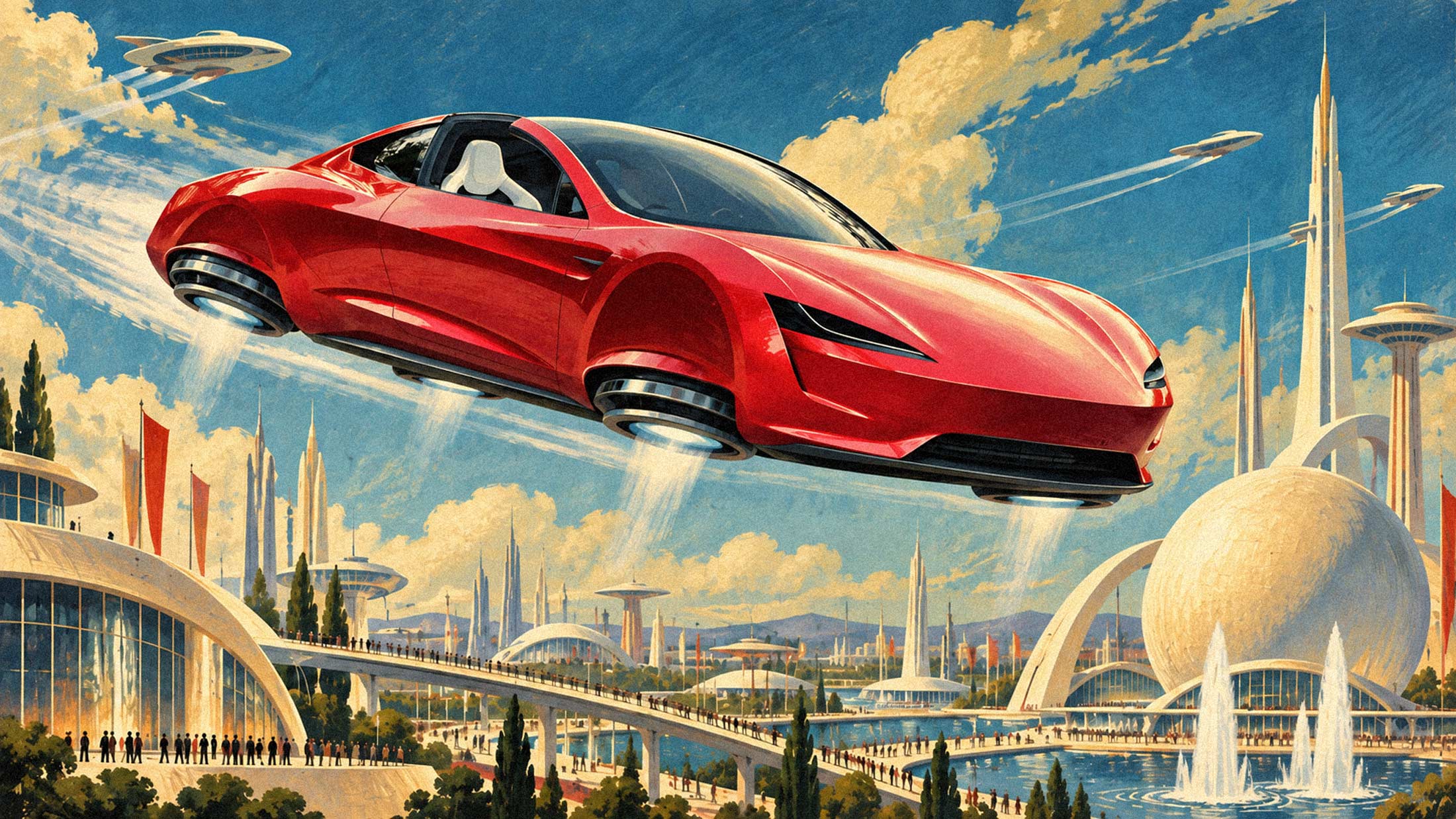
But Musk has also said, flatly, "The new Tesla Roadster can fly." And in August, The Information reported that Tesla planned to demonstrate a hovering Roadster at SpaceX's McGregor testing facility, with the demo car operated remotely because the thrusters are loud enough to damage eardrums. That demo eventually became the October 1 event in Waco.
What a Flying Car Needs
If the Roadster can actually sustain flight, even briefly, it represents something more interesting than another 0-60 record. Tesla already dominates straight-line acceleration. The Model S Plaid embarrassed supercars years ago. Another tenths-of-a-second improvement is bragging rights. A vehicle that lifts off the ground is a category shift.
The question is regulatory, not physical. SpaceX clearly knows how to make things hover. The cold-gas thruster system reportedly carries a composite-overwrapped pressure vessel holding gases at 6,000 psi in place of the rear seats. Physics-wise, there's no mystery. But getting federal approval to operate a rocket-assisted passenger vehicle in populated areas is another matter entirely.
Here's where speculation becomes interesting. Texas has become the default testing ground for Tesla's most ambitious projects. The Cybercab just launched commercially in Austin on September 3, 2026, operating without steering wheels or pedals on public streets while NHTSA evaluates whether that's acceptable. The eVTOL industry is also converging on Texas, with the FAA selecting the state for a pilot program testing air taxi routes between Austin, Dallas, San Antonio, and Houston. Companies like Joby, Archer, BETA, and Wisk are already flying test aircraft in the state.
If Tesla wants to prove out a flying Roadster for real-world use, Texas is the obvious starting point. The playbook would mirror the Cybercab rollout: a geographically limited deployment, a curated pilot program, and data collection aimed at convincing regulators that the technology is safe enough to scale. The thruster-equipped Roadster may start as a track-only showpiece for wealthy collectors, but that's rarely where Musk stops.
Starlink as the Missing Piece
A flying car needs more than propulsion. It needs navigation, communication, and integration with existing airspace. That's where Starlink enters the picture.
In February 2025, Musk pushed hard for SpaceX's Starlink to take over the FAA's air traffic control communications backbone, claiming the existing Verizon system was "breaking down very rapidly." The FAA began testing Starlink terminals at facilities in Atlantic City and Alaska. That initiative, reportedly called TDM X, aimed to have the system fully functional within 12 to 18 months.
Meanwhile, Starlink adoption among commercial airlines has exploded. United Airlines expects to have more than 1,000 aircraft equipped by the end of 2026. Southwest announced installations across 300 planes. American Airlines signed on. Qatar Airways has Starlink across its entire Boeing 777 fleet. The technology that keeps passengers streaming Netflix at 35,000 feet can also keep a flying vehicle in constant communication with ground control and surrounding aircraft.
For a Roadster operating in low-altitude urban airspace, Starlink connectivity would be critical. Unlike commercial aviation, where pilots follow established routes and communicate with tower controllers, a flying personal vehicle needs real-time situational awareness of everything around it. That means high-bandwidth, low-latency data links. It means integration with air traffic systems. And it means the kind of AI-driven autonomous navigation Tesla has been building for a decade.
Autonomy Is the Point
Consider the Cybercab. It has no steering wheel, no pedals. Passengers get in, state a destination, and the vehicle handles everything. Tesla's Full Self-Driving system, now running on the AI4 computer, has logged over 380,000 unsupervised miles in Austin without a notable incident, according to the company's own disclosures.
A flying Roadster would likely work the same way. Owners wouldn't need pilot's licenses. They wouldn't need to understand three-dimensional navigation or air traffic protocols. The vehicle's onboard systems, potentially combining Tesla's FSD architecture with xAI's Grok for natural language interaction and complex reasoning, would handle takeoff, flight path optimization, obstacle avoidance, and landing. The human's job would be to tell it where to go.
This tracks with Musk's broader vision. AI agents are already taking over tasks that used to require human expertise. Driving is one. Flying would be the next.
Urban Infrastructure Questions
If personal flying vehicles become viable, the built environment has to adapt. Current homes have garages and driveways designed for wheeled vehicles. Apartment buildings have ground-level parking structures. None of that works for something that takes off vertically.
The eVTOL companies already grappling with this problem envision vertiports on rooftops, dedicated landing pads at major destinations, and charging infrastructure positioned for vertical access. For a flying Roadster, residential use might mean rooftop helipads on single-family homes or parking decks at the top of buildings rather than the bottom. Zoning codes would need overhauls. HOA rules would need rewrites. Fire codes would need rethinking.
The power requirements are also substantial. Battery technology has improved dramatically, but sustained vertical flight demands enormous energy density. Tesla has promised a 620-mile range for the base Roadster, which suggests a battery pack around 200 kWh. Whether that figure holds when the vehicle is hovering rather than rolling is another question entirely. Cold-gas thrusters themselves don't draw battery power directly, but repressurizing the COPV tanks and powering the vehicle's other systems during flight would still require substantial reserves.
The Deposit Question
Tesla is once again taking $50,000 deposits for the Roadster, structured as a $5,000 credit card charge followed by a $45,000 wire transfer within 10 days. The company describes the deposit as fully refundable, but the experience of 2017 reservation holders suggests getting your money back requires persistence. Tesla held their deposits for nearly nine years while repeatedly missing delivery deadlines.
The base car was originally priced at $200,000, with a Founders Series at $250,000. Those numbers have been removed from Tesla's website. After nine years of inflation and what appears to be a comprehensive redesign, including carbon-fiber-tub architecture and butterfly doors, the final price will almost certainly be higher. Tesla's reservation terms describe any purchase price as an estimate, with options, hardware, and packaging still being finalized.
On Polymarket, contracts pricing Roadster deliveries by the end of 2026 trade under 5 percent. For 2027, the number is around 61 percent. The market is thinly traded, but it captures the ambient skepticism.
What Happens Next
The October 1 reveal will answer some questions and raise others. Tesla may show a hovering demonstration, may announce production timelines, may clarify which features are confirmed and which remain aspirational. The world Musk envisions, where AI handles transportation and humans simply indicate destinations, has been promised for a long time. Parts of it are now operating on public streets in Austin.
Whether the Roadster becomes a flying car, a track-only curiosity, or another delayed promise depends on engineering, regulation, and Tesla's willingness to see something through. The thruster hardware exists. The satellite infrastructure exists. The autonomous driving software exists. Putting it all together into a consumer product that regulators will approve for urban airspace is the hard part.
For the people who put down $50,000 in 2017, October 1 is either vindication or another chapter in an increasingly familiar story. For everyone else, it's a chance to see what Tesla thinks the future of personal transportation looks like. The answer might actually involve leaving the ground.